
- Domů

- Digitální fotografie
- susan nudelman
- Ream Clean
 Preview
 Koupit tisk Objednat reprodukci
 Sdílet
 Sdílet
 Podrobnosti o díle
 Přidat do oblíbených

 Stáhnout
 Podobné položky
 Rentgenové snímky
 Slideshow
Ream Clean
 Painting
- Contemporary Realism
 1971
1971- Contemporary
 56.0 x 76.0 cm
 Museo de Arte Contemporáneo de Puerto Rico
 Zobrazit více
Koupě vysoce rozlišeného, vylepšeného digitálního obrazu, který je mnohem kvalitnější než online náhled.
Každý soubor je pečlivě připraven našimi odborníky pomocí pokročilých nástrojů a expertní manuální retuše. Zajišťujeme, aby každý obraz disponoval výjimečnou ostrostí, přesnou barevnou věrností a jemnými detaily.
Finální soubor vám bude do 72 hodin zaslán e-mailem, optimalizovaný pro okamžité použití v profesionálním, redakčním i tiskovém prostředí. Nabízíme stejnou kvalitu, které důvěřují špičková designová studia, nakladatelství i galerie.
Digitální obrazy
Stáhněte si soubor ve vysokém rozlišení pro osobní prohlížení, tisk a kreativní projekty.
Součást každé objednávky digitálního obrazu
Profesionální digitální doručení, zaručeno.
Když si vyberete ArtsDot.com, nezískáváte pouze obrázek – získáváte digitální umělecké dílo s profesionálně vylepšenými detaily, zpracované s precizností a podpořené zárukou za spokojenost. Zde je vše, co vaše objednávka automaticky obsahuje:

Rychlé doručení e-mailem
Váš digitální obraz ve vysokém rozlišení vám bude zaslán e-mailem do 72 hodin od objednávky – připraven k okamžitému použití.

Digitální soubor s využitím AI
Vaše umělecké dílo je profesionálně optimalizováno pomocí pokročilých nástrojů umělé inteligence a manuální úpravy, což zajišťuje maximální úroveň detailu, ostrosti a přesnosti barev.

Bezplatné doživotní znovuodeslání
Soubor jste omylem smazali nebo ztratili? Žádný problém – kdykoliv vám ho znovu zašleme zcela zdarma.

Bez poplatků za dovoz – navždy
Užijte si své umělecké dílo okamžitě bez celních poplatků, daní nebo nákladů na dopravu – digitální stažení je vždy bez daňových povinností.

Záruka přesnosti barev
Pomocí profesionálních nástrojů a správy barev zajišťujeme, aby váš digitální obraz odrážel původní barvy co nejvěrněji.

60denní záruka spokojenosti
Pokud nebudete s digitální fotografií spokojeni, provedeme její revizi nebo vám vrátíme 100% během 60 dnů – bez jakýchkoliv dotazů.

100% záruka vrácení peněz
Nespokojeni? Získejte plnou částku zpět do 60 dní od přijetí vašeho digitálního souboru – bez jakýchkoliv dotazů.

Slevy při hromadných objednávkách
Koupěte si 3 obrazy, ušetřete 10% - Koupěte si 5, ušetřete 15% - Koupěte si 10+, ušetřete 20%. Ideální pro kreativní projekty, galerie a agentury.
Popis sběratelského kusu
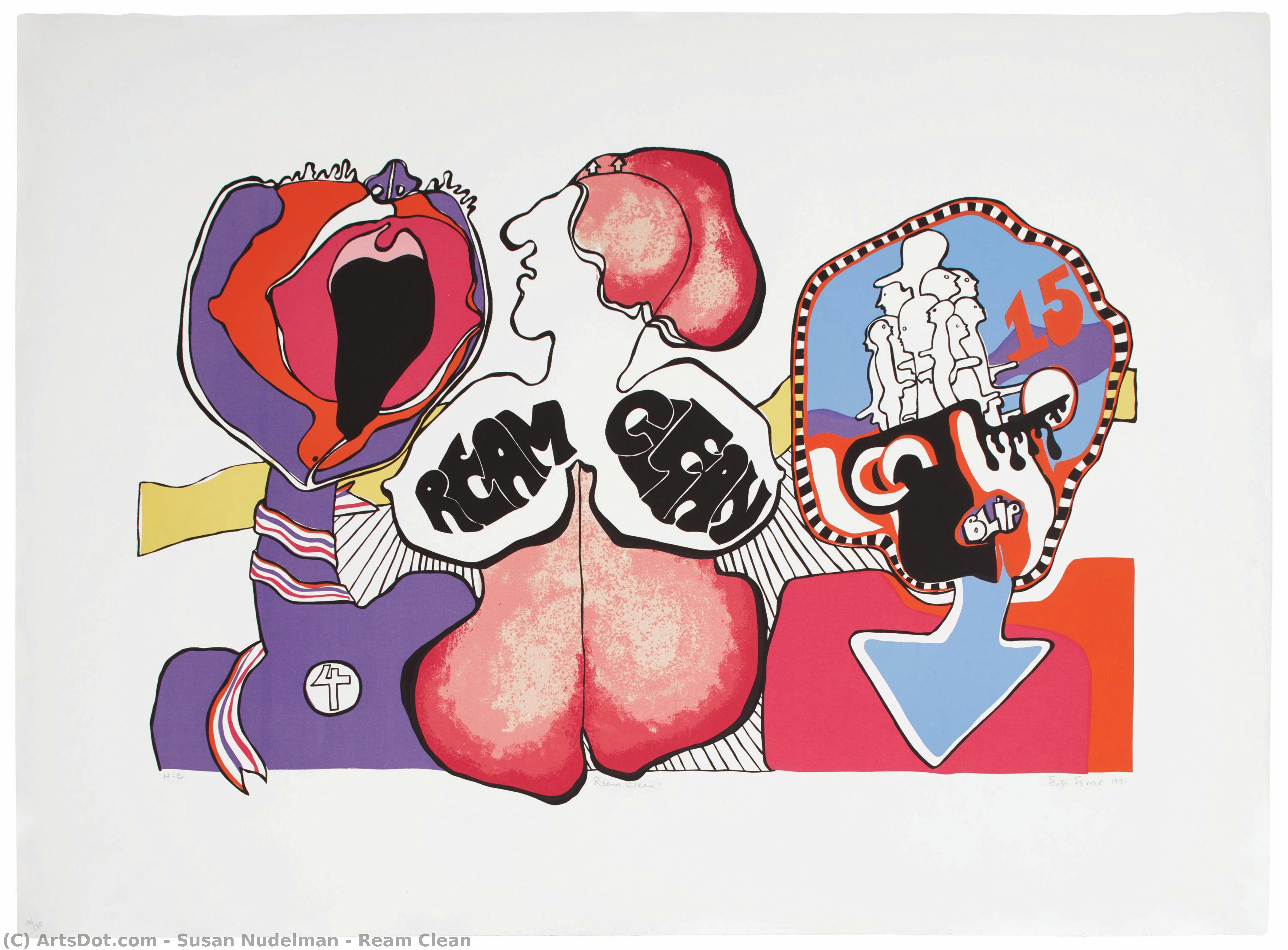
A Tapestry of Human Connection: Exploring Susan Nudelman's Ream Clean
In the evocative landscape of twentieth-century figurative painting, few works capture the raw, uninhibited essence of human presence quite like Susan Nudelman’s 1971 masterpiece, Ream Clean. This captivating composition invites the viewer into a crowded, intimate space where the boundaries between individuals seem to blur and dissolve. At the heart of this visual narrative is a central female figure, rendered with a profound sense of vulnerability and strength, her exposed form serving as an anchor for the surrounding sea of humanity. Nudelman masterfully orchestrates a scene populated by at least six figures, each caught in a moment of repose or movement, creating a rhythmic dance of limbs and gazes that pulls the observer into their shared, silent dialogue.
The painting is far more than a mere study of the human form; it is a complex psychological landscape. Nudelman utilizes a unique blend of surrealist undertones and figurative realism to weave a story of coexistence. The inclusion of seemingly disparate elements—such as the two sports balls positioned strategically within the frame and the enigmatic presence of a clock on the right periphery—suggests a deeper, perhaps more symbolic, layer of meaning. These objects act as temporal and physical anchors, grounding the ethereal, almost dreamlike quality of the figures in a tangible reality. The clock, in particular, introduces a poignant meditation on the passage of time, contrasting the eternal nature of human connection with the fleeting moments of our physical existence.
Technically, Ream Clean is a triumph of composition and tonal balance. The artist employs a sophisticated approach to light and shadow, ensuring that despite the density of the figures, the eye finds rest and direction throughout the canvas. The interplay of flesh tones against the more muted or varied backgrounds creates a sense of depth that makes the scene feel immersive, as if one could step directly into this private gathering. For the discerning collector or interior designer, this piece offers an unparalleled opportunity to introduce a conversation starter into a curated space. Its ability to evoke both curiosity and contemplation makes it a versatile jewel for any high-end collection, providing a sophisticated focal point that resonates with themes of intimacy, time, and the beautiful complexity of the human condition.
Podobná umělecká díla


Biografie umělce
Paul Klee: A Life Painted in Light and Shadow – 1940 and Beyond
The year 1940 casts a long shadow over the life and work of Paul Klee, marking not just a pivotal moment in his artistic journey but also a period of profound upheaval for Europe. Born in Bern, Switzerland, in 1879, Klee’s career unfolded against a backdrop of shifting political landscapes, burgeoning artistic movements, and the looming threat of war – a reality that deeply informed his art and ultimately shaped its distinctive character. While he had already established himself as a significant figure within the Expressionist and Cubist circles by the early 20th century, it was in the years leading up to his untimely death in Zug, Switzerland, in 1940 that Klee’s artistic language truly crystallized, revealing a complex interplay of personal introspection, intellectual rigor, and a deeply felt engagement with the world around him.
Klee's early influences were remarkably diverse. He initially studied at the Kunstlerausschule Bern, but quickly gravitated towards the more experimental approaches offered by Hans von Drach zur Graf in Munich. This exposure to the vibrant energy of the German art scene introduced him to the tenets of Expressionism, a movement characterized by its emotional intensity and subjective interpretation of reality. Simultaneously, he was captivated by the pioneering work of Wassily Kandinsky, whose theories on color and spirituality profoundly impacted Klee’s artistic philosophy. Kandinsky's emphasis on abstraction as a means of conveying inner experience resonated deeply with Klee’s own desire to explore the fundamental elements of art – line, shape, and color – in their purest forms. This early encounter laid the groundwork for his later development of a highly personal and idiosyncratic style, one that would defy easy categorization.
The years between 1915 and 1920 saw Klee’s artistic output expand dramatically, encompassing a wide range of media including drawings, watercolors, lithographs, and collages. His work during this period is characterized by a playful experimentation with form and color, often infused with elements of Surrealism – a movement he embraced without fully committing to its tenets. He explored themes of childhood, mythology, and the human condition through a series of evocative images that are both whimsical and deeply poignant. Notably, his “Twittering Machine” (1924), a complex mechanical device designed to generate random musical notes and visual patterns, exemplifies Klee’s fascination with systems, chance, and the intersection of art and technology. This period also witnessed the development of his distinctive "Kinderzeichnungen" (Child Drawings), a series of seemingly naive sketches that reveal a profound understanding of line, gesture, and composition – a testament to Klee's belief in the inherent artistic potential of children.
The outbreak of World War II dramatically altered the course of Klee’s life and work. Fearing for his safety and the destruction of his art collection, he relocated to Switzerland in 1940, where he continued to paint until his death from cancer. The war years were a period of intense anxiety and uncertainty for Klee, but also one of remarkable creative productivity. His paintings from this time are imbued with a sense of melancholy and resignation, reflecting the devastation and displacement that gripped Europe. Works like “Ship in the Dark” (1939-40) – a haunting image of a small boat navigating a turbulent sea under a starry sky – capture the feeling of isolation and vulnerability in a world consumed by conflict. The use of muted colors, fragmented forms, and ambiguous spatial relationships creates a powerful sense of unease and foreboding.
Despite his premature death at the age of 61, Paul Klee’s legacy endures as one of the most innovative and influential artists of the 20th century. His unique approach to abstraction, informed by his deep understanding of art history, music theory, and psychology, continues to inspire generations of artists. His work is characterized by its playful experimentation, emotional depth, and a profound sense of humanity. Klee’s exploration of color, line, and form transcends stylistic boundaries, establishing him as a pivotal figure in the development of modern art. His influence can be seen in the works of countless artists who have followed in his footsteps, solidifying his place as a true visionary – an artist who painted not just with pigment and brush, but with light and shadow, joy and sorrow, hope and despair.
Key Works & Artistic Developments (1940s)
- Ship in the Dark (1939-40): Perhaps Klee’s most iconic work of the 1940s, this painting embodies the anxieties and uncertainties of wartime Europe. The small boat adrift on a turbulent sea symbolizes humanity's vulnerability in the face of overwhelming forces.
- The Great Bear (1940): A complex and layered composition that reflects Klee’s interest in mythology, symbolism, and the interconnectedness of all things. The painting is filled with intricate details and ambiguous forms, inviting multiple interpretations.
- The Island of Doom (1940): This work showcases Klee's exploration of darkness and despair, reflecting the mood of Europe during World War II. The use of stark contrasts and unsettling imagery creates a powerful sense of foreboding.
- Continued development of his “Kinderzeichnungen” – these drawings remained a vital source of inspiration for Klee throughout his career, offering insights into his artistic process and his understanding of the human condition.
Klee’s Theoretical Writings & Artistic Philosophy
Beyond his paintings, Paul Klee was also a prolific writer and theorist. His *Schriften zur Form und Gestaltungslehre* (Writings on Form and Design Theory), published posthumously, offer invaluable insights into his artistic philosophy. He argued that art should be based on a deep understanding of the fundamental elements – line, shape, color – and that artists should strive to create works that are both aesthetically pleasing and intellectually stimulating. Klee’s emphasis on intuition, spontaneity, and the exploration of inner experience profoundly influenced the development of Abstract Expressionism in the post-war era.
Legacy & Historical Significance
Paul Klee's work transcends mere aesthetic appeal; it is a profound reflection of his time – a period marked by war, displacement, and existential uncertainty. His art serves as a poignant reminder of humanity’s capacity for both destruction and creativity. Klee’s legacy extends far beyond the confines of the art world, inspiring artists, designers, and thinkers across diverse fields. He remains a vital voice in the ongoing conversation about the nature of art, the role of the artist, and the relationship between art and life.

susan nudelman
1940 - 2006

