

 Náhled v interiéru
 Sdílet
 Sdílet
 Podrobnosti o díle
 Průvodce

 Stáhnout
 Podobné položky
 Rentgenové snímky
 Slideshow
 Otázky a odpovědi
 Statistiky
Nelson


 Zobrazit více
Giclée / Umělecký tisk
Giclée nebo plátěný tisk muzeální kvality s rychlou výrobou a širokou nabídkou povrchových úprav. ( Koupit ručně malovaný obraz Přepnout na digitální obraz)




P118B Kč10

P118H Kč10

P118W Kč10

P438Z Kč10

P508JH Kč12

P508YH Kč12

P805H Kč10

P805Z Kč10

P919BZ Kč10

P919G Kč10

P919XJ Kč10

P959ZH Kč10

P968JZ Kč12

W106C Kč8

W218G Kč10

W218JH Kč8

W218Y Kč10

W307PJ Kč10

W316G Kč10

W316PJ Kč8

W316Y Kč10

W398PJ Kč8

W4111J Kč10

W500HY Kč15

W500JH Kč15

W692G Kč12

W849H Kč8

W940BG Kč15

W953PJ Kč8




Vyberte si z našich přednastavených velikostí, které odpovídají původním proporcím díla.

Zadejte šířku a výšku, které potřebujete pro váš rám nebo stěnu. Tisk lze pouze oříznout, nikdy však nelze zvětšit obraz nad jeho původní rozměr, proto při výběru jiného formátu dochází ke ztrátě části obrazu. Před samotným tiskem vám zašleme digitální náhled k schválení. Obraz zobrazený na této stránce nenabízí skutečný výřez — ten uvidíte pouze v náhledu.
Celosvětové doručení () do 2 týdnů namísto standardních 4/5 týdnů. (19 listopad)

Zdarma celosvětová expresní doprava

Vysoce kvalitní lněné plátno

Kompletní pojištění přepravy

Záruka vrácení celního poplatku

Záruka věrného barevného souladu

100dení lhůta pro vrácení zboží (pouze při vadách výroby)

100% záruka vrácení peněz

Sleva při více objednávkách
 Skleněná varianta je dostupná pouze u rozměrů menších než 110 cm

Nelson
Giclée / Umělecký tisk
Rozměry reprodukce
-


Celková cena za vybrané možnosti reprodukcí
Kč 1361
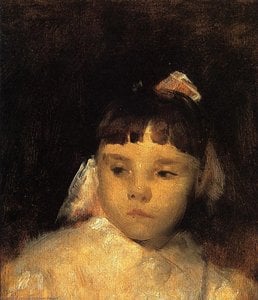
Nelson: A Glimpse into American Realism
Robert Henri’s "Nelson," painted in 1914, stands as a poignant example of American Realism, capturing the essence of everyday life with striking honesty and emotional depth. This oil on canvas portrait depicts a young boy, his gaze direct and seemingly introspective, inviting viewers to contemplate his inner world. The painting's power lies not just in its skillful execution but also in Henri’s ability to convey a sense of quiet dignity and perhaps even a touch of melancholy through the subject's posture and expression. The deep blue background serves to isolate Nelson, focusing attention on his face and upper body, enhancing the intimacy of the portrait.The Artist and His Vision: Robert Henri and the Ashcan School
Robert Henri (1865-1929) was a pivotal figure in American art, renowned for his bold style and commitment to portraying urban life with unflinching realism. As a leading member of the Ashcan School, Henri rejected the idealized subjects favored by traditional academic painting, instead choosing to depict scenes from everyday existence – bustling city streets, working-class neighborhoods, and ordinary people. His approach was revolutionary, challenging artistic conventions and paving the way for future generations of American artists. Henri’s influence extended beyond his own paintings; he was a dedicated teacher who encouraged his students to find beauty and significance in the commonplace, fostering a spirit of independent expression and social awareness within the art world. He was also an organizer of "The Eight," a group of artists who protested against the restrictive exhibition practices of the National Academy of Design, further solidifying his reputation as a champion of artistic freedom.Composition and Technique: Capturing Emotion Through Brushwork
Henri’s technique in “Nelson” is characterized by loose, expressive brushstrokes that imbue the painting with a sense of energy and spontaneity. The visible texture of the paint adds depth and dimension to the portrait, creating a dynamic interplay between light and shadow. The artist's use of color is equally impactful; the warm tones of Nelson’s skin contrast beautifully with the cool blue background, drawing the viewer's eye directly to the subject. The composition itself is deliberately simple, allowing the focus to remain squarely on Nelson’s face and expression. This deliberate restraint amplifies the emotional impact of the portrait, inviting viewers to project their own interpretations onto the young boy’s contemplative gaze. The absence of distracting details further emphasizes the intimacy between the viewer and the subject, creating a powerful sense of connection.Symbolism and Emotional Resonance
While seemingly straightforward in its depiction, "Nelson" carries layers of symbolic meaning. The boy's posture—arms crossed, head slightly bowed—suggests introspection or perhaps a quiet defiance. His direct gaze challenges the viewer, inviting them to engage with his emotions and experiences. Henri’s choice to portray Nelson not as an idealized figure but as a real boy, complete with subtle imperfections, speaks to his commitment to portraying humanity in all its complexity. The painting evokes a sense of nostalgia and reflection, prompting viewers to consider the lives and stories of those often overlooked by mainstream society. "Nelson" is more than just a portrait; it's a window into a specific moment in time, capturing the spirit of American Realism and offering a glimpse into the heart of an individual.Otázky a odpovědi
Jaká velikost tisku díla „Nelson“ od Robert Henri se hodí do doporučené místnosti?
Pro místnost typu Living Room je doporučená velikost tisku díla „Nelson“ od Robert Henri Medium.
S jakým pocitem je spojeno dílo "Nelson"?
„Nelson“ je spojováno s Reflective pocity. Emocionální náboj díla popisuje dojem, který z něj vyzařuje.
Je dílo „Nelson“ od Robert Henri spíše světlé, nebo tmavé?
Z hlediska vnímané jasnosti je dílo „Nelson“ od Robert Henri balanced.
Podobná díla




Biografie umělce
A Turbulent Genesis: The Early Life of Robert Henri
Robert Henri, born Robert Henry Cozad in Cincinnati, Ohio, in 1865, carried within him from the outset a sense of displacement and reinvention that would profoundly shape both his life and art. His childhood was far from idyllic; shadowed by the volatile relationship between his father, John Jackson Cozad—a man of ambition and risk as a gambler and real estate developer—and his mother, Theresa Gatewood Cozad. This instability culminated in a dramatic event in 1882: a fatal shooting over a land dispute that forced the family into flight, adopting new identities to escape retribution. Young Robert became Robert Henri, a deliberate severing from a past fraught with conflict and a symbolic rebirth as an artist. The westward journey through Nebraska and Colorado, culminating in a settling in New York City and then Atlantic City, instilled within him a deep empathy for those living on the fringes of society—an empathy that would become a defining characteristic of his artistic vision. This early experience of upheaval and reinvention fostered a spirit of independence and a commitment to portraying life as it truly was, unburdened by convention or societal expectation.Forging a New Vision: Artistic Development and Influences
Henri’s formal artistic education began at the Pennsylvania Academy of the Fine Arts in Philadelphia under Thomas Anshutz, where he honed his technical skills. However, it was his subsequent journey to Paris in 1888 that truly ignited his artistic awakening. Initially drawn to the academic tradition at the Académie Julian and influenced by masters like William-Adolphe Bouguereau and François Millet, Henri gradually gravitated towards Impressionism. Yet, he wasn’t content with merely replicating what he saw; he sought a more profound engagement with reality—a way to capture not just the fleeting effects of light but also the raw emotion and vitality of modern life. This quest led him to embrace a bolder, more direct approach, influenced by the Dutch Realist Franz Hals, whose loose brushwork and psychological insight resonated deeply with Henri’s own artistic sensibilities. He began experimenting with *pochades*, small wood panels used for quick sketches, encouraging spontaneity and immediacy in his work. Returning to America, he became a dedicated teacher, imparting not just technique but also a philosophy of art rooted in observation, honesty, and individual expression.Championing the Real: The Ashcan School and “The Eight”
Robert Henri’s impact on American art extended far beyond his own canvases; he became a catalyst for change, challenging the conservative norms of the established art world. He was a central figure in the emergence of the Ashcan School—a group of artists who dared to depict the gritty realities of urban life, from bustling city streets to crowded tenements. Henri’s commitment to realism and his rejection of academic pretension led him to organize “The Eight” in 1908—a collective of like-minded artists including William Glackens, George Luks, Everett Shinn, and John Sloan—who staged an independent exhibition as a direct protest against the restrictive policies of the National Academy of Design. This act of defiance was a watershed moment in American art history, signaling a shift away from European dominance and towards a uniquely American artistic voice. Henri’s paintings during this period, such as “Woman in Manteau” (1899) and his evocative portraits, captured the dignity and resilience of ordinary people, offering a powerful counterpoint to the idealized representations favored by the establishment.Legacy and Enduring Influence
Robert Henri’s influence on subsequent generations of American artists is immeasurable. As a teacher, he mentored a remarkable roster of talent, including Joseph Stella, Edward Hopper, Rockwell Kent, George Bellows, Norman Raeben, Louis D. Fancher, and Stuart Davis—artists who would go on to shape the course of 20th-century art. His book, *The Art Spirit*, published posthumously in 1923, remains a seminal text for aspiring artists, offering timeless wisdom on observation, technique, and the importance of artistic integrity. *Henri’s commitment to portraying life with honesty and empathy*, his rejection of convention, and his unwavering belief in the power of art to connect with audiences continue to inspire artists today. His paintings are not merely representations of reality; they are windows into the human condition—testaments to the beauty, struggle, and resilience of the human spirit. He left an indelible mark on American Realism, paving the way for a more democratic and inclusive art world that celebrated the everyday experiences of ordinary people. His legacy endures not only through his own masterful works but also through the countless artists he inspired to find their own voices and tell their own stories.
Robert Henri
1865 - 1929 , Spojené státy americké
Rychlé informace o umělci
- Artistic Movement Or Style: Ashcan School, Realismus
- Artists Or Movements Influenced By This Artist:
- Edward Hopper
- The Eight
- Artists Who Influenced This Artist:
- William Bouguereau
- François Millet
- Date Of Birth: 24. června 1865
- Date Of Death: 12. července 1929
- Full Name: Robert Henry Cozad
- Nationality: Američan
- Notable Artworks:
- Žena v mantlu
- Ne sníh
- Sissy ve žlutém
- Place Of Birth: Cincinnati, USA
Související články

Emoční transmutace ve vizuálním umění: Studie afektivní reprezentace skrze barvu, formu a texturu
Prozkoumejte hluboký vztah mezi emocemi a vizuálním uměním. Analýza barvy, formy a textury v obrazech od Caravaggia po současnost. Odborné postřehy pro sběratele i milovníky umění.
Top 10 děl Fauvismu: Umělecké mistrovské kousky a inspirace pro váš interiér
Prozkoumejte 10 ikonických děl fauvismu od Matisse, Deraina a dalších. Objevte příběhy za expresionistickými barvami a revolučním uměleckým stylem. Najděte inspiraci pro váš interiér s reprodukcemi nejvyšší kvality na ArtsDot.com.

The Ashcan School: Realism, Urban Life & the Democratization of American Art
Explore the revolutionary Ashcan School! Discover how artists like Henri & Sloan challenged tradition with gritty realism, capturing urban life in early 20th-century America. Learn about their impact on American art history.

Robert Henri & the Spirit of American Realism: A Legacy of Urban Life and Artistic Independence
Explore the life & legacy of Robert Henri, a pivotal figure in American Realism. Discover his captivating portraits, influence on the Ashcan School, and enduring impact on art history. Learn more at ArtsDot.

Abbott Handerson Thayer: Ethereal Realism & Spiritual Symbolism in American Art
Explore the captivating world of Abbott Handerson Thayer, a pioneer of American realism & Symbolism. Discover his ethereal angel paintings, innovative techniques, and lasting influence on art history. Learn about his scientific pursuits & Transcendentalist spirit.
