


The picture follows your choices: , .
Popis sbírného předmětu
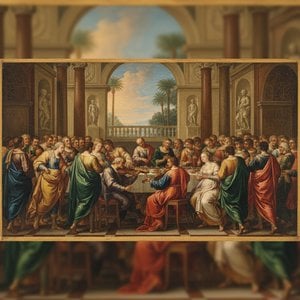
Discover Paolo Veronese’s ‘Plato’! A Renaissance masterpiece featuring a dignified Plato surrounded by classical motifs. Explore this iconic painting's beauty & significance in Venice.
 Zobrazit více
Biografie umělce
Paolo Veronese (1528-1588): Benátský renesanční mistr, známý pro bohaté barvy, dramatické kompozice a opulentní scény oslavující život a architekturu Venuce.
Ručně malovaná olejová reprodukce
Rukou malované olejné plátno v libovolném rozměru i s rámem, vyrobené našimi umělci na zakázku. ( Přepnout na tisk Přepnout na digitální obraz)
More about this painting
 Náhled v interiéru
 Sdílet
 Sdílet
 Podrobnosti o díle
 Průvodce

 Stáhnout
 Podobné položky
 Rentgenové snímky
 Slideshow
 Q&A
Q&A Statistiky
Order your painting in four simple steps
Take your time. You can change any answer; the price in your order card follows each choice.
1 Step one of four
Which size would you like?
These sizes keep the proportions of the original painting. The drawing shows your choice on a wall, above a two-metre sofa.
Or give your own measurements
Vyberte si z našich přednastavených velikostí, které odpovídají původním proporcím díla.

Zadejte šířku a výšku, které potřebujete pro váš rám nebo stěnu. Protože se jedná o ruční malbu, při výběru jiného formátu může umělec kolem obrazu domalovat o něco více, nebo jej mírně oříznout — rozhodnete si vy. Před zahájením malby vám zašleme digitální náhled ke schválení. Obraz zobrazený na této stránce neodpovídá skutečnému výsledku — pouze digitální náhled jej zobrazuje.
2 Step two of four
How should it be prepared: rolled, stretched or framed?
The prices below are for the size you chose in step one.
Choose the edges of the stretched canvas
Choose your frame

White Kč1

Blurside Kč1

Extended Kč1

P118B Kč10

P118H Kč10

P118W Kč10

P438Z Kč10

P508JH Kč12

P508YH Kč12

P805H Kč10

P805Z Kč10

P919BZ Kč10

P919G Kč10

P919XJ Kč10

P959ZH Kč10

P968JZ Kč12

W106C Kč8

W218G Kč10

W218JH Kč8

W218Y Kč10

W307PJ Kč10

W316G Kč10

W316PJ Kč8

W316Y Kč10

W398PJ Kč8

W4111J Kč10

W500HY Kč15

W500JH Kč15

W692G Kč12

W849H Kč8

W940BG Kč15

W953PJ Kč8

H24-GOLD Kč30

H24-SILVER Kč30

H36-GOLD Kč45

H36-SILVER Kč45
V rámu
Moulding: . Overall size with the frame: .
3 Step three of four
Would you like anything changed in the painting?
Most people answer no. Because each painting is made by hand, our artist can also adapt it for you.
After order, ArtsDot.com team will email client for instructions and provide a mockup preview
4 Step four of four
A few finishing options
All of them are optional. The answers already selected cost nothing extra.
Who paints it?
Celosvětová doprava () za 3–4 týdny namísto standardních 5 týdnů. (30 říjen). Bez kompromisů v kvalitě.
A nameplate, as in a museum?
Detaily ryté bronzové plakety
This elegant plaque features the artist's name and the title of the artwork, finely engraved for a timeless presentation.
It is made from bronze with a refined, elegant finish. The text is precisely laser-engraved for a sharp and permanent result. Measuring 9x2 cm, the plaque is compact yet easy to read. It's built to be durable and scratch-resistant, offering a professional, museum-quality look. Mounting is simple thanks to the included adhesive backing.
Detaily průhledné akrylové desky
The plaque includes essential engraved details such as the artist's name, the title of the artwork, the date it was created, the type of media used-like oil on canvas or watercolor-a brief description of the piece, and a QR code that links to the complete artwork information.
It is crafted from clear acrylic, offering a sleek, modern appearance. The text is UV-engraved in black to ensure strong visual contrast. With a size of 10x15 cm, it ensures optimal readability. It comes equipped with two metal hooks for secure wall mounting. The plaque is designed to be weather-resistant, making it suitable for various environments, and it includes interactive features that work seamlessly with smartphone scanning.
Detaily černé akrylové destičky
This elegant plaque includes engraved information such as the artist's name, the title of the artwork, the date it was created, the type of media used (like oil on canvas or watercolor), a short description of the artwork, and a QR code for quick access to more information.
The plaque itself is made from refined black acrylic with a premium finish. The text is laser-engraved in white for high contrast and readability. Its size is 10x15 cm, designed to be easy to read. It comes with two metal hooks for professional mounting. The design is sleek and fits any interior style. It is also weather-resistant and durable, with built-in digital integration for mobile compatibility.
A protective varnish?
When do you need it?
✓ Check and order
Your painting, as you ordered it

Plato
Technika reprodukce
Rozměry reprodukce
-

Vybraní mistři umění
Vyšší míra detailu, jemnosti a delší doba výroby
-

Možnosti rámování reprodukcí
-
-
U děl nebo reprodukcí, u nichž je jakákoliv strana větší než 105 cm (přibližně 41 palců), bude rám dodán jako sestava v rozloženém stavu. Tato metoda zajišťuje bezpečné doručení a chrání dílo před poškozením během přepravy.
Vyžaduje se odborná montáž – nejedná se o produkt pro svépomocnou realizaci (DIY).
Sestava musí být složena a plátno napnuto zkušeným profesionálním rámovačem s použitím dřevěného lepidla (není součástí balení), kleští na napínání plátna a svorek pro udržení pravých úhlů křížů během schnutí lepidla. Nesprávná montáž nebo nerovnoměrné napnutí plátna může způsobit trvalé poškození uměleckého díla, které není kryto naší zárukou.
 U děl nebo reprodukcí, u nichž je jakákoliv strana větší než 105 cm (přibližně 41 palců), bude rám dodán jako sestava v rozloženém stavu. Tato metoda zajišťuje bezpečné doručení a chrání dílo před poškozením během přepravy.
Jsou zahrnuty všechny lišty z masivního dřeva, přesně na míru nařezané.
Sestavuje se pomocí součástí balení (šroubů), plus dřevěného lepidla na rohové spoje, které není součástí balení a musí jej zajistit váš rámovač.
Vyžaduje se profesionální nářadí, které není součástí sady: kleště na napínání plátna a svorky pro udržení kolmosti příček během schnutí lepidla.
Důležité:
Spoje v rozích vyžadují lepidlo na dřevo, tyčinky musí být přichyceny pomocí svorek, dokud lepidlo zcela neuschne, a pro napnutí plátna na sestavený rám je zapotřebí kleští na natahování plátna. Žádný z těchto náčiní není součástí sady. Před objednáním této velikosti prosím zajistěte zkušeného profesionálního rámovače.

Popisek díla
-
-

Ochranný lak
Lesklý lak (zvýrazňuje barvy, chrání před světlem a vlhkostí)
-

Přizpůsobit své umělecké dílo
Příklady možných úprav: nahrazení obličeje fotografií zákazníka; přidání domácího mazlíčka (např. výměna kočky za psa); vložení skrytého vzkazu do pozadí; změna krajiny nebo prvků v pozadí.
-

Prioritní doručení
Celosvětové doručení () za 3–4 týdny namísto standardních 5 týdnů. (30 říjen). Bez kompromisů v kvalitě.
-
Expresní doručení
Celosvětová doprava () do 5 týdnů. (6 listopad).
V ceně
Celková cena za vybrané možnosti reprodukcí
Kč 5712
Skleněná varianta je dostupná pouze u rozměrů menších než 110 cm
Included with every order
- Zdarma celosvětová expresní doprava
- Vysoce kvalitní lněné plátno
- Kompletní pojištění přepravy
- Záruka vrácení celního poplatku
- Záruka věrného barevného souladu
- 100dení lhůta pro vrácení zboží (pouze při vadách výroby)
- 100% záruka vrácení peněz
- Sleva při více objednávkách


The Enigmatic Plato: A Renaissance Portrait of Wisdom
Paolo Veronese’s “Plato,” painted circa 1560 and currently residing in the Biblioteca Nazionale Marciana in Venice, is more than simply a portrait; it's a meticulously crafted embodiment of classical philosophy and humanist ideals. This masterpiece transcends the conventions of its time, offering a profound meditation on knowledge, contemplation, and the enduring legacy of ancient Greece. Veronese, a master of Mannerism – a style characterized by rich color palettes, intricate detail, and dramatic lighting – expertly captures the essence of Plato, not merely as a historical figure but as an intellectual archetype.
The painting immediately draws the eye to its central subject: Plato himself. He is depicted in a dignified pose, seated within a richly ornamented niche that functions almost as a stage for his philosophical presence. His gaze is directed upwards, suggesting a state of profound thought and introspection – a visual representation of the pursuit of wisdom. The drapery enveloping him is rendered with astonishing realism, showcasing Veronese’s mastery of texture and form; each fold and pleat seems to ripple with life, adding depth and volume to the composition. Notice how the deep reds of his robes contrast sharply with the muted tones of the surrounding walls and ceiling – a deliberate choice that emphasizes Plato's importance within the scene.
A Symphony of Color and Architectural Detail
Veronese’s signature style is vividly displayed in “Plato.” The color palette is extraordinarily vibrant, employing hues rarely seen in portraits of this period. Deep reds dominate, lending a sense of gravitas and authority to Plato's figure, while golds and blues subtly illuminate the architectural setting. The artist’s use of light is equally masterful, creating dramatic contrasts that sculpt the form of the subject and heighten the emotional impact of the scene. The arched doorway framing Plato isn’t merely an architectural element; it acts as a powerful symbol – representing both confinement and transition, suggesting the philosopher's journey from earthly concerns to higher realms of thought.
Beyond the immediate visual appeal, “Plato” is laden with symbolic meaning. The surrounding architecture—a lavishly decorated niche reminiscent of classical Roman design—references the philosophical traditions that shaped Plato’s thinking. The inclusion of various objects within the scene – scrolls, books, and perhaps even a lyre – further reinforces his intellectual pursuits. These details aren't simply decorative; they are carefully chosen to communicate Plato’s dedication to learning, debate, and the pursuit of truth. The overall effect is one of profound contemplation, inviting the viewer to join Plato in his quest for understanding.
Historical Context and Artistic Legacy
“Plato” was created during a period of immense artistic and intellectual ferment in Venice – a city renowned for its patronage of the arts and its embrace of humanist ideals. Veronese’s work reflects this vibrant cultural landscape, blending classical influences with Venetian traditions. The painting stands as a testament to the enduring power of Greek philosophy and its continued relevance in Western thought. It's important to note that Veronese was working within the Mannerist style, which emphasized elegance, artificiality, and complex compositions – qualities that are beautifully exemplified in this portrait.
Reproductions of “Plato” by ArtsDot.com offer a unique opportunity to experience the beauty and intellectual depth of this remarkable painting firsthand. Owning a hand-painted reproduction allows you to bring a piece of Renaissance history into your home, transforming any space into a sanctuary for contemplation and artistic appreciation. For those interested in learning more about Paolo Veronese or the Biblioteca Nazionale Marciana, we encourage you to explore the resources linked below – a journey that promises to deepen your understanding of this extraordinary artist and his timeless masterpiece.
- Learn more about Paolo Veronese: https://ArtsDot.com
- Explore the Biblioteca Nazionale Marciana: https://Wikipedia
Otázky a odpovědi
Je „Plato“ od Paolo Veronese známým uměleckým dílem?
Úroveň popularity zaznamenaná pro „Plato“ od Paolo Veronese je Iconic.
Jaká je převládající barva díla „Plato“ od Paolo Veronese?
„Plato“ má převládající Amber to Saffron tón.
Jaké nastavení tisku se doporučuje pro „Plato“ od Paolo Veronese?
Velikost Large, orientace Tall: toto je doporučená konfigurace tisku pro dílo „Plato“ od Paolo Veronese.
Podobná díla


Paolo Veronese
1528 - 1588, Itálie
Biografie umělce
A Venetian Visionary: The Life and Art of Paolo Veronese
Paolo Caliari, known to the world as Paolo Veronese, emerged from the vibrant artistic landscape of 16th-century Venice as a master of color, composition, and opulent spectacle. Born in Verona in 1528, the son of a stonecutter, his early life was steeped in the visual richness of his surroundings – the classical architecture, sculpted forms, and burgeoning humanist ideals that characterized the region. His initial training under Antonio Badile and Giovanni Francesco Caroto laid a foundation in traditional techniques, but it was his move to Venice in the 1550s that truly ignited his artistic genius. The city itself became his muse, its bustling marketplaces, grand palazzi, and shimmering waterways informing the scale and drama of his work. He quickly absorbed the influences of established Venetian masters like Titian, whose mastery of color profoundly impacted Veronese’s palette, yet he forged a distinct style characterized by an unparalleled sense of theatricality and grandeur.The Painter of Feasts and Grand Narratives
Veronese's reputation rests upon his monumental paintings, particularly those depicting lavish feasts and biblical scenes transformed into dazzling displays of Venetian life. The Wedding at Cana, completed in 1563 for the Benedictine monastery of San Giorgio Maggiore, stands as a testament to his skill. This colossal canvas isn’t merely an illustration of the miracle; it's a vibrant panorama of 16th-century society, teeming with elegantly dressed figures, musicians, and architectural details rendered with breathtaking precision. The painting is not just about what happened at Cana but *how* it would have looked if it had occurred in Venice during Veronese’s time – a remarkable feat of imaginative reconstruction. Similarly, The Feast in the House of Levi, originally titled The Last Supper, caused controversy with the Inquisition due to its inclusion of contemporary figures and a seemingly irreverent atmosphere. Veronese defended his artistic license, asserting that painters were entitled to the same creative freedom as poets and jesters – a bold statement reflecting his belief in art’s power to interpret and reimagine sacred narratives. These works weren't simply religious depictions; they were celebrations of life, wealth, and the splendor of Venice itself. He wasn’t interested in austere spirituality but rather in capturing the joy and abundance of existence. His ability to seamlessly blend historical accuracy with imaginative embellishment set him apart from many of his contemporaries.Influences and Artistic Development
While Titian’s influence on Veronese’s colorism is undeniable, his artistic development was a complex interplay of various influences. The architectural precision he brought to his compositions owes much to the classical tradition prevalent in Verona during his formative years, particularly the work of architects like Michele Sanmicheli. He also absorbed elements from Central Italian masters such as Raphael and Parmigianino, evident in the graceful lines and harmonious arrangements within his paintings. However, Veronese didn’t simply imitate these influences; he synthesized them into a uniquely Venetian style characterized by its dramatic use of light, vibrant color palettes, and meticulous attention to detail. He excelled at creating illusions of space and depth, employing perspective techniques to draw viewers into the heart of his elaborate scenes. His mastery of oil painting allowed him to achieve an unparalleled luminosity and richness of texture. He also ran a large workshop, with contributions from his brother Benedetto and sons Gabriele and Carlo (or 'Carletto'), ensuring that his style continued to flourish even after his death in 1588.Major Achievements and Notable Works
Veronese’s career produced an astonishing array of masterpieces, each showcasing his distinctive talents. Beyond the monumental *Wedding at Cana* and *Feast in the House of Levi*, he created numerous altarpieces for churches throughout Venice and Verona, including works for the Cappella dei Barbarigo in San Zeno church. His ceiling paintings for the Ducal Palace were particularly ambitious, transforming the spaces into opulent settings for courtly life. The *Marriage Procession of Saint George* (1576-78) is another highlight, a complex and richly detailed allegory that exemplifies his mastery of composition and color. His work for the monastery of S. Sebastiano, including the decoration of the refectory, remains one of the most impressive examples of Venetian Renaissance art. Veronese’s ability to seamlessly integrate architecture, figures, and decorative elements into a single, cohesive whole is what truly distinguishes his style.Legacy and Historical Significance
Paolo Veronese’s impact extends far beyond the realm of Renaissance art. His work has resonated through centuries, inspiring artists across various disciplines. His dramatic compositions and vibrant color schemes have been cited as influences on everything from Baroque painting to modern cinema – even finding echoes in the visual aesthetics of Spaghetti Westerns. He was part of the “great trio” of Venetian painters—alongside Titian and Tintoretto—each contributing uniquely to the city’s artistic legacy, yet Veronese often stands apart for his sheer exuberance and celebration of earthly pleasures. His paintings continue to captivate audiences with their grandeur and spectacle, offering a glimpse into the opulent world of 16th-century Venice.- He redefined historical painting by imbuing it with contemporary life.
- His use of color remains influential for artists today.
- His work embodies the spirit of Renaissance humanism and celebration of earthly beauty.


Související články

Deset mistrovských děl neoklasicismu: Umění, které definovalo éru | ArtsDot.cz
Prozkoumejte 10 ikonických děl neoklasicismu od mistrů jako David, Ingres a Canova. Objevte příběhy za uměleckými technikami a nadčasovou krásou. Reprodukce obrazů nejvyšší kvality na ArtsDot.cz – inspirace pro váš interiér!

The Enduring Legacy of Oil on Canvas: Technique, History & Aesthetic Impact
Explore the rich history & techniques of oil painting – from Renaissance masters to Impressionism. Discover pigments, layering methods, and why this timeless medium endures. Expert insights for artists & art enthusiasts.
Paolo Veronese: A Renaissance Master of Color, Composition, and Venetian Splendor
Explore the vibrant world of Paolo Veronese, a Renaissance master renowned for his opulent compositions, masterful use of color, and dramatic Venetian scenes. Discover key artworks & legacy.