


 Zobrazit v interiéru
 Odeslat
 Sdílet
 Podrobnosti
 Průvodce

 Stáhnout obrázek
 Podobné kousky
 Rentgenové snímky
 Slideshow
 Statistiky
Pragerstrasse


 Přečíst si více
Umělecké dílo zobrazené na této stránce je chráněno autorským zákonem, což znamená, že nemůžeme legálně vytvářet ani prodávat jeho identickou reprodukci. Tato ochrana je vymáhána na základě mezinárodních dohod, jako například Berberská úmluva a národními zákony, včetně těch stanovených v Americký autorský zákon – Díl 17. Všechna práva vyhrazena.
Tato metoda je plně v souladu s autorským právem, protože nezahrnuje kopírování ani duplikování chráněného díla. Jde o kreativní reinterpretaci – nový obraz, který je inspirován originálem, ale není s ním identický.
Giclée / Umělecký tisk
Giclée nebo plátěný tisk muzeální kvality s rychlou výrobou a širokou nabídkou povrchových úprav. ( Objednat ručně malovanou reprodukci Přepnout na digitální verzi obrazu)




P118B Kč10

P118H Kč10

P118W Kč10

P438Z Kč10

P508JH Kč12

P508YH Kč12

P805H Kč10

P805Z Kč10

P919BZ Kč10

P919G Kč10

P919XJ Kč10

P959ZH Kč10

P968JZ Kč12

W106C Kč8

W218G Kč10

W218JH Kč8

W218Y Kč10

W307PJ Kč10

W316G Kč10

W316PJ Kč8

W316Y Kč10

W398PJ Kč8

W4111J Kč10

W500HY Kč15

W500JH Kč15

W692G Kč12

W849H Kč8

W940BG Kč15

W953PJ Kč8




Vyberte si z našich přednastavených velikostí, které odpovídají původním proporcím díla.

Zadejte šířku a výšku, které potřebujete pro váš rám nebo stěnu. Tisk lze pouze oříznout, nikdy však nelze zvětšit obraz nad jeho původní rozměr, proto při výběru jiného formátu dochází ke ztrátě části obrazu. Před samotným tiskem vám zašleme digitální náhled k schválení. Obraz zobrazený na této stránce nenabízí skutečný výřez — ten uvidíte pouze v náhledu.
Celosvětové doručení () do 2 týdnů namísto standardních 4/5 týdnů. (21 říjen)

Zdarma celosvětová expresní doprava

Vysoce kvalitní lněné plátno

Úplné pojištění přepravy

Záruka vrácení celního poplatku

Záruka věrného barevného shodu

100dení lhůta pro vrácení zboží (pouze při vadách výroby)

100% garance vrácení peněz

Sleva při více objednávkách
 Skleněná varianta je dostupná pouze u rozměrů menších než 110 cm

Pragerstrasse
Giclée / Umělecký tisk
Velikost reprodukce
-


Celková cena
Kč 1318
A Snapshot of Weimar Disillusionment: Exploring Otto Dix’s Pragerstrasse
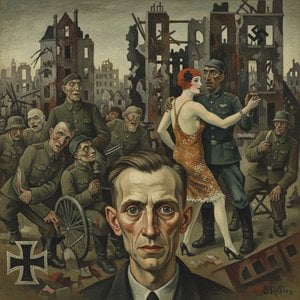
Otto Dix's "Pragerstrasse," painted in 1920, stands as a hauntingly beautiful emblem of the disillusionment that gripped Germany following World War I. More than just a depiction of a social gathering—a café scene on Pragerstrasse itself—it’s a meticulously crafted manifesto of Dadaism and Neue Sachlichkeit, movements determined to dismantle artistic conventions and confront societal hypocrisy. As a specialist at ArtsDot.com, offering exceptional handmade oil painting reproductions, I want to illuminate the profound layers embedded within this iconic artwork.The Dadaist Aesthetic: Chaos Embraced
Dix’s approach immediately distinguishes itself from traditional portraiture or landscape painting. The Dadaists rejected logic and reason, prioritizing spontaneity and absurdity as tools for artistic expression. This is vividly realized in “Pragerstrasse.” Figures are rendered with jarring distortions—faces stretched, limbs exaggerated—a deliberate tactic to destabilize the viewer's perception and challenge accepted notions of beauty. The artist employs a deliberately unsettling color palette dominated by reds and yellows, colors associated with violence and decay, juxtaposed against muted blues and greens that offer fleeting glimpses of tranquility. These contrasting hues amplify the emotional tension inherent in the scene.Technique and Composition: A Calculated Discomfort
Dix’s masterful technique contributes significantly to the artwork's impact. He utilizes thick impasto—heavy application of paint—creating palpable textural surfaces that convey a sense of immediacy and unease. The composition is deliberately asymmetrical, guiding the eye across the canvas in an unsettling dance. Despite the apparent chaos, Dix employs careful geometric structuring beneath the surface distortions, anchoring the scene within a framework of visual order. The placement of chairs and tables reinforces this underlying structure, subtly highlighting the artificiality of the setting.Historical Context: Weimar’s Fractured Psyche
“Pragerstrasse” is inextricably linked to the turbulent era of Weimar Republic Germany—a period marked by economic instability, political polarization, and simmering anxieties about the legacy of militarism. Dix's work captures the pervasive atmosphere of cynicism and moral compromise that characterized this society. The inclusion of a book on the floor symbolizes intellectual disillusionment – questioning established dogma and embracing alternative perspectives. It’s a visual record of a moment frozen in time, reflecting the profound psychological scars inflicted by the Great War.Symbolism Beyond Representation: An Emotional Resonance
Beyond its formal elements, “Pragerstrasse” resonates with deeper symbolic meanings. The figures themselves represent fragments of humanity—individuals grappling with trauma and uncertainty. Their expressions convey a spectrum of emotions ranging from boredom to despair, mirroring the anxieties of an entire nation struggling to reconcile itself with its past. Dix’s deliberate distortions serve not merely as stylistic devices but as conduits for conveying psychological states – fear, anxiety, and disillusionment. The painting compels viewers to confront uncomfortable truths about human nature and societal failings.- This striking reproduction captures the essence of Dix's Dadaist vision.
- Ideal for interior design projects seeking a bold statement piece.
Otázky a odpovědi
Jaká témata se objevují v díle „Pragerstrasse“ od Otto Dix?
„Pragerstrasse“ od Otto Dix zobrazuje: dadaism, social commentary, weimar society, postwar art, chaos harmony, human interaction, street scene.
Jak si mohu prohlédnout „Pragerstrasse“ od Otto Dix ve formě skluzobránku?
K dispozici je sklízivka: stránka Diaporama díla „Pragerstrasse“ od Otto Dix.
Z jakého materiálu je vyrobeno dílo "Pragerstrasse"?
„Pragerstrasse“ je vytvořeno v technice Oil On Canvas.
Související díla


Biografie umělce
Early Life and the Shadow of War
Wilhelm Heinrich Otto Dix, born in 1891 in Untermhaus, Germany – a small village now part of Gera – emerged from a world defined by industrial labor and a quiet yearning for artistic expression. His father, Franz Dix, was an iron foundry worker, providing a grounding in the realities of manual labor, while his mother, Louise, possessed a poetic spirit, creating a domestic environment that subtly nurtured young Otto’s creative inclinations. Crucially, it was the influence of his cousin, Fritz Amann – a painter – that truly ignited Otto's ambition. Hours spent in Amann’s studio weren’t merely lessons in technique; they were an immersion into a world where artistic expression held tangible power and significance. This early exposure fostered a deep desire to create, shaping his future trajectory as an artist. Otto began his formal art training at the local school, but it was his time with Amann that truly awakened his creative spirit. Following this formative period, Otto continued his studies at the Kunstgewerbeschule in Dresden, initially focusing on applied arts and crafts – a practical approach to design. However, the eruption of World War I dramatically altered the course of his life. Driven by patriotic fervor, he volunteered for military service, an experience that would irrevocably transform him from a promising landscape painter into a searing chronicler of war’s horrors. The brutal realities of trench warfare—the mud, the constant shelling, the unimaginable loss—left an indelible mark on his psyche and profoundly influenced his artistic vision. Battles like those at the Somme and in Flanders instilled within him a deep sense of disillusionment and a profound understanding of human suffering.The Weimar Republic and Neue Sachlichkeit
Returning from the war, Otto Dix was no longer the aspiring landscape painter he once had been. The trauma he’d witnessed had fundamentally reshaped his perspective, leading him to reject the emotional excesses of Expressionism in favor of a new aesthetic—*Neue Sachlichkeit*, or New Objectivity. This movement, emerging in the aftermath of World War I, sought to depict reality with unflinching honesty and critical social commentary, rejecting romanticized notions of heroism and glorifying instead the stark truths of the era. Dix quickly became one of its leading figures, alongside artists like George Grosz and Max Beckmann. His early post-war works reflected this new approach, often depicting the physical and psychological wounds inflicted upon soldiers – a subject he tackled with brutal realism. Paintings such as *The Trench* (1923) caused considerable public outrage due to their graphic depictions of dismembered bodies, forcing museums to temporarily hide them from view. This wasn’t merely shock value; it was a deliberate attempt to confront viewers with the uncomfortable realities of war and challenge prevailing societal attitudes towards conflict. Dix's *Neue Sachlichkeit* extended beyond simply portraying the horrors of war. He turned his attention to the social and moral decay he observed in Weimar Germany – a period marked by economic instability, political extremism, and rampant consumerism. His paintings often depicted scenes of debauchery, prostitution, and social alienation, offering a scathing critique of the era’s excesses. *Metropolis* (1928), for example, is a particularly powerful indictment of urban life, filled with unsettling imagery and a sense of moral emptiness. Dix's portraits from this period are equally unflinching, capturing the cynicism and disillusionment prevalent among Germany’s intellectual elite.Influences and Artistic Style
Otto Dix’s artistic style was remarkably eclectic, drawing inspiration from a diverse range of sources. Initially influenced by Expressionism – particularly its emphasis on emotional intensity – he quickly moved towards *Neue Sachlichkeit*, characterized by its stark realism, precise lines, and rejection of subjective interpretation. He also drew heavily from the work of Northern Renaissance masters such as Lucas Cranach, Hans Baldung Grien, and Albrecht Dürer, incorporating their compositional techniques and attention to detail into his own paintings. Furthermore, he was deeply affected by the ideas of Friedrich Nietzsche, whose philosophy encouraged a rejection of bourgeois morality and an embrace of intense experiences – including war and suffering. This philosophical influence is evident in the raw emotionality and often unsettling imagery found throughout his oeuvre. Dix’s use of color was also notable; he frequently employed muted tones and stark contrasts to create a sense of unease and drama. Dix's ability to seamlessly blend technical skill with emotional depth set him apart from many of his contemporaries. He wasn’t simply documenting reality; he was interpreting it through the lens of profound empathy and moral outrage. His exploration of themes such as war, trauma, social injustice, and the human condition continues to resonate powerfully today.Later Years and Legacy
As the Nazi Party rose to power in Germany during the 1930s, Otto Dix found himself increasingly targeted by the regime’s repressive policies. His art was deemed “degenerate” – a label used to denounce works that were considered politically or morally objectionable. Forced into exile, he continued to paint, shifting his focus away from overtly political themes and towards landscapes and religious subjects—a strategic move designed to avoid persecution. Despite this shift, his work retained an underlying sense of tension and unease, reflecting the turbulent times in which he lived. Following World War II, Dix experienced a resurgence of recognition and acclaim, though the scars of both wars remained deeply etched within him. He became a respected figure in post-war Germany, but never fully escaped the shadow of his traumatic past. Otto Dix died in 1969, leaving behind a body of work that remains profoundly unsettling, powerfully evocative, and undeniably significant. His art serves as a stark reminder of the horrors of war and the fragility of human existence—a testament to his courage, vision, and enduring commitment to truth.- Dix’s works are displayed in major museums worldwide, including the Museum of Modern Art in New York and the Suermondt-Ludwig-Museum in Germany.
- His etchings, particularly *The War*, are considered masterpieces of graphic art.
- He remains a pivotal figure in understanding the artistic and social landscape of Weimar Germany.

Otto Dix
1891 - 1969 , Německo
Rychlé informace
- Artistic Movement Or Style: Neue Sachlichkeit
- Artists Or Movements Influenced By This Artist: ['George Grosz']
- Date Of Birth: 2. prosince 1891
- Date Of Death: 25. července 1969
- Full Name: Wilhelm Heinrich Otto Dix
- Nationality: Němec
- Notable Artworks:
- The Trench
- Metropolis
- War Cripples
- Place Of Birth: Untermhaus, Německo
Související články

Oil on Canvas: A Historical & Technical Exploration of a Timeless Artistic Medium
Explore the rich history & enduring techniques of oil painting on canvas. Discover the science behind its longevity, conservation practices, and contemporary relevance. Expert insights for art enthusiasts.

Neue Sachlichkeit: Objectivity, Realism & Social Commentary in Interwar German Art
Explore Neue Sachlichkeit – the pivotal German art movement critiquing Weimar society with unflinching realism. Discover key artists like Dix & Grosz, its historical context, and collecting insights for discerning investors.

The Enduring Power of Painting: A Historical & Contemporary Exploration of Form and Emotion
Explore the rich history & enduring techniques of oil painting with ArtsDot. Discover masterpieces, learn about art collecting, and find authentic handmade reproductions crafted by skilled artists.

The Enduring Legacy of Oil on Canvas: Technique, History & Aesthetic Impact
Explore the rich history & techniques of oil painting – from Renaissance masters to Impressionism. Discover pigments, layering methods, and why this timeless medium endures. Expert insights for artists & art enthusiasts.
Otto Dix: Trauma, Society & Artistic Rebellion in Weimar Germany
Explore the powerful and unsettling art of Otto Dix, a key figure of Neue Sachlichkeit. Discover his unflinching depictions of Weimar Germany's trauma, society, and war through insightful analysis & iconic masterpieces.


