


 Zobrazit v interiéru
 Odeslat
 Sdílet
 Podrobnosti
 Průvodce

 Stáhnout obrázek
 Podobné kousky
 Rentgenové snímky
 Slideshow
 Statistiky
Lovers
 Acrylic On Canvas
- WallArt
- Expressionist Cubism
 23.0 x 18.0 cm
 Přečíst si více
Zakupte si digitální obraz ve vysokém rozlišení a vylepšeném provedení, který nabízí mnohem vyšší kvalitu než online náhled.
Každý soubor je pečlivě připraven našimi specialisty s využitím pokročilých nástrojů a odborné manuální retuše. Zajišťujeme, aby každý obraz disponoval výjimečnou ostrostí, přesnou barevnou věrností a jemnými detaily.
Finální soubor vám bude do 72 hodin zaslán e-mailem, optimalizovaný pro okamžité použití v profesionálním, redakčním i tiskovém prostředí. Nabízíme stejnou kvalitu, které důvěřují špičková designová studia, nakladatelství i galerie.
Digitální obrazy
Stáhněte si soubor ve vysokém rozlišení pro osobní prohlížení, tisk a kreativní projekty. ( Přepnout na tiskové verze Objednat ručně malovanou reprodukci)
Součást každé objednávky digitálního obrazu
Exponenciální digitální doručení, zaručené
Když si vyberete ArtsDot.com, nezískáváte pouze obrázek – získáváte digitální umělecké dílo s profesionálně vylepšenými detaily, zpracované s precizností a podpořené zárukou za spokojenost. Zde je vše, co vaše objednávka automaticky obsahuje:

Bleskové doručení e-mailem
Váš digitální obraz ve vysokém rozlišení vám bude zaslán e-mailem do 72 hodin od objednávky – připraven k okamžitému použití.

Digitální soubor s podporou AI
Vaše umělecké dílo je profesionálně optimalizováno pomocí pokročilých nástrojů umělé inteligence a manuální úpravy, což zajišťuje maximální úroveň detailu, ostrosti a přesnosti barev.

Doživotní bezplatné znovuodeslání
Soubor jste omylem smazali nebo ztratili? Žádný problém – kdykoliv vám ho znovu zašleme zcela zdarma.

Bez poplatků za dovoz – navždy
Užijte si své umělecké dílo okamžitě bez celních poplatků, daní nebo nákladů na dopravu – digitální stažení je vždy bez daňových povinností.

Záruka přesnosti barev
Díky profesionálním nástrojům a správě barev zajišťujeme, aby váš digitální obraz odrážel původní barvy co nejvěrněji.

100dená záruka spokojenosti
Pokud nebudete s digitálním obrázkem spokojeni, provedeme jeho revizi nebo vám vrátíme 100% platby do 100 dnů – bez jakýchkoliv dotazů.

100% záruka vrácení peněz
Nespokojeni? Získejte plnou náhradu peněz do 100 dnů od obdržení digitálního souboru – bez zbytečných dotazů.

Slevy při hromadných objednávkách
Při koupi 3 obrazů ušetříte 10% – Při koupi 5 obrazů ušetříte 15% – Při koupi 10+ obrazů ušetříte 20%. Ideální pro kreativní projekty, galerie a agentury.
A Dreamscape of Love and Longing: Marc Chagall’s “Lovers”
Marc Chagall's "Lovers," rendered in a captivating monochrome palette, isn’t merely a depiction of an intimate moment; it’s a portal into the artist’s deeply personal world—a realm where memory intertwines with myth and the familiar landscapes of his childhood bleed into fantastical visions. This evocative piece, often associated with Chagall's exploration of Russian folklore and Jewish identity, speaks to universal themes of love, connection, and the bittersweet ache of longing. The painting immediately draws the viewer in with its central focus: two figures locked in a tender embrace, their faces nearly touching within an oval frame that simultaneously protects and confines them.
The composition is deliberately flattened, eschewing traditional perspective for a more symbolic approach. Chagall’s signature style—a potent blend of Cubism, Expressionism, and Symbolism—is evident in the simplified forms and distorted features. The figures aren't rendered with photographic realism; instead, they are stylized representations imbued with emotional weight. Notice how their limbs flow organically, mirroring the undulating lines that define the background – a suggestion of rolling hills and perhaps even a distant village, hinting at Chagall’s roots in Vitebsk, Belarus. The three indistinct figures lurking in the periphery add to the dreamlike quality, acting as silent witnesses or perhaps echoes of past loves and experiences.
Technique and Materials: A Dance of Ink and Line
Examining the technique reveals a deliberate layering of textures achieved through meticulous hatching and cross-hatching. These subtle variations in tone create a sense of depth and volume, particularly noticeable in the rendering of the figures’ clothing and hair. The artist skillfully employed black ink or charcoal on paper, creating a surface that is both delicate and robust. The visible lines themselves become part of the artwork's narrative—a testament to the hand that brought this vision to life. It’s a technique reminiscent of his early training as a sign painter, grounding the fantastical elements in a tangible, almost tactile reality.
Interestingly, research into Chagall’s work reveals parallels with “Lovers’ Sky” (1957), another painting featuring intertwined figures against a vibrant, swirling backdrop. This suggests a recurring motif—the idea of love transcending earthly boundaries and soaring towards the heavens. The monochromatic palette in "Lovers" amplifies this sense of elevation, stripping away distractions and focusing solely on the emotional core of the scene.
Symbolism and Emotional Resonance
Beyond its visual appeal, “Lovers” is rich with symbolic meaning. The oval frame can be interpreted as a representation of intimacy, protection, or even imprisonment—a space where love exists in isolation. The close proximity of the figures’ faces underscores their profound connection, while the lack of explicit detail invites viewers to project their own experiences and emotions onto the scene. The painting evokes a powerful sense of nostalgia, a yearning for a lost moment or an idealized past.
Chagall himself often spoke of his childhood memories in Vitebsk—the vibrant colors, the bustling marketplaces, and the deep-seated traditions of his Jewish community. “Lovers” is arguably a distillation of these memories, filtered through the lens of his artistic vision. It’s a testament to the enduring power of personal experience to shape an artist's work and resonate with audiences across generations.
A Timeless Masterpiece for Home and Collection
Reproductions of “Lovers” offer a beautiful way to bring Chagall’s dreamlike world into your home. The artwork’s enduring appeal lies in its ability to evoke powerful emotions—a sense of romance, longing, and the beauty of human connection. Whether displayed as a statement piece in a contemporary space or incorporated into a more traditional setting, this captivating image will undoubtedly serve as a source of inspiration and contemplation for years to come. Consider a hand-painted reproduction – a faithful recreation that captures the essence of Chagall’s original vision, allowing you to experience the magic of “Lovers” firsthand.
Otázky a odpovědi
Kde si mohu koupit digitální kopii díla „Lovers“ od Marc Chagall?
„Lovers“ je k dispozici jako stažení digitálního obrazu ve vysokém rozlišení, lze jej zakoupit přímo na stránce Digitální obraz.
Jak harmonické jsou barvy díla „Lovers“ od Marc Chagall?
Barevná harmonie díla "Lovers" je hodnocena jako Strong Color Unity.
Jak byla dílo "Lovers" vytvořeno a jaká je jeho velikost?
Dílo „Lovers“ je vytvořeno v technice Acrylic On Canvas a v původní podobě má rozměry 23 x 18 cm.
Související díla


Biografie umělce
A Life Painted in Dreams: The World of Marc Chagall
Marc Chagall, born Moishe Shagal in 1887 in the small Belarussian town of Liozna near Vitebsk, wasn’t merely a painter; he was a poet of color, a weaver of dreams, and a chronicler of memory. His life, spanning nearly a century, mirrored the tumultuous currents of the 20th century, yet his art remained steadfastly rooted in a deeply personal vision—one infused with the folklore of his Hasidic Jewish upbringing and an unwavering belief in the power of imagination. Vitebsk itself was more than just a birthplace; it became the emotional core of his artistic universe, a recurring motif populated by flying figures, whimsical animals, and the vibrant hues of remembered landscapes. The town’s unique blend of cultures—Russian Orthodox churches alongside bustling Jewish marketplaces—forged an aesthetic sensibility that would defy easy categorization throughout his long career. Though he sought formal training first with a local sign painter and later in St. Petersburg under Léon Bakst, and then in Paris at the Académie de la Grande Chaumière, Chagall never fully embraced any single artistic movement. He absorbed elements of Cubism, Symbolism, and Fauvism, but always filtered them through his own intensely personal lens, creating a style that was uniquely, unmistakably Chagall.Early Years and Artistic Beginnings
Chagall’s formative years were marked by hardship and displacement. Born into a Jewish family in Vitebsk, he experienced the trauma of pogroms—violent anti-Jewish riots—which instilled in him a profound awareness of persecution and loss. Despite these challenges, Chagall possessed an innate talent for drawing and painting from a young age. He initially studied at Vitebsk Art School, where he honed his skills under Bakst’s guidance, experimenting with theatrical design alongside visual art. This early exposure to the stage would profoundly influence his later work, particularly his use of stylized figures and dramatic compositions. His artistic explorations continued in St. Petersburg, where he developed a distinctive style characterized by bold colors and expressive brushstrokes—a stylistic approach that foreshadowed his groundbreaking achievements to come.The Symbolist Influence and Early Paintings
Chagall’s artistic development was significantly shaped by the Symbolist movement, which championed emotion and imagination over realistic representation. Artists like Gustave Moreau and Edvard Munch served as important inspirations, encouraging him to delve into psychological landscapes and explore themes of spirituality and mythology. His early paintings—such as *I and the Village* (1911)—demonstrate this influence vividly. The village isn’t rendered realistically but as a fragmented collection of recollections, imbued with symbolic meaning. Recurring motifs like birds, apples, and windows reflect Chagall's preoccupation with themes of flight, fertility, and transcendence—concepts central to Jewish mysticism and folklore. These images are not merely decorative; they convey profound emotional resonance, capturing the essence of memory and experience.Cubism and Surrealism: Bridging Formal Movements
While Chagall resisted categorization into any single artistic movement, he skillfully incorporated elements of Cubism and Surrealism into his oeuvre. He embraced Picasso’s pioneering approach to fractured perspectives and geometric abstraction, adapting it to his own expressive style. Simultaneously, he explored the dreamlike imagery and irrational juxtapositions characteristic of Surrealist art—influenced by artists like Dalí and Magritte. This fusion of styles resulted in canvases that defy conventional logic while retaining a palpable sense of emotional intensity. Works like *Over Vitebsk* (1920-1922) exemplify this synthesis, presenting a fantastical depiction of his hometown bathed in luminous colors—a testament to Chagall’s ability to transform personal experience into universal themes.Mature Years and International Recognition
The 1930s witnessed Chagall's ascent to international fame. He established himself as a celebrated artist in Paris, where he continued to produce monumental paintings that captivated audiences worldwide. The outbreak of World War II forced him to flee occupied France for the United States, seeking refuge in New York City—a period marked by profound emotional upheaval and artistic experimentation. During his time in America, Chagall created some of his most iconic works, including *White Crucifixion* (1938), a haunting meditation on suffering and faith that powerfully captured the anxieties of the era. He returned to France after the war, receiving numerous prestigious commissions—including the ceiling of the Paris Opera—and cementing his legacy as one of the greatest artists of the 20th century. His stained glass windows for Jerusalem’s Hadassah Hebrew University Medical Center synagogue stand as a testament to his enduring vision and artistic prowess. Chagall's influence on subsequent generations of artists is undeniable; he bridged the gap between European modernism and Jewish cultural identity, becoming known as “the quintessential Jewish artist of the twentieth century.” His ability to synthesize personal experience, folklore, and universal themes continues to resonate with audiences worldwide. He left behind a body of work that is both deeply personal and universally accessible, inviting viewers to lose themselves in a world painted with dreams and illuminated by hope.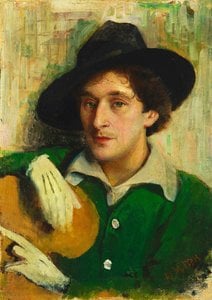
Marc Chagall
1887 - 1985 , Belorusko
Rychlé informace
- Artistic Movement Or Style: Modernismus, Kubismus
- Artists Or Movements Influenced By This Artist:
- Surrealismus
- Moderní umělci
- Artists Who Influenced This Artist:
- Bakst
- Delaunay
- Borovikovsky
- Date Of Birth: 6 července 1887
- Date Of Death: 28. března 1985
- Full Name: Marc Chagall
- Nationality: Rusko (nyní Bělorus)
- Notable Artworks:
- I a vesnice
- Nad Vitebskem
- Bílá křížová cesta
- Place Of Birth: Liozna, Belarus