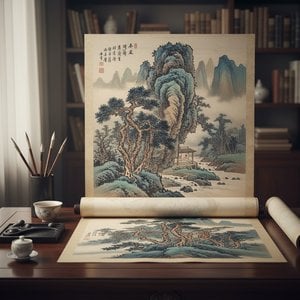
A Life Woven with Ink and Rain
The story of Wu Shixian (1845 – 1916) is one inextricably linked to the twilight years of the Qing Dynasty, a period of profound transformation in China. Born in Nanjing, Jiangsu province, into a family steeped in intellectual pursuits, Wu’s early life was marked by exposure to traditional learning and a burgeoning interest in Western art—a relatively new phenomenon rapidly infiltrating Shanghai at the time. Unlike many of his contemporaries who embraced overtly political or revolutionary themes, Wu chose to focus on capturing the ephemeral beauty of nature, specifically the evocative power of fog and rain over mountainous landscapes. This dedication to atmospheric realism, coupled with a subtle yet discernible influence from Western techniques, distinguishes him as a unique figure within the broader context of Chinese landscape painting.
His journey took him beyond his birthplace, eventually settling in Shanghai where he immersed himself in the burgeoning artistic scene. Shanghai’s proximity to European influences—particularly French Impressionism—provided Wu with invaluable insights into color theory and brushwork. However, rather than simply mimicking Western styles, Wu skillfully integrated these techniques into a distinctly Chinese aesthetic, creating a synthesis that is both familiar and strikingly original. He adopted the sobriquet “Splash-Ink Monk,” reflecting his deliberate and almost meditative approach to painting – each stroke imbued with intention and a deep connection to the natural world.
The Shixian Style: Fog, Mist, and the Essence of Landscape
Wu Shixian’s artistic signature lies in his masterful depiction of atmospheric conditions. He wasn't interested in rendering landscapes as static representations; instead, he sought to capture their fleeting moods—the dense fog clinging to mountain peaks, the subtle shifts in light filtering through rain clouds, and the overall sense of mystery and tranquility that these elements evoke. This focus on atmosphere is often referred to as “Shixian style,” a term derived from his own artistic name. It’s a style characterized by delicate washes of ink, layered textures created with varying brushstrokes, and an almost ethereal quality that transports the viewer into the heart of the scene.
Unlike many landscape painters who prioritized detailed depictions of flora and fauna, Wu often reduced elements to their essential forms—a suggestion of a pine tree shrouded in mist, a distant peak barely visible through the rain. This simplification wasn’t an act of omission but rather a deliberate choice to emphasize the overall mood and atmosphere of the scene. He was deeply influenced by the Zhe School of painting, known for its emphasis on capturing the essence of nature and conveying subtle emotions through color and brushwork. His work also shows traces of Mi Fu (1521–1605), a renowned landscape painter who pioneered the use of ink washes to create atmospheric effects.
Technique and Materials: A Dance with Ink
Wu Shixian’s technique was rooted in traditional Chinese ink wash painting, but he employed it with remarkable innovation. He utilized a variety of brushstrokes—from delicate washes to bold, expressive marks—to create layers of texture and depth. He favored using rice paper as his support, allowing the ink to bleed and spread naturally, contributing to the hazy, atmospheric effects that define his work. The careful control of water was paramount; it dictated the flow and intensity of the ink, shaping the overall composition.
His palette was deliberately restrained, primarily consisting of black ink and a limited range of colors—often muted blues, greens, and browns—used sparingly to enhance the atmospheric effects. He avoided bright, saturated hues, preferring instead to create subtle gradations of tone that mimic the diffused light of fog and rain. The meticulous layering of ink washes created a sense of depth and luminosity, as if the scene were constantly shifting and evolving.
Legacy and Significance
Wu Shixian’s work represents a pivotal moment in Chinese landscape painting—a bridge between tradition and modernity. While deeply rooted in established artistic conventions, his innovative use of atmospheric effects and subtle color palettes foreshadowed the developments that would characterize 20th-century Chinese art. His paintings are not merely depictions of landscapes; they are evocative explorations of mood, emotion, and the relationship between humanity and nature. Today, Wu Shixian’s work is highly valued by collectors and scholars alike, recognized for its exquisite beauty, technical mastery, and profound artistic vision.