Early Life and Artistic Training
Hendrik Jacobus Scholten entered the world in Amsterdam on 11 July 1824. His early years in the Dutch capital provided the foundation for a life spent observing the quiet rhythms of domesticity and nature. He began his path in the arts through a formal apprenticeship in Amsterdam, where he first learned to command the brush and the pencil. This period of study was essential, as it transformed a young man's curiosity into a disciplined method of seeing the world.
His talent was nurtured under the watchful eyes of Petrus Franciscus Greive and Lambertus Johannes Hansen. These teachers provided him with the technical rigor necessary to master the nuances of light and form. Through their guidance, Scholten learned to approach a canvas with a sense of precision and patience. He did not merely seek to copy what he saw, but to understand the very essence of the subjects before him.
By 1852, his dedication to his craft had earned him a place of distinction. He became a member of the Royal Academy of Art in Amsterdam, a milestone that marked his transition from a student to a recognized practitioner. This recognition allowed him to move forward with the confidence of a trained professional, ready to contribute his own quiet vision to the long tradition of Dutch painting.
Artistic Style and Technique
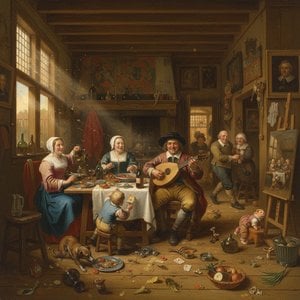
Scholten possessed a temperament that sought the quietude of a settled life, a preference that dictated the very nature of his brushwork. He turned his gaze toward the domestic sphere, finding a profound sense of purpose in the depiction of interiors. In these private rooms, he sought to capture a stillness that mirrored the atmosphere of the Dutch Golden Age. He was a devoted follower of Pieter de Hooch, and this influence was most visible when he arranged figures within a room. He did not seek the clamor of the street, but rather the soft, diffused light that settles upon a quiet corner or a well-appointed hearth.
His hand was as versatile as his interests were varied. While his paintings often focused on the steady rhythm of domesticity, he moved with equal ease between the canvas and the more delicate medium of watercolor. He was a man of many marks, producing drawings and illustrations that required a disciplined eye for detail. His landscapes were not mere backdrops but were treated with a specific, gentle sensitivity. He found beauty in the pastoral, often populating his scenes with flowers or the simple, unhurried movements of rural life. This ability to render the natural world with such precision allowed him to transition seamlessly from the structured geometry of an indoor setting to the open, airy expanses of the countryside.
- Sunday Morning, about 1865
- Levensavond
- Young girl with flower basket
Professional Career and Roles
As his reputation grew, Scholten moved through the most respected circles of the Dutch art world. He sought the company of his peers by joining several influential societies, finding a place among the members of Arti et Amicitiae in Amsterdam. His presence was also felt within the Kunstbevorderend Genootschap V.W. and the Vereeniging Sint Lucas. These affiliations were more than mere memberships; they connected him to the very pulse of the artistic life in Amsterdam and beyond, including the Pulchri studio in the Hague and the Kunstliefde in Utrecht.
His devotion to the stewardship of art led him to a significant appointment in 1872, when he became the art curator of the Teylers Stichting. This role allowed him to oversee the collection of the Teylers Museum, a position that required a deep understanding of history and preservation. He lived and worked in the Teyler's fundatiehuis from 1863 until his final days, a residence that kept him close to the institutions he served. His scholarly side emerged through his meticulous work for the museum, culminating in a comprehensive catalog of its holdings that he published in 1904.
Notable Works and Subjects
Scholten found his greatest expression in the quietude of the home. In his painting Sunday Morning, he captures a domestic scene where a young woman reads from a Bible to an elderly woman seated before a fireplace. This work reveals his interest in the soft, diffused light that settles upon a room, turning a simple moment of devotion into a study of stillness. He often turned his gaze toward the past, recreating the atmosphere of the seventeenth century through his depictions of interior life.
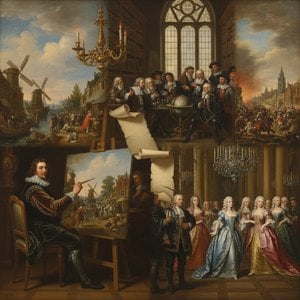
His brush also traveled through the corridors of history. He rendered The Princess of Orange Visiting the Work-shop of Bartholomeus van der Helst, a scene that places the viewer within a bustling historical setting. Such interests in narrative and heritage led him to contribute illustrations for the Dutch history book De voornaamste geschiedenissen van Noord-Nederland by Jacob van Lennep. Through these illustrations, he acted as a visual storyteller, translating the written chronicles of the North into lasting imagery.
Many of his canvases found their permanent homes within the galleries of significant museums, where they continue to observe the passing of time. His subjects ranged from pastoral landscapes and floral arrangements to the subtle interactions of figures in a room. Whether he was painting a lady in a satin dress or a quiet evening gathering, his focus remained on the grace of the moment and the weight of the atmosphere.
- Sunday Morning
- The Princess of Orange Visiting the Work-shop of Bartholomeus van der Helst
- Levensavond
Legacy and Professional Circles
Scholten moved through the artistic heart of the Netherlands, finding his place within the most esteemed circles of his time. He was a man deeply connected to the institutions that nurtured the Dutch spirit, holding memberships in the Pulchri studio in the Hague and the Schilder- en teekengenootschap Kunstliefde in Utrecht. His presence was felt in Haarlem as well, where he was a member of Kunst zij ons doel. These associations were more than mere titles; they were the spaces where a painter of his temperament could engage with the evolving currents of his profession.
His influence extended beyond the walls of these societies through the guidance he offered to others. He became a teacher to Jacobus van Looy, passing on the disciplined techniques he had mastered throughout his long life. This transmission of skill ensured that his approach to light and domestic stillness would find a voice in the next generation. Through his students and his active participation in these various art societies, his presence remained woven into the fabric of the Dutch art scene long after his brush was laid aside.
Въпроси и отговори
Къде мога да видя творбите на Hendrik Jacobus Scholten в 3D галерия?
Творбите на Hendrik Jacobus Scholten могат да бъдат разгледани в 3D галерия на страницата 3D галерия на художника.
Къде и през коя година е роден/а Hendrik Jacobus Scholten?
Hendrik Jacobus Scholten е роден в Amsterdam през 1824 г.
Къде мога да видя цветовата палитра на творчеството на Hendrik Jacobus Scholten?
Цветовият профил на творчеството на Hendrik Jacobus Scholten е представен на страницата Палитра на генома на художника.