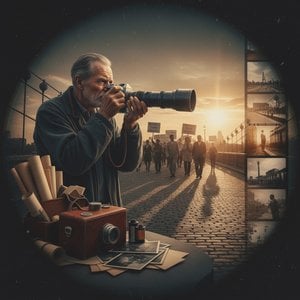
The Architect of Light: The Life and Legacy of Fred Hartsook
In the golden, flickering era of early cinema and the dawn of a new American century, few eyes captured the soul of celebrity quite like Fred Hartsook. To look upon a Hartsook portrait is to step into a world of soft shadows and luminous presence, where the boundaries between reality and Hollywood glamour began to blur. Born in 1876 into a lineage deeply rooted in the photographic craft, Hartsook was destined to inherit more than just a camera; he inherited a vision. His father and uncles were masters of the studio, and even as he briefly pursued the precise, structural discipline of civil engineering under his uncle’s tutelage, the pull of the darkroom remained irresistible. This unique blend of engineering precision and artistic intuition would later become the hallmark of his technical mastery, allowing him to build what was famously described as the largest photographic business operation in the world.
His journey was one of movement and expansion, mirroring the very growth of the American West. From his early days operating a traveling studio across the Utah Territory alongside his first wife, Flora “Flossie” Newcomb, to his eventual conquest of the California coast, Hartsook’s career was a testament to entrepreneurial brilliance. He did not merely take pictures; he constructed an empire of imagery. By establishing prominent studios in Santa Ana and Santa Barbara, he positioned himself at the epicenter of a cultural revolution. As the silent film era blossomed, Hartsook became the preferred chronicler of the legends who defined it. His lens graced the faces of Charlie Chaplin, Mary Pickford, and Lillian Gish, capturing not just the physical likenesses of these icons, but the very essence of their cinematic magic. He possessed a rare ability to translate the flickering light of the silver screen into the permanent, dignified medium of the studio portrait.
A Pantheon of Icons and Historical Significance
The true magnitude of Hartsook’s achievement lies in his ability to bridge the gap between the political stage and the silver screen. His portfolio serves as a vital historical archive, documenting the titans of both industry and governance. It is one thing to capture a movie star; it is quite another to command the presence of President Woodrow Wilson during a formal sitting in 1919, or to immortalize the heroic spirit of Charles Lindbergh. His work captured the transition of America from a frontier nation into a global powerhouse, documenting the faces that steered its destiny. Through his meticulous use of light and composition, he elevated photography from a mere mechanical process to a high art form capable of conveying profound character.
Beyond the studio walls, Hartsook’s life was as expansive as his photographic reach. He was a man of diverse passions, finding success as a rancher and developer. His ventures into cattle farming—specifically with prized Holstein cattle—and the creation of the celebrated Hartsook Inn in Humboldt County revealed a spirit that thrived on cultivation and growth. Whether he was developing a landscape or a portrait, his touch was one of refinement and scale. Though he passed away in 1930, leaving behind a legacy etched in silver nitrate and light, the impact of his work remains. He remains the definitive visual biographer of an era, a master who understood that to photograph a legend, one must first learn how to capture their light.
Въпроси и отговори
Мога ли да разглеждам творбите на Hartsook Photo по настроение?
Пространство по настроение на Hartsook Photo е страница, която подрежда произведенията на художника според настроението им.
Къде мога да видя творбите на Hartsook Photo в 3D галерия?
Възможно е виртуално посещение: страницата 3D галерия на Hartsook Photo представя творбите на художника в триизмерна галерия.
Къде могат да бъдат намерени произведенията на Hartsook Photo, разпределени по теми?
Атлас по теми на Hartsook Photo е страница, която класифицира творбите на художника според техните сюжети.