Early Life, Family and Training
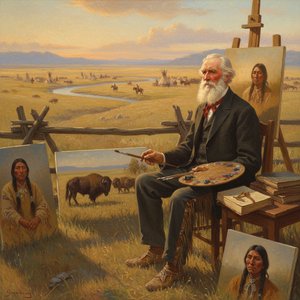
Datus E. Myers entered the world on September 29, 1879, in the town of Jefferson, Oregon. His early years in the West provided a foundation for a life spent observing the landscapes and people of the American frontier. As he matured, his interest in the visual arts led him away from his birthplace toward formal instruction. He sought out the disciplined study of form and composition, attending the Chouinard School of Art and later the Chicago Art Institute. These institutions provided him with the technical language necessary to translate the world around him onto canvas.
In 1910, his personal life became intertwined with the world of design when he married Alice Clark Myers. She was an architect, and her professional understanding of structure and space likely shared a common language with his own artistic pursuits. Together, they would eventually find their way toward the high desert, but their early years were defined by this union of creative disciplines. Their partnership was built on a shared commitment to the arts, as they moved through the formative decades of their professional lives.
Life and Activity in New Mexico
In 1923, Myers and his wife, the architect Alice Clark Myers, made the decision to move to Santa Fe. By 1925, they had settled in the Camino del Monte Sol area, finding a permanent home amidst the high desert landscape. It was here that his brush found its true subject. He became deeply preoccupied with the scenery of the region, producing many landscape paintings that sought to capture the essence of the terrain. His work often turned toward the people of the land, crafting idealized representations of Indigenous life within the American West.
His connection to the local community deepened during the 1930s through his involvement with the New Deal. He took on the responsibility of serving as the Indian Division field coordinator for the Public Works of Art Program. This was a position of significant social weight, as it required him to travel and connect with the local Pueblos. He spent much of his time recruiting Indigenous artists from these communities, helping them find a place within the WPA public art programs. Through this work, he helped bridge the gap between local talent and federal patronage, ensuring that the hands of the Pueblo artists were part of the era's public creative output.
Въпроси и отговори
Какво настроение изразяват творбите на Datus E. Myers?
Работите на Datus E. Myers могат да бъдат разгледани по настроение на страницата Пространство по настроение, където произведенията са подредени според тяхното емоционално състояние.
Как е разделена кариерата на Datus E. Myers на периоди?
Хронологичен преглед на творчеството на Datus E. Myers може да бъде открит на страницата Хронология, където произведенията са подредени по ред на създаване им, разделени на периоди.
Къде могат да бъдат намерени произведенията на Datus E. Myers, групирани по художествено направление?
Страницата Всички художествени направления групира произведенията на Datus E. Myers според тяхното художествено направление.
Къде могат да бъдат намерени творбите на Datus E. Myers, организирани по цвят?
Работите на Datus E. Myers могат да бъдат разгледани по цвят на страницата Спектър по цвят на художника.