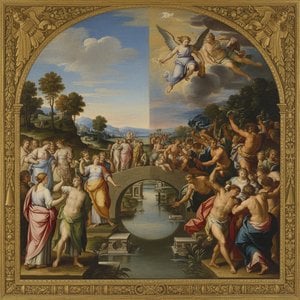
Carlo Bianconi: The Architect of Milanese Artistic Vision
Carlo Bianconi (1732 – august 15, 1802) stands as a fascinating figure in the artistic landscape of late Baroque and early neoclassical Italy. Born in Bologna, he embarked on an intellectual journey that would ultimately lead him to prominence as a painter, engraver, architect, and influential editor—a testament to his versatility and dedication to fostering cultural enrichment. His formative years were spent honing his skills under the tutelage of Ercole Graziani the Younger, establishing a foundation for his subsequent artistic endeavors. Bianconi’s early work focused primarily on engraving, particularly depictions of antiquities, reflecting the burgeoning interest in classical scholarship during his time. This passion for antiquity would permeate throughout his career, informing his architectural designs and shaping his broader aesthetic sensibilities.Early Artistic Training and Engraving Techniques
Bianconi's artistic development began under the guidance of Ercole Graziani the Younger, a respected Bolognese sculptor who instilled in him a profound appreciation for classical art and meticulous craftsmanship. Recognizing the importance of mastering foundational skills, Bianconi diligently practiced engraving techniques—primarily utilizing mezzotint—producing stunningly detailed prints that captured the grandeur and elegance of ancient sculptures and architectural ruins. His engravings were characterized by exceptional precision and tonal subtlety, demonstrating his mastery of printmaking artistry and establishing him as a leading figure in Bolognese engraving circles. Notable among his early works are depictions of Roman temples and statues, showcasing his unwavering commitment to faithfully reproducing classical forms with remarkable accuracy.Collaboration with Mauro Tesi: Shaping Bolognese Patronage
Bianconi’s artistic trajectory gained significant momentum through his partnership with Mauro Tesi, a wealthy Bolognese aristocrat who served as a pivotal patron of the arts. Together, they conceived and executed the monumental sculpture commemorating Saint Augustine, a project that cemented Bianconi's reputation as a skilled architect and demonstrated his ability to translate intellectual ideas into tangible artistic expressions. This collaboration exemplifies the spirit of Bolognese artistic culture during the Enlightenment—a period characterized by ambitious projects aimed at elevating civic pride and celebrating religious devotion. The sculpture’s intricate design and masterful execution underscored Bianconi’s architectural vision and solidified his position as a leading sculptor in Bologna.Milanese Academia and Artistic Leadership
In 1778, Bianconi relocated to Milan, accepting a prestigious role as secretary of the Brera Academy – an institution that would become his home for twenty years. During this time, he played an instrumental role in promoting artistic discourse and fostering the development of young talent. Recognizing the importance of disseminating knowledge about art and antiquities, Bianconi tirelessly edited Giuseppe Malvasia’s guide to Bologna, furthering scholarly understanding and bolstering the city's cultural prestige. Furthermore, his publication of “A Guide to Arts and Antiquities in Milan” in 1787 solidified his commitment to educating the public and documenting the artistic heritage of Milanese society. He championed innovative pedagogical approaches, encouraging critical engagement with art history and inspiring a new generation of artists to pursue excellence.Architectural Achievements: A Legacy of Baroque Elegance
Bianconi’s architectural contributions are particularly noteworthy, showcasing a masterful command of Baroque principles. He designed several churches in Milan, including Chiesa dei Santi Vittore e Carlo and Chiesa di SS. Vittore e Carlo, each adorned with intricate sculptures by Algardi and vibrant frescoes reflecting the stylistic trends of the era. These buildings stand as enduring symbols of Bolognese and Milanese artistic heritage—testaments to Bianconi’s vision for creating spaces that inspire contemplation and convey grandeur. His designs prioritized harmonious proportions, opulent ornamentation, and dramatic lighting effects, embodying the aesthetic ideals of Baroque art and establishing him as one of Milan's foremost architects. ##Concluding Significance: Beyond Technique – An Advocate for Artistic Appreciation Carlo Bianconi's legacy extends beyond his technical prowess; he was a fervent champion of artistic appreciation and intellectual curiosity. His work served as an inspiration to subsequent generations of artists and scholars, contributing significantly to the cultural landscape of Italy during the Enlightenment. By meticulously documenting antiquities and promoting scholarly discourse, Bianconi ensured that the beauty and wisdom of classical antiquity would continue to resonate throughout history—a testament to his enduring contribution to artistic understanding and cultural preservation. He remains a symbol of Bolognese intellectual heritage and an exemplar of artistic dedication.Въпроси и отговори
От коя държава е Carlo Bianconi?
Carlo Bianconi е роден в Италия.
Мога ли да разглеждам творбите на Carlo Bianconi по цветова палитра?
За да намерите творби на Carlo Bianconi в определена цветова палитра, посетете страницата на художника: По палитра.
Как е разделена кариерата на Carlo Bianconi на периоди?
Хронологичен преглед на творчеството на Carlo Bianconi може да бъде открит на страницата Хронология, където произведенията са подредени по ред на създаване им, разделени на периоди.