Преглед в реален мащаб
 Изпрати
 Сподели
 Детайли
 Ръководство

 Изтегляне
 Подобни артикули
 Рентгенова снимка
 Слайдшоу
 Въпроси и отговори
 Статистика
Casting in the Falls


 Прочети повече
Жикле / Художествен принт
Giclée печат или принт върху платно с музейно качество, бързо производство и гъвкави опции за завършен вид. ( Купете ръчно рисувана картина Превключване към дигитално изображение)




P118B €10

P118H €10

P118W €10

P438Z €10

P508JH €12

P508YH €12

P805H €10

P805Z €10

P919BZ €10

P919G €10

P919XJ €10

P959ZH €10

P968JZ €12

W106C €8

W218G €10

W218JH €8

W218Y €10

W307PJ €10

W316G €10

W316PJ €8

W316Y €10

W398PJ €8

W4111J €10

W500HY €15

W500JH €15

W692G €12

W849H €8

W940BG €15

W953PJ €8




Изберете от нашите предварително зададени размери, които съответстват на оригиналните пропорции на произведението.

Въведете необходимата ширина и височина, за да паснат на вашата рамка или стена. Принтовете могат само да се изрязват, но никога не могат да бъдат по-големи от оригиналната картина, така че при размер с различен формат част от изображението ще бъде загубена. Преди да започнем печат, ще ви изпратим дигитален мок업 за одобрение. Изображението, показано на тази страница, не показва реалното изрязване — само мок업ът го показва.
Доставка по целия свят () в рамките на 2 седмици вместо стандартните 4/5 седмици. (7 Ноември)

Безплатна експресна доставка по целия свят

Висококачествено ленено платно

Пълно застраховане на доставката

Гаранция за възстановяване на митнически такси

Гаранция за пълно съответствие на цветовете

Политика за връщане в рамките на 100 дни (само при дефекти)

100% Гаранция за връщане на сумата

Оферта за отстъпка при поръчка на повече бройки
 Опцията със стъкло е налична само за размери под 110 см

Casting in the Falls
Жикле / Художествен принт
Размер на репродукцията
-


Обща цена
€ 56
A Moment Frozen in Time: The Luminous Spirit of Casting in the Falls
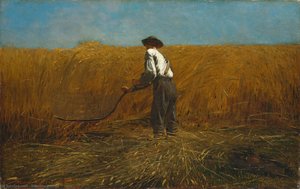
Winslow Homer's "Casting in the Falls," completed in 1889, is far more than a mere depiction of a picturesque waterfall; it is a profound meditation on humanity’s relationship with nature and the quiet dignity of rural American life. Hanging proudly at the Dallas Museum of Art, this watercolor captures a fleeting tableau—men fishing alongside a powerful cascade—yet manages to convey an enduring sense of serenity and contemplation. Homer's genius lay in his ability to distill complex emotions into deceptively simple compositions, prioritizing direct observation over academic convention. The viewer is placed at the very base of the falls, looking upstream, where the graceful motion of a fisherman in the midst of his cast becomes the focal point of a larger, breathing ecosystem.
The artist's masterful use of watercolor distinguishes this work from many of its contemporaries. Unlike oil paintings that often strive for heavy, illusionistic depth, Homer utilizes the medium to achieve a luminous quality that perfectly replicates the dapple of sunlight filtering through the surrounding foliage. He employs loose, confident brushstrokes—a hallmark of his style—to capture the kinetic energy of moving water and the subtle variations in color. Through the skillful blending of hues, an atmospheric haze is created, enhancing the sense of distance and immersing the viewer in the scene’s tranquil environment. The reserved white of the paper is artfully employed to highlight the frothing foam of the current, while touches of signature red in the foreground water and the fisherman's belt contribute to a striking visual unity.
Symbolism and the American Landscape
Beyond its immediate visual appeal, "Casting in the Falls" resonates with deeper symbolic meanings. The fishermen represent humanity’s efforts to engage with nature, seeking both sustenance and solace amidst its raw power. Their stillness contrasts sharply with the turbulent flow of the waterfall, suggesting a quiet acceptance of forces beyond human control. This dialogue between man and landscape prompts us to consider our own place within the larger ecosystem. The waterfall itself serves as a dual symbol of both power and beauty—forces that coexist harmoniously within the natural world, representing resilience, renewal, and the enduring spirit of the American wilderness.
This work firmly establishes Homer within the broader tradition of American landscape painting, yet his approach remains uniquely intimate. While contemporaries like Frederic Church sought to portray America’s grandeur on a monumental scale through dramatic vistas, Homer eschewed grand narratives in favor of observing everyday life. He captures the essence of the American experience through a lens of honesty and authenticity, avoiding the temptation to romanticize or idealize his subjects. For collectors and interior designers alike, a high-quality reproduction of this piece offers more than just decoration; it brings a sense of peace, wonder, and a connection to the timeless beauty of the natural world into any space.
Въпроси и отговори
Има ли "Casting in the Falls" силен светлотеневи контраст?
Нивото на контраст в „Casting in the Falls“ на Уинслоу Хомър е Statement.
Намира ли се "Casting in the Falls" в страната на своя създател?
Да – произведението се съхранява в родината на художника. Уинслоу Хомър е роден в Съединени американски щати, а оригиналът на „Casting in the Falls“ се съхранява в музей в Съединени Американски Щати.
Намира ли се „Casting in the Falls“ на Уинслоу Хомър в обществено достояние?
Що се отнася до авторското право, „Casting in the Falls“ е в в обществено достояние – авторското право е изтекло.
Подобни произведения


Биография на художника
Winslow Homer: A Brush With the American Spirit
Winslow Homer, born in Boston in 1836, wasn’t sculpted by the traditional European art academies that shaped so many of his contemporaries. Instead, he emerged from a distinctly American experience, one rooted in practicality and observation. His journey began not with grand historical canvases, but as a commercial illustrator at the tender age of twelve for Harper's Weekly. This early apprenticeship was formative, honing an exceptional ability to capture scenes with clarity and detail – skills that would become hallmarks of his mature work. He wasn’t learning perspective in Paris; he was learning to *see* America, its people, and its unfolding story. The bustling streets of Boston, the quiet dignity of rural New England life, these were his first subjects, rendered with a precision born of necessity for the demands of print media. This foundation allowed him to transition into painting, initially in watercolor, before fully embracing the expressive potential of oil paints.From Pastoral Scenes to the Raw Power of Nature
Homer’s early paintings often depicted idyllic scenes – children playing, farmers tending their fields, quiet moments of domesticity. These works, while charming, hinted at a deeper artistic sensibility waiting to be unleashed. The catalyst for this transformation was undoubtedly the Civil War. As a war correspondent for Harper's Weekly, Homer witnessed firsthand the brutal realities of conflict. He didn’t focus on heroic battles or grand strategies; instead, he documented the everyday lives of soldiers and civilians, the quiet moments of grief and resilience amidst chaos. This experience profoundly altered his artistic vision. The pastoral scenes gave way to more challenging subjects: veterans grappling with trauma, freed slaves navigating a new world, and the stark beauty of landscapes touched by hardship. He began to explore themes of struggle, isolation, and humanity’s precar He wasn't interested in imitating European styles; he wanted to create an art that was uniquely American, reflecting its landscapes, its people, and its challenges. His style also evolved, becoming bolder and more direct, reflecting the raw emotional impact of what he had witnessed. Breezing Up (A Fair Wind), painted in 1876, exemplifies this skill – a quintessential depiction of American maritime life, brimming with energy and movement. The Gulf Stream, created decades later, is perhaps his most iconic work, a powerful and symbolic portrayal of a lone man battling the forces of nature, a metaphor for human struggle against overwhelming odds. He wasn’t simply painting what he saw; he was conveying a feeling, an emotional truth about the human condition.Mastering Light, Texture, and the American Landscape
Winslow Homer's artistic technique is immediately recognizable for its solidity and texture. He wasn’t interested in fleeting impressions; he wanted to build up a sense of tangible reality on the canvas. His oil paintings are characterized by a direct painting approach – layers of paint applied with confidence, creating depth and luminosity. He possessed an extraordinary ability to capture light, whether it was the dazzling glare of the sun on the ocean or the soft glow of twilight over a rural landscape. This mastery extended to his watercolors, where he achieved remarkable atmospheric effects through vibrant colors and delicate washes. Innocence, a poignant portrayal of childhood set against the backdrop of nature, and Man of Science, demonstrating his skill in capturing human psychology, are testaments to this commitment.A Legacy Forged in American Realism
Winslow Homer's art offers a profound window into 19th-century America, providing invaluable insights into the social, political, and cultural landscape of his time. His paintings are not merely beautiful representations; they are powerful statements about human resilience, the beauty and power of nature, and the complexities of the American experience. He died in 1910, leaving behind a prolific body of work that continues to resonate with audiences today. His ability to depict America with honesty and authenticity, without romanticizing or idealizing it. He wasn’t interested in imitating European styles; he wanted to create an art that was uniquely American, reflecting its landscapes, its people, and its challenges. His influence can be seen in the work of later American painters who sought to depict their own country with similar directness and emotional depth.- His work continues to inspire contemporary artists.
- Homer remains a pivotal figure in the development of American Realism.

Уинслоу Хомър
1836 - 1910 , Съединени американски щати
Бърза информация
- Artistic Movement Or Style: Американски реализъм
- Artists Or Movements Influenced By This Artist: ['Американски художници']
- Artists Who Influenced This Artist:
- Барбизонската школа
- Курбет
- Милет
- Date Of Birth: Октомври 3, 1836 г.
- Date Of Death: 1910 г.
- Full Name: Winslow Homer
- Nationality: Американски
- Notable Artworks:
- Бризът
- Теченията
- Невинност
- Place Of Birth: Бостън, САЩ
Свързани статии

Ephemeral Visions: Exploring the Artistic Legacy & Nuances of Watercolor Painting
Explore the captivating world of watercolor painting! Discover its rich history, essential techniques, influential artists & collecting tips from art experts. A comprehensive guide for enthusiasts.

Ephemeral Visions: Exploring the History & Emotional Resonance of Watercolor Painting
Explore the captivating history of watercolor painting, from ancient techniques to modern masters like Kandinsky & Blake. Discover essential artists, collecting tips & the emotional power of this luminous medium. Expert insights for art enthusiasts.

Топ 10 шедьоври на акварела, променили изкуството завинаги | ArtsDot.com
Разгледайте топ 10 шедьоври на акварела от Turner, Monet и Sargent! Открийте историите зад тези емблематични картини, техниките им и как промениха изкуството. Купете висококачествени репродукции за вашия дом в ArtsDot.com.

Ephemeral Visions: Exploring the Artistic Legacy & Contemporary Practice of Watercolor Painting
Explore the captivating world of watercolor painting! Discover its rich history, essential techniques, influential artists & collecting tips. A comprehensive guide for art enthusiasts from ArtsDot.

Топ 25 шедьовъра на Джон Констабъл: Английски пейзажи за вашия дом | ArtsDot.com
Открийте топ 25 шедьовъра на Джон Констабъл – английски пейзажи, романтизъм и красотата на природата. Репродукции с музейно качество за вашия дом! Разгледайте пълната колекция онлайн на ArtsDot.com.