

 Изпрати
 Сподели
 Детайли
 Ръководство

 Изтегляне
 Подобни артикули
 Слайдшоу
 Въпроси и отговори
 Статистика
Ferryman


 Прочети повече
Получете файл, готов за печат, който предлага много по-високо качество от уеб прегледа. Всяко дигитално изображение, което предлагаме, е извлечено от висококачествен оригинал в нашата база данни — обикновено с ширина между 5 000 и 15 000 пиксела — така че със сигурност да можете да принтирате в голям формат, да кадрирате тесно или да възпроизведете фините детайли.
Нито един файл не напуска нашето студио без внимание. Дигитален експерт проверява цветовете спрямо оригиналната картина и ги коригира при необходимост, след което подобрява яснотата и детайлите с професионални инструменти за ретуш — винаги оставайки верен на мазките и стила на художника. Резултатът е изображение, което изглежда като самата картина, а не като сканиран образ с филтър.
Одобрявате преди финализиране: нашият експерт ще изпрати изображението по имейл в рамките на 72 часа за ваш преглед. Не сте доволни? Можете да поискате подобрения или корекции, или пълно възстановяване на сумата, ако качеството не отговаря на очакванията ви.
Това е качеството, на което разчитат издателства, дизайн студиа, галерии и печатници.
Дигитално изображение
Изтеглете файл с висока резолюция за лично съхранение, принтиране и творчески проекти. ( Превключване към принт Купете ръчно рисувана картина)
Включено във всяка поръчка за дигитални изображения
Гарантирана експертна дигитална доставка
Избирайки ArtsDot.com, вие не получавате просто изображение – вие придобивате професионално обработена дигитална творба, създадена с прецизност и подкрепена от гаранция за удовлетворение. Ето какво автоматично е включено във вашата поръчка:

Бърза доставка по имейл
Вашето дигитално изображение с висока резолюция ще бъде изпратено по имейл в рамките на 72 часа от поръчката – готово за незабавно използване.

Дигитален файл с подобрено качество чрез ИИ
Вашата картина е професионално оптимизирана чрез усъвършенствани инструменти с изкуствен интелект и ръчна редакция, което гарантира максимална детайлност, яснота и точност на цветовете.

Безплатна доживотна повторна доставка
Изгубили сте или сте изтрили файла си по погрешка? Не се притеснявайте – ще го изпратим отново на Вас по всяко време, безплатно.

Без митнически такси – завинаги
Насладете се на вашето произведение незабавно, без мита, такси или разходи за доставка – дигиталните изтегляния винаги са освободени от данъци.

Гаранция за цветово съответствие
Гарантираме, че вашето дигитално изображение отразява оригиналните цветове възможно най-точно чрез използването на професионални инструменти и системи за управление на цветовете.

100-дневна гаранция за удовлетвореност
Ако не сте доволни от вашето дигитално изображение, ще го преработим или ще възстановим 100% от сумата в рамките на 100 дни – без излишни въпроси.

100% Гаранция за връщане на сумата
Не сте доволни? Получете пълен възврат на сумата в рамките на 100 дни от получаването на вашия цифров файл – без излишни въпроси.

Отстъпки за големи поръчки
Купете 3 изображения, спестете 10% - Купете 5, спестете 15% - Купете 10+, спестете 20%. Идеално за творчески проекти, галерии и агенства.
A Visionary Encounter with Form
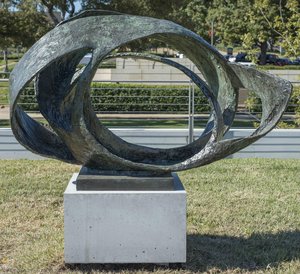
In the vast, open expanse of a verdant landscape, where the whispers of nature meet the silent strength of human ingenuity, stands Ferryman. This striking work by the renowned British sculptor Tony Cragg invites the viewer into a profound dialogue between the organic and the industrial. At first glance, the sculpture presents a captivating paradox: a large-scale, metallic rabbit perched with unexpected grace upon a rugged concrete base. The figure, though clearly recognizable in its soft, familiar silhouette, is transformed by its medium, rendered in a way that suggests both the lightness of a living creature and the enduring weight of modern art. It is a piece that commands attention, not through aggression, or noise, but through a quiet, monumental presence that anchors the surrounding field.
The artistry of Cragg lies in his ability to manipulate material to evoke complex emotional responses. In Ferryman, the metallic surface catches the shifting light of the sky, creating a dynamic interplay of shadows and highlights that breathes life into the sculpture's form. The contrast between the smooth, engineered precision of the metal and the raw, unyielding texture of the concrete pedestal creates a tension that is central to the work's allure. This juxtaposition serves as a metaphor for the contemporary condition—the intersection of our biological origins and our increasingly technological existence. For the collector or interior designer, this piece offers a sophisticated focal point, bringing a sense of sculptural depth and intellectual curiosity to any curated space.
The Alchemy of Material and Memory
To understand Ferryman, one must look toward the historical trajectory of Tony Cragg himself. Emerging from the vibrant assemblage movement, Cragg has spent decades redefining how we perceive fragments and forms. This work, dating from 1997, reflects a period of mastery where the artist moved beyond the mere accumulation of discarded objects toward a more fluid, integrated approach to three-dimensional space. The sculpture does not merely sit upon the earth; it seems to emerge from it, bridging the gap between the man-made and the natural world. The presence of distant buildings and the subtle inclusion of human observers in the landscape further emphasize this connection, placing the artwork within a living, breathing ecosystem.
The symbolism within the piece is as layered as the artist's technique. The rabbit, often a symbol of fertility, rebirth, and sudden movement, is here frozen in a moment of stillness, acting as a silent sentinel over the landscape. This stillness invites a meditative state in the viewer, encouraging a slow, rhythmic observation of the surrounding environment. For those seeking to incorporate high-quality reproductions into their homes or galleries, Ferryman represents more than just a decorative object; it is an invitation to contemplate the permanence of art amidst the transience of life. It is a masterpiece of balance, offering a sophisticated aesthetic that resonates with anyone who finds beauty in the harmony of contrasting elements.
Въпроси и отговори
Налична ли е творбата "Ferryman" като художествен отпечатък?
Принт на „Ferryman“ на Tony Cragg може да бъде поръчан директно от неговата страница Художествен принт: художествен принт върху памучно платно или архивен канвас хартия.
За какво се препоръчва използването на принт от "Ferryman"?
Репродукцията на „Ferryman“ на Tony Cragg е препоръчителна за Focal. Това предложение произтича от темата, настроението и цветовете на произведението.
Мога ли да видя „Ferryman“ на Tony Cragg върху моята собствена стена преди покупка?
Можете да прегледате „Ferryman“ на Tony Cragg върху вашата собствена стена чрез страницата за Преглед с AR на произведението, използвайки добавена реалност на съвместимо устройство.
Подобни произведения




Биография на художника
The Architect of Fragmented Forms
Sir Anthony Cragg, a titan of British contemporary sculpture, possesses the rare ability to breathe life into the inanimate. Born in Liverpool in 1949, Cragg’s artistic consciousness was shaped by an early mastery of painting, yet it was his profound fascination with the three-dimensional realm that would eventually redefine the boundaries of modern sculpture. His journey through the Gloucestershire College of Arts and Technology and Wimbledon School of Art provided a rigorous foundation, but it was his move to Germany in 1977 that acted as a true catalyst, thrusting him into an international dialogue with the avant-garde and expanding his sculptural vocabulary beyond the limits of traditional medium.
In the early stages of his career, Cragg emerged as a pioneer of the assemblage movement, finding profound beauty in the discarded and the mundane. He possessed a singular vision for transforming everyday detritus—stacked chairs, weathered tables, and forgotten boxes—into complex, rhythmic reliefs. Through works such as “Stack” (1975), he demonstrated an uncanny ability to manipulate spatial arrangement and color, turning fragments of plastic and wood into vibrant geometric abstractions. This period was defined by a philosophical rejection of representational imagery; instead, Cragg sought to distill visual language into its purest essence, forcing the viewer to confront the raw energy of form and texture without the distraction of recognizable subjects.
Evolution of Material and Motion
As his career progressed through the mid-1970s and into the 1980s, Cragg’s ambitions grew from the intimate scale of wall-mounted reliefs to the monumental presence of large-scale installations. He began to bridge the gap between architecture and sculpture, creating works that engaged aggressively with the spaces they inhabited. His mastery over diverse materials—ranging from the industrial coldness of fiberglass to the timeless weight of bronze—allowed him to explore a spectrum of textures and densities. In pieces like “Red Indian” (1982–3), one can observe his meticulous method of arranging individual fragments to generate larger, more complex images that simultaneously evoke organic, natural growth and rigid, geometric precision.
The brilliance of Cragg’s development lies in his ability to navigate the tension between the artificial and the biological. His later series, such as 'Early Forms' and 'Rational Beings', showcase a sculptor deeply invested in the concept of emergence—the way complex structures arise from simple components. His sculptures often appear to be in a state of flux, caught in a moment of transformation or unfolding. This sense of kinetic energy, even within static bronze or resin, creates a psychological depth that challenges our perceptions of stability and permanence.
Legacy and Artistic Significance
The historical significance of Sir Anthony Cragg cannot be overstated; he has fundamentally altered the trajectory of contemporary sculpture by dismantling the distinction between found objects and fine art. His work serves as a bridge between the sculptural traditions of the past and the fragmented, multi-material reality of the present. By treating the fragment not as a broken piece, but as a building block for new realities, he has provided a visual language for an era defined by complexity and interconnectedness.
Today, Cragg remains a vital force in the global art scene, his influence felt in the way contemporary artists approach materiality and spatial intervention. His achievements are marked by:
- Innovation in Assemblage: Redefining the use of discarded materials to create high-art aesthetics.
- Material Versatility: The seamless integration of fiberglass, bronze, and plastic into a cohesive sculptural language.
- Spatial Dialogue: A profound ability to transform architectural environments through monumental installations.
- Philosophical Depth: Exploring the intersection of geometric abstraction and organic, biological forms.

Tony Cragg
1949 -
Бърза справка
- Full Name: Tony Cragg
- Nationality: British
- Date Of Birth: 1949
- Place Of Birth: Liverpool, UK
- Notable Artworks:
- Axehead
- Opening Spiral
- Dining Motions
- Artistic Movement Or Style: Assemblage art
- Artists Who Influenced This Artist:
- Robert Irwin
- Donald Judd