

 Преглед в реален мащаб
 Изпрати
 Сподели
 Детайли
 Ръководство

 Изтегляне
 Подобни артикули
 Рентгенова снимка
 Слайдшоу
 Въпроси и отговори
 Статистика
Number 3, 1950


 Прочети повече
Жикле / Художествен принт
Giclée печат или принт върху платно с музейно качество, бързо производство и гъвкави опции за завършен вид. ( Купете ръчно рисувана картина Превключване към дигитално изображение)




P118B €10

P118H €10

P118W €10

P438Z €10

P508JH €12

P508YH €12

P805H €10

P805Z €10

P919BZ €10

P919G €10

P919XJ €10

P959ZH €10

P968JZ €12

W106C €8

W218G €10

W218JH €8

W218Y €10

W307PJ €10

W316G €10

W316PJ €8

W316Y €10

W398PJ €8

W4111J €10

W500HY €15

W500JH €15

W692G €12

W849H €8

W940BG €15

W953PJ €8




Изберете от нашите предварително зададени размери, които съответстват на оригиналните пропорции на произведението.

Въведете необходимата ширина и височина, за да паснат на вашата рамка или стена. Принтовете могат само да се изрязват, но никога не могат да бъдат по-големи от оригиналната картина, така че при размер с различен формат част от изображението ще бъде загубена. Преди да започнем печат, ще ви изпратим дигитален мок업 за одобрение. Изображението, показано на тази страница, не показва реалното изрязване — само мок업ът го показва.
Доставка по целия свят () в рамките на 2 седмици вместо стандартните 4/5 седмици. (12 Ноември)

Безплатна експресна доставка по целия свят

Висококачествено ленено платно

Пълно застраховане на доставката

Гаранция за възстановяване на митнически такси

Гаранция за пълно съответствие на цветовете

Политика за връщане в рамките на 100 дни (само при дефекти)

100% Гаранция за връщане на сумата

Оферта за отстъпка при поръчка на повече бройки
 Опцията със стъкло е налична само за размери под 110 см

Number 3, 1950
Жикле / Художествен принт
Размер на репродукцията
-


Обща цена
€ 56
A Universe of Color: Exploring Jackson Pollock’s Number 3, 1950
Jackson Pollock's *Number 3, 1950* is arguably one of the most iconic and significant works of Abstract Expressionism. This monumental canvas isn’t about depicting a scene; it *is* the scene – an immersive field of energy, color, and gesture that redefined painting in the mid-20th century. It currently resides at the Museum of Modern Art (MoMA) in New York City, a testament to its enduring importance.Deconstructing the Technique: Drip Painting Revolutionized
Pollock’s revolutionary technique is immediately apparent. He abandoned traditional easel painting, instead working on an unprimed canvas laid horizontally on the floor. Using household enamel paints – often thinned and poured directly from cans or applied with sticks, hardened brushes, and knives – he dripped, splashed, and flung paint onto the surface. This wasn’t random chaos; it was a carefully orchestrated process of movement and control. The resulting web of lines and colors creates an all-over composition, devoid of a central focal point, inviting the viewer to explore the entire surface equally. This “action painting”, as it came to be known, emphasized the *process* of creation as much as the final product.Historical Context: The Rise of Abstract Expressionism
Emerging in post-World War II America, Abstract Expressionism was a radical departure from representational art. Artists sought to express subjective emotions and psychological states through abstract forms. Influenced by Surrealist automatism – the idea of accessing the subconscious mind – Pollock aimed to tap into universal archetypes and primal energies. He wasn’t trying to paint *something*; he was attempting to convey *feeling* directly onto the canvas. Artists like Wassily Kandinsky, a pioneer of abstract art, laid some groundwork for this movement, but Pollock took abstraction to an entirely new level of scale and physicality.Decoding the Symbolism: Beyond Representation
While *Number 3, 1950* lacks traditional symbolism, its power lies in its evocative qualities. The swirling patterns can be interpreted as representing cosmic forces, psychological landscapes, or simply the raw energy of life itself. The dominant hues of orange and white, punctuated by subtle undertones of other colors, create a dynamic tension. Some art historians suggest that Pollock’s work reflects his engagement with Jungian psychology, seeing the layers of paint as representing different levels of the unconscious mind. The painting's sheer scale envelops the viewer, creating an almost meditative experience.Emotional Impact and Lasting Legacy
*Number 3, 1950* is a deeply emotive work. It evokes feelings of exhilaration, anxiety, and awe. Its complexity invites prolonged contemplation, revealing new details with each viewing. Pollock’s influence on subsequent generations of artists is immeasurable. He paved the way for Minimalism, Pop Art, and countless other movements that challenged traditional artistic conventions.Bringing Pollock Home: High-Quality Reproductions
- This painting exemplifies the core tenets of Abstract Expressionism, making it a cornerstone piece for any art collection.
- The use of oil on canvas in the original allows for rich texture and vibrant color, qualities faithfully reproduced in our high-quality reproductions.
- Its large scale makes it a striking statement piece, ideal for modern interiors seeking an impactful focal point.
- The dynamic composition and energetic brushwork bring a sense of movement and vitality to any space.
Въпроси и отговори
Кой размер на принта от „Number 3, 1950“ на Пол Джаксън Полк е подходящ за препоръчаната стая?
За Living Room се препоръчва печат на „Number 3, 1950“ с размер Large.
„Number 3, 1950“ на Пол Джаксън Полк портретна, пейзажна или квадратна композиция ли е?
Форматът на „Number 3, 1950“ е Panoramic. Това е полезно при планирането на мястото, където ще бъде поставена репродукцията.
Как се позиционира „Number 3, 1950“ сред често срещаните теми в творчеството на Пол Джаксън Полк?
Сред утвърдените теми на Пол Джаксън Полк – key pollock work, drip technique pioneer, abstract expressionism's core, kandinsky, abstract art, action painting style, gestural abstraction, post-war anxiety – „Number 3, 1950“ привнося собствен фокус върху abstract, drip painting, pollock, color field, chaos, energy, texture, modern art.
Подобни произведения


Свързани статии

Топ 10 шедьовъра на абстрактния експресионизъм – изкуство за вашия дом от ArtsDot.com
Разгледайте топ 10 шедьовъра на абстрактния експресионизъм – Полък, Ротко, де Кунинг и други. Открийте историите зад тези емблематични картини и преобразете дома си с изкуство от ArtsDot.com! Разгледайте пълната колекция онлайн.

Beyond Representation: Exploring the Evolution & Enduring Impact of Abstract Art
Explore the evolution of Abstract Expressionism & its profound impact on modern art. Discover key artists, defining styles, collecting insights & build your own significant collection with ArtsDot.

Beyond Representation: Emotional Depth & Formal Innovation in Abstract Expressionism
Explore the profound emotional depth & formal innovation of Abstract Expressionism. Discover key artists, collecting insights, and investment potential with expert guidance. Learn more now.
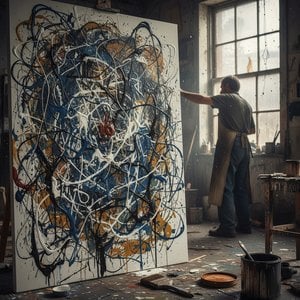
Paul Jackson Pollock: A Radical Departure – Exploring Abstract Expressionism's Pioneering Figure and His Enduring Legacy
Explore the revolutionary art of Jackson Pollock & Abstract Expressionism. Discover his iconic drip paintings, lasting impact, and considerations for collecting this pivotal American artist. Expert insights at ArtsDot.

Beyond Representation: Exploring the Emotional Landscape of Abstract Expressionism
Explore the profound emotional world of Abstract Expressionism with ArtsDot. Discover key artists like Pollock & Rothko, learn about collecting, and find museum-quality reproductions to inspire your space.


