


 Преглед в реален мащаб
 Сподели
 Сподели
 Подробности
 Ръководство

 Изтегляне
 Подобни артикули
 Рентгенова снимка
 Слайдшоу
 Статистика
Number 1


 Разгърни целия текст
Ръчно изработена маслена репродукция
Ръчно рисувана маслена картина върху платно във вашия размер и рамка, изработена по поръчка от нашите художници. ( Избор на принт Превключване към дигитално изображение)




P118B €10

P118H €10

P118W €10

P438Z €10

P508JH €12

P508YH €12

P805H €10

P805Z €10

P919BZ €10

P919G €10

P919XJ €10

P959ZH €10

P968JZ €12

W106C €8

W218G €10

W218JH €8

W218Y €10

W307PJ €10

W316G €10

W316PJ €8

W316Y €10

W398PJ €8

W4111J €10

W500HY €15

W500JH €15

W692G €12

W849H €8

W940BG €15

W953PJ €8




Изберете от нашите предварително зададени размери, които съответстват на оригиналните пропорции на произведението.

Можете да въведете свои собствени размери, за да паснат на конкретна рамка или пространство. Ако избраният от вас размер не съответства на пропорциите на оригиналното изображение, ние ще изрежем произведението или ще разширим картината с допълнителни ръчно рисувани елементи. Дигитален макет ще бъде изпратен за ваше одобрение преди започване на производството.
Моля, обърнете внимание, че предпрогледа на екрана не отразява действителното изрязване или разширяване. Само макетът ще покаже точно финалната композиция.
Въпреки че са налични персонализирани размери, препоръчваме да изберете размер от предварително дефинирания списък, за да запазите оригиналните пропорции.
След получаване на поръчка, екипът на ArtsDot.com ще изпрати имейл до клиента с инструкции и ще предостави примерен макет за преглед.
Доставка по целия свят () в рамките на 3-4 седмици вместо стандартните 5 седмици. (11 Октомври). Без компромис с качеството.

Безплатна експресна доставка по целия свят

Висококачествено ленено платно

Пълно застраховане на доставката

Гаранция за възстановяване на митнически такси

Гаранция за пълно съответствие на цветовете

Политика за връщане в рамките на 100 дни (само при дефекти)

100% Гаранция за връщане на сумата

Отстъпка при поръчка на повече произведения
 Опцията със стъкло е налична само за размери под 110 см

Number 1
Техника на репродукция
Размер на репродукцията
-


Крайна цена
€ 226
A Universe in Chaos and Control: Deconstructing Jackson Pollock’s “Number 1”
Jackson Pollock's "Number 1, 1948," housed within the hallowed halls of the Museum of Modern Art in New York, isn’t merely a painting; it’s an immersion. It’s a visceral experience that pulls you into the heart of Abstract Expressionism, demanding not just observation but engagement – a willingness to surrender to its dynamic energy and embrace the inherent ambiguity at its core. Created during a pivotal moment in Pollock's career, this monumental canvas represents a radical departure from traditional artistic conventions, embodying a new language of gesture, color, and emotion.
The painting’s genesis lies within Pollock’s revolutionary “drip” technique – a method he meticulously developed over years. Forget brushes and palettes; here, the artist became a conduit, channeling paint directly from cans onto an unstretched canvas laid flat on the floor of his studio. This unorthodox approach liberated him from the constraints of conventional composition, allowing for a breathtaking freedom of movement and a profound connection between the artist’s body and the artwork. The result is a surface teeming with layered pigments – yellows, blues, blacks, reds, and whites – all suspended in a chaotic yet strangely balanced arrangement. It's as if Pollock has captured a fleeting moment of pure, unadulterated energy, frozen in time.
Decoding the Composition: Order Within the Storm
At first glance, “Number 1” appears to be an explosion of color and form – a swirling vortex of seemingly random marks. However, beneath this surface chaos lies a carefully constructed composition. The painting is anchored by four distinct black masses that frame the central field, creating a sense of contained dynamism. These dark shapes act as boundaries, defining the space within which the vibrant colors dance and collide. A vertical element, resembling a column of black paint and canvas, powerfully directs the viewer’s eye across the expanse of the painting, mimicking the movement of a flowing river or a towering structure.
Furthermore, a diagonal line slicing through the composition from lower left to upper right generates a subtle tension, adding a layer of complexity to the overall visual experience. Scattered throughout the canvas are tiny, intensely colored drips – reds, yellows, oranges, and blues – that function as miniature focal points, each carrying its own symbolic weight. The prominent red dot near the center is often interpreted as a representation of individuality within the vastness of existence, a small beacon of self-awareness amidst an overwhelming universe.
The Soul of Abstraction: Pollock’s Legacy
“Number 1” isn't simply about color and form; it’s deeply rooted in the context of Abstract Expressionism, a movement that emerged in mid-20th century America as a reaction against European artistic traditions. Artists like Pollock sought to express raw emotion and subjective experience through non-representational imagery. Pollock himself struggled with personal demons – alcoholism and emotional instability – and many believe these internal conflicts found expression within his art. The frenetic energy of “Number 1” can be seen as a reflection of this turbulent inner world.
Jackson Pollock’s legacy extends far beyond the canvas. He fundamentally altered our understanding of what painting could be, paving the way for future generations of artists to explore new forms of expression. “Number 1, 1948” stands as a testament to his innovative spirit and his profound impact on the art world – a captivating masterpiece that continues to challenge and inspire viewers today.
Въпроси и отговори
За какво се препоръчва репродукция на „Number 1“ на Пол Джаксън Полк?
Препоръчителното приложение за „Number 1“ на Пол Джаксън Полк е Neutral. Може да се използва и за други цели също.
Каква е яркостта на „Number 1“ на Пол Джаксън Полк?
Записаната светлост за „Number 1“ на Пол Джаксън Полк е Soft Shadow.
Кой е художникът зад "Number 1"?
Художникът зад "Number 1" е Пол Джаксън Полк. Произведението е каталогизирано под името на Пол Джаксън Полк.
Къде мога да намеря статистика за „Number 1“ на Пол Джаксън Полк?
Страницата Статистика на „Number 1“ на Пол Джаксън Полк представя статистика за публичните посещения: месечни посещения на това произведение, сравнение с най-гледаните творби на автора и произход на посетителите му.
Колко светъл е „Number 1“ като цяло?
В общия случай „Number 1“ е записано като balanced. Възприеманата яркост описва колко светло или тъмно изглежда произведението.
Кога е създадено "Number 1"?
"Number 1" датира от 1948. Тази дата поставя произведението в контекста на кариерата на Пол Джаксън Полк и неговата епоха.
На каква възраст Пол Джаксън Полк създава „Number 1“?
Пол Джаксън Полк създава „Number 1“ на възраст 36. Художникът е роден през 1912, а датировката на произведението е 1948.
Свързани произведения


Биография на художника
Early Life and the Seeds of Innovation
Paul Jackson Pollock, born in Cody, Wyoming, in 1912, was a restless spirit from the outset. His early life was marked by frequent relocation as his father pursued work as a land surveyor across the vast landscapes of the American West. This itinerant existence instilled in young Pollock a deep connection to the natural world and an exposure to diverse cultures, particularly through encounters with Native American art during those surveying trips – impressions that would subtly permeate his artistic vision later in life. Though he never explicitly imitated Indigenous styles, the raw energy and spiritual resonance of these early experiences undoubtedly left their mark. Pollock’s formal artistic training began at the Manual Arts High School in Los Angeles, followed by studies at the Art Students League of New York under the tutelage of Thomas Hart Benton. Benton, a prominent figure in the Regionalist movement, emphasized rhythmic composition and narrative themes rooted in American life. While Pollock initially absorbed these lessons, his inherent inclination leaned toward more abstract explorations. He was also profoundly impacted by Mexican muralists like José Clemente Orozco, whose powerful depictions of social struggle resonated deeply with him. These early influences laid a foundation, but it was the burgeoning world of Surrealism that truly unlocked Pollock’s artistic potential.The Birth of Action Painting and a Revolutionary Technique
The 1930s saw Pollock experimenting with various techniques, seeking alternatives to traditional brushwork. He began pouring paint, exploring its fluidity and unpredictable nature. However, it was around 1947 that his artistic trajectory underwent a radical transformation. Abandoning the easel altogether, Pollock laid canvases directly on the floor, initiating what would become known as his “drip technique.” He then proceeded to drip, splash, and fling paint onto the canvas from above, orchestrating a dynamic dance between artist, medium, and surface. This wasn’t merely about applying paint; it was about embodying the act of creation itself. Pollock's canvases became arenas for physical expression, capturing the immediacy of his gestures and emotions. The resulting paintings are characterized by their “all-over” composition – a lack of central focus that invites the viewer to explore the entire surface as a unified field of energy. Intricate networks of lines and colors intertwine, creating a visual complexity that is both captivating and challenging. He employed unconventional tools—sticks, knives, even syringes—to manipulate the paint in unpredictable ways, further emphasizing the spontaneous nature of his process.- This technique was revolutionary because it rejected traditional brushwork.
- It emphasized the physical act of painting as a performance.
Influences and Artistic Development
Pollock’s artistic development wasn't solely driven by experimentation. He drew inspiration from diverse sources, including the works of European masters like Picasso and Braque, as well as the vibrant murals of Mexican artists such as Diego Rivera. The influence of Surrealism, with its exploration of the subconscious and dreamlike imagery, also played a significant role in shaping his artistic vision. His exposure to Native American art during his father’s surveying trips instilled a deep appreciation for patterns, rhythms, and symbolic language – elements that subtly informed his abstract compositions. Key Influences:- Thomas Hart Benton (Regionalism)
- José Clemente Orozco (Mexican Muralism)
- Surrealism
- Native American Art
Iconic Works and Lasting Legacy
Pollock’s most celebrated works—such as Number 1, 1950 (Lavender Mist), One: Number 31, 1950, Blue Poles: Number 11, 1952, and Convergence—are testaments to his revolutionary technique. These paintings are not simply images; they are records of a performance, imbued with the artist’s physical presence and emotional intensity. The dynamic energy that emanates from these canvases is palpable, drawing viewers into a world of pure abstraction. Notable Works:- Number 1, 1950 (Lavender Mist)
- One: Number 31, 1950
- Blue Poles: Number 11, 1952
- Convergence
A Complex Figure and Enduring Influence
Despite initial skepticism, Pollock’s work eventually gained widespread recognition and acclaim. He was a complex figure—a brilliant artist grappling with personal demons, including alcoholism. His untimely death in 1956 at the age of 44 only served to heighten his mystique and solidify his place as one of the most important artists of the 20th century. His legacy continues to inspire artists today, demonstrating the power of experimentation, emotional expression, and a willingness to challenge conventional artistic boundaries. His innovative techniques and expressive style ensure his enduring influence for generations to come.
Пол Джаксън Полк
1912 - 1956 , Съединени американски щати
Бързи факти
- Artistic Movement Or Style: Абстрактен експресионизъм
- Artists Or Movements Influenced By This Artist:
- Цветно поле
- Абстрактен експресионизъм
- Artists Who Influenced This Artist:
- Бентън
- Орозко
- Массон
- Date Of Birth: 28 януари 1912
- Date Of Death: 11 август 1956
- Full Name: Paul Jackson Pollock
- Nationality: Американски
- Notable Artworks:
- Lavender Mist
- One: 31
- Blue Poles
- Convergence
- Place Of Birth: Коди, САЩ
Свързани статии
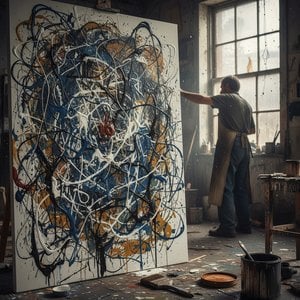
Paul Jackson Pollock: A Radical Departure – Exploring Abstract Expressionism's Pioneering Figure and His Enduring Legacy
Explore the revolutionary art of Jackson Pollock & Abstract Expressionism. Discover his iconic drip paintings, lasting impact, and considerations for collecting this pivotal American artist. Expert insights at ArtsDot.

Beyond Representation: Exploring the Emotional Landscape of Abstract Expressionism
Explore the profound emotional world of Abstract Expressionism with ArtsDot. Discover key artists like Pollock & Rothko, learn about collecting, and find museum-quality reproductions to inspire your space.

Beyond Representation: Emotional Depth & Formal Innovation in Abstract Expressionism
Explore the profound emotional depth & formal innovation of Abstract Expressionism. Discover key artists, collecting insights, and investment potential with expert guidance. Learn more now.

Топ 10 шедьовъра на абстрактния експресионизъм – изкуство за вашия дом от ArtsDot.com
Разгледайте топ 10 шедьовъра на абстрактния експресионизъм – Полък, Ротко, де Кунинг и други. Открийте историите зад тези емблематични картини и преобразете дома си с изкуство от ArtsDot.com! Разгледайте пълната колекция онлайн.

John Jackson: A Comprehensive Exploration of Technique, Context, and the Evolution of a Modern Visionary
Explore the life & work of John Jackson, a pivotal figure in Abstract Expressionism. Discover his innovative techniques, historical context, and lasting influence on modern art. A guide for discerning collectors.


