

 Купи принт
 Изпрати
 Сподели
 Details

 Изтегляне
 Подобни
 X-Ray
X-Ray Слайдшоу
Teagown


Ръчно изработена маслена репродукция
Ръчно рисувана маслена картина върху платно във вашия размер и рамка, изработена по поръчка от нашите художници.




P118B $10

P118H $10

P118W $10

P438Z $10

P508JH $12

P508YH $12

P805H $10

P805Z $10

P919BZ $10

P919G $10

P919XJ $10

P959ZH $10

P968JZ $12

W106C $8

W218G $10

W218JH $8

W218Y $10

W307PJ $10

W316G $10

W316PJ $8

W316Y $10

W398PJ $8

W4111J $10

W500HY $15

W500JH $15

W692G $12

W849H $8

W940BG $15

W953PJ $8




 Прочетете повече
Изберете от предварително зададените размери, които съответстват на оригиналните пропорции на произведението.

Можете да въведете свои собствени размери, за да пасне на конкретна рамка или пространство. Ако избраният от вас размер не съответства на пропорциите на оригиналното изображение, ние ще изрежем произведението или ще удължим картината с допълнителни ръчно рисувани елементи. Дигитален макет ще бъде изпратен за ваше одобрение преди започване на производството.
Моля, обърнете внимание, че прегледът на екрана не отразява действителното изрязване или разширяване. Само макетът ще покаже точно финалния състав.
Въпреки че са налични персонализирани размери, препоръчваме да изберете размер от предварително дефинирания списък, за да запазите оригиналните пропорции.
След поръчка, екипът на ArtsDot.com ще изпрати имейл на клиента за инструкции и ще предостави преглед на макет.
Доставка по целия свят () в рамките на 3/4 седмици вместо стандартните 5 седмици. (1 Юли). Без компромис с качеството.

Безплатна експресна доставка по целия свят

Висококачествено ленено платно

Пълно застраховане при доставка

Гаранция за възстановяване на митнически такси

Гаранция за цветова точност

60-Дневен период за връщане (Само при дефекти)

100% Гаранция за връщане на парите

Предложение за отстъпка при поръчка на едро
 Стъклото е налично само в размери под 110 см

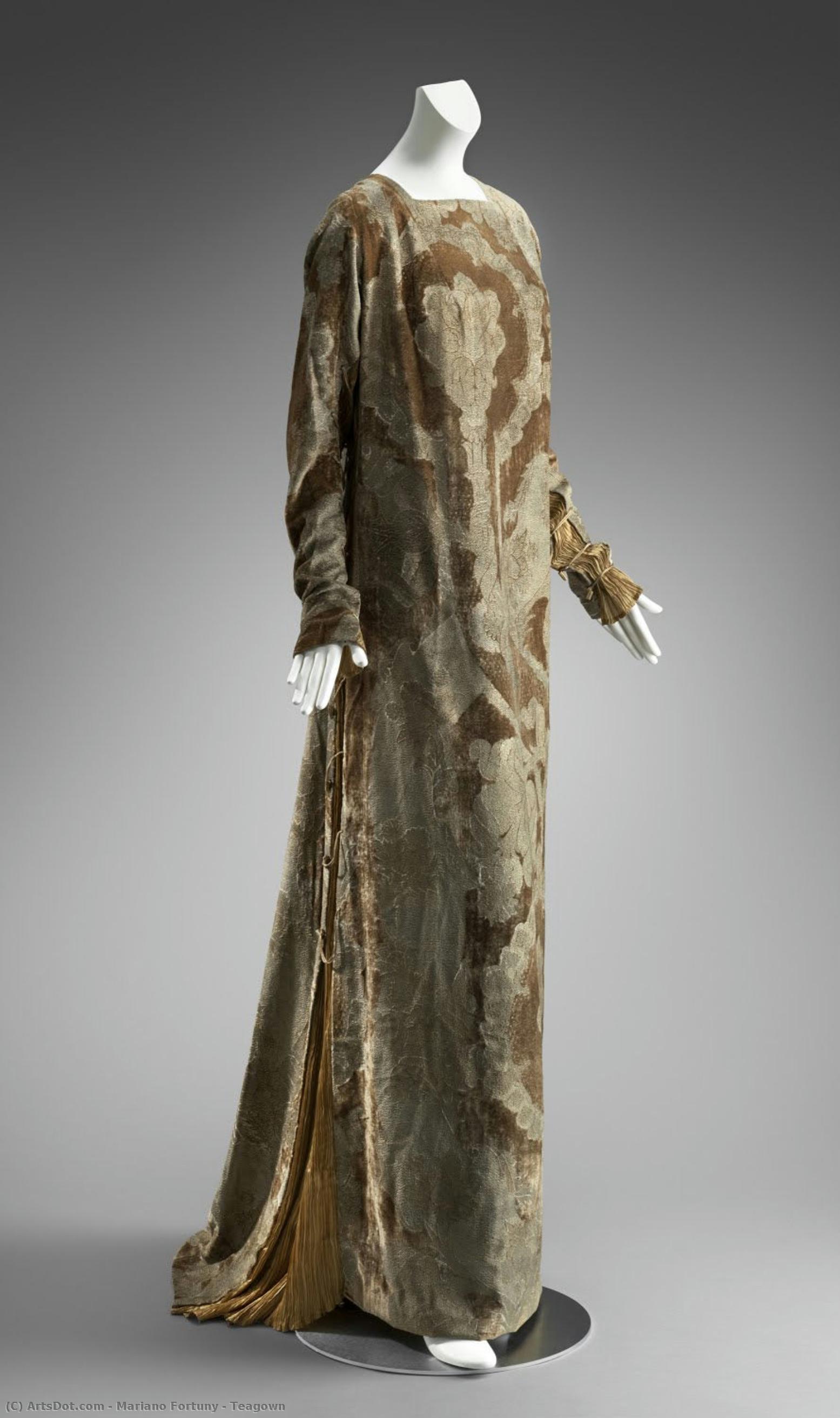
Teagown
Репродукционен метод
Размер на репродукцията
-


Обща цена
-
Описание на произведението
Teagown: A Venetian Echo of Grecian Elegance
Mariano Fortuny’s “Teagown,” completed in 1920, transcends mere textile art; it embodies the spirit of a bygone era—specifically, the opulent Belle Époque and its fascination with classical antiquity. This stunning silk velvet dress isn't simply draped fabric; it’s a meticulously crafted homage to the chiton, the simple tunic worn by Greek maidens revered for their purity and beauty.
- Subject Matter: The central focus is undeniably the dress itself—a full-length garment designed to convey grace and sophistication. However, its visual impact extends beyond its form, drawing inspiration from sculptural representations of ancient Greece.
- Style & Technique: Fortuny’s masterful technique exemplifies Venetian textile artistry at its finest. Stenciled gold detailing mimics the shimmering surface of Delphic bronze sculptures, creating a textural interplay that captivates the eye. The undulating stems and large leaves—characteristic of Ventian velvets—are deliberately chosen to evoke the organic forms found in Greek landscapes.
- Historical Context: Created during a period marked by artistic revival and intellectual curiosity, “Teagown” reflects the broader movement towards rediscovering classical ideals. Fortuny’s contemporaries were captivated by the elegance of ancient Greece, influencing fashion trends and decorative arts alike. The dress's design deliberately references this cultural fascination.
- Symbolism: The chiton itself carries profound symbolic significance—representing innocence, virtue, and idealized femininity. By adopting this motif, Fortuny elevates the dress beyond a mere garment into an emblem of timeless beauty and refinement. The gold accents further symbolize wealth and prestige, mirroring the lavish tastes of the aristocracy during the 1920s.
- Emotional Impact: Viewing “Teagown” evokes feelings of serenity, luxury, and nostalgia for a romanticized past. Its muted color palette—primarily browns and golds—contributes to an atmosphere of quiet elegance, inviting contemplation and admiration for artistic craftsmanship. The dress’s flowing silhouette embodies grace and movement, mirroring the fluidity of classical sculpture and conveying a sense of effortless beauty.
The meticulous pleating method employed by Fortuny—and subsequently adopted by Henriette Nigrin—was revolutionary in its time, achieving an unprecedented level of drape and comfort. This innovation underscores Fortuny’s commitment to pushing artistic boundaries while honoring the legacy of classical art.
Ultimately, “Teagown” stands as a testament to Mariano Fortuny's genius—a captivating fusion of Venetian textile tradition and Grecian inspiration that continues to inspire collectors and designers today. Its enduring appeal lies in its ability to transport viewers back to an era defined by artistic splendor and intellectual refinement.
Подобни произведения


Биография на художника
Early Life and Inspiration
Mariano Fortuny, a name synonymous with theatrical innovation and opulent textiles, was born in Granada, Spain, on May 11, 1871. His early life was marked by profound loss – his father, Mariano Fortuny y Marsal, a respected genre painter, tragically died when the young boy was just three years old. This event profoundly shaped his family’s trajectory, leading them to relocate to Paris, France, where his mother, Cecilia de Madrazo, sought solace and opportunity for her son. It was in this vibrant Parisian environment that Mariano's artistic talents began to blossom, nurtured by exposure to diverse fabrics and materials – a crucial element that would later deeply influence his creative vision. From a young age, he demonstrated remarkable skill across various mediums: painting, photography, sculpting, architecture, etching, and even theatrical stage lighting design. His family’s own collection of textiles, amassed through travels and trade, served as an invaluable source of inspiration, fueling his fascination with color, texture, and the transformative power of fabric. The legacy of his father, a genre painter known for capturing everyday life, also played a significant role in shaping Mariano's artistic sensibilities.Artistic Talents and Revolutionary Inventions
Mariano Fortuny quickly established himself as a multifaceted artist, showcasing an extraordinary range of skills that defied conventional categorization. He wasn’t simply a painter; he was a visionary inventor, a meticulous designer, and a master of illusion. His early years in Paris were dedicated to honing his artistic abilities, but it was during this period that he began experimenting with innovative techniques aimed at revolutionizing the world of theatrical design. Fortuny's most celebrated achievement is undoubtedly the *fortuny cyclorama dome*, a groundbreaking invention that fundamentally altered stage lighting and set design. This ingenious structure, constructed from plaster or cloth, utilized indirect lighting to create seamless transitions between scenes, eliminating harsh shadows and fostering a sense of depth and realism previously unattainable on stage. His treatise, “Eclairage Scenique” (1904), meticulously documented his discoveries regarding the manipulation of reflected light – how changing the surface it bounced off could alter its color, intensity, and overall effect. Fortuny’s inventive spirit didn't stop there; he patented over twenty inventions between 1901 and 1934, demonstrating a relentless pursuit of innovation across various fields, including stage machinery, lighting systems, and even specialized paints and dyes.Collaborations and Recognition
Fortuny’s work gained widespread recognition in the 1920s, largely thanks to his collaborations with prominent figures who recognized his unique vision. He forged a particularly close relationship with Richard Wagner, the German composer, whose operas deeply inspired him. Fortuny meticulously recreated scenes from Wagner's grand operas for the famous opera house, La Scala of Milan, adapting his dome system to accommodate the theater’s vast scale and even inventing a sophisticated suction fan mechanism to maintain the dome’s taut structure – a testament to his engineering prowess. His work was also celebrated by Marcel Proust, the renowned French novelist, who found in Fortuny's creations an embodiment of the elusive beauty and atmosphere of Venice. The Countesse de Bearn commissioned him for lavish sets for her private theatre, further solidifying his reputation as a leading designer. Fortuny’s influence extended beyond the stage; he was also involved in designing costumes for opera singers like Eleonora Duse and Isadora Duncan, showcasing his versatility and artistic sensibility.Legacy and Venetian Influence
Mariano Fortuny passed away on May 3, 1949, in Venice, Italy, leaving behind a legacy that continues to resonate today. His work profoundly influenced French novelist Marcel Proust, who described Fortuny’s creations as capturing the essence of Venice itself. His life and artistic endeavors were depicted in Pere Gimferrer's novel "Fortuny," offering a literary exploration of his complex personality and creative process. Fortuny’s innovations in theatrical lighting revolutionized the stagecraft industry, while his textiles – particularly the iconic “Knossos” design – became highly sought after by fashion designers and collectors alike. His studio in Venice, Palazzo Pesaro degli Orfei, remains a testament to his artistic vision, now housing the Museo Mariano Fortuny y Madrazo, where visitors can explore his extraordinary creations and delve deeper into his remarkable life. Fortuny’s enduring influence is evident not only in the world of art and design but also in the continued fascination with Venice as a source of inspiration – a city that he so profoundly captured through his unique artistic lens.
Мариано Фортуни
1871 - 1949 , Испания
Бързи факти
- Artistic Movement Or Style: Ориентализъм
- Artists Or Movements Influenced By This Artist: ['Марсел Пруст']
- Artists Who Influenced This Artist: ['Ричард Вагнер']
- Date Of Birth: 11 май 1871
- Date Of Death: 3 май 1949
- Full Name: Mariano Fortuny y Marsal
- Nationality: Испанец
- Notable Artworks:
- Теагвон
- Портрет на Енерите Фортуни
- Place Of Birth: Гранада, Испания
Всички статии

Mariano Fortuny: A Fusion of Art, Fashion & Design – Exploring a Venetian Innovator's Legacy
Explore the captivating world of Mariano Fortuny – artist, designer & innovator. Discover his revolutionary textiles, iconic Delphos gown, and lasting influence on art, fashion & interiors. A collector's guide to a Venetian master.


Azure Visions: Exploring Representations of the Blue Dress in Western Art History
Explore the rich history of the blue dress in Western art! Discover its symbolism, from Renaissance masterpieces to modern interpretations by artists like Martin & Schiele. Uncover cultural meanings and artistic techniques.
Geometric Design in Art: A Historical Survey & Contemporary Appeal for Collectors
Explore the enduring legacy of geometric abstraction! Discover key artists, historical movements & investment insights for discerning art collectors. Expert guidance from ArtsDot.

Crimson Threads of Narrative: Exploring Symbolism & Representation in Artworks Featuring the Red Dress
Explore the rich symbolism of the red dress in art history! From ancient power displays to iconic portraits like Cézanne’s 'Madame Cezanne', discover the cultural and artistic significance behind this captivating color. Expert analysis & insights.

Как Муралите Могат да Закотвят Интериорен Дизайн: Ръководство за Хотелски Дизайнери
Ръководство за хотелски дизайнери: как да използвате мурали за създаване на уникален интериор и силен бранд. Съвети, тенденции и експертни насоки от .


