

 Преглед в реален мащаб
 Изпрати
 Сподели
 Детайли
 Ръководство

 Изтегляне
 Подобни артикули
 Рентгенова снимка
 Слайдшоу
 Q&A
Q&A Статистика
Mending nets

- 164.0 x 133.0 cm


 Прочети повече
Жикле / Художествен принт
Giclée печат или принт върху платно с музейно качество, бързо производство и гъвкави опции за завършен вид. ( Купете ръчно рисувана картина Превключване към дигитално изображение)




P118B €10

P118H €10

P118W €10

P438Z €10

P508JH €12

P508YH €12

P805H €10

P805Z €10

P919BZ €10

P919G €10

P919XJ €10

P959ZH €10

P968JZ €12

W106C €8

W218G €10

W218JH €8

W218Y €10

W307PJ €10

W316G €10

W316PJ €8

W316Y €10

W398PJ €8

W4111J €10

W500HY €15

W500JH €15

W692G €12

W849H €8

W940BG €15

W953PJ €8




Изберете от нашите предварително зададени размери, които съответстват на оригиналните пропорции на произведението.

Въведете необходимата ширина и височина, за да паснат на вашата рамка или стена. Принтовете могат само да се изрязват, но никога не могат да бъдат по-големи от оригиналната картина, така че при размер с различен формат част от изображението ще бъде загубена. Преди да започнем печат, ще ви изпратим дигитален мок업 за одобрение. Изображението, показано на тази страница, не показва реалното изрязване — само мок업ът го показва.
Доставка по целия свят () в рамките на 2 седмици вместо стандартните 4/5 седмици. (3 Ноември)

Безплатна експресна доставка по целия свят

Висококачествено ленено платно

Пълно застраховане на доставката

Гаранция за възстановяване на митнически такси

Гаранция за пълно съответствие на цветовете

Политика за връщане в рамките на 100 дни (само при дефекти)

100% Гаранция за връщане на сумата

Оферта за отстъпка при поръчка на повече бройки
 Опцията със стъкло е налична само за размери под 110 см

Mending nets
Жикле / Художествен принт
Размер на репродукцията
-


Обща цена
€ 55
Introduction to Mending Nets by Joaquín Sorolla Y Bastida
Joaquín Sorolla y Bastida’s “Mending Nets,” painted in 1901, is more than just a depiction of domestic labor; it's an exquisite distillation of the Spanish light and life that defined his artistic vision. This oil on canvas masterpiece, measuring 164 x 133 cm and currently residing within the Museo Nacional de San Carlos in Mexico City, offers a poignant glimpse into the rhythms of everyday existence – a theme central to Sorolla’s celebrated oeuvre. The painting captures four women engaged in the seemingly simple act of repairing fishing nets, transforming an ordinary scene into a study of collaboration, warmth, and the enduring spirit of community.
A Masterclass in Light and Color
Sorolla's genius lies primarily in his masterful manipulation of light. He was renowned for his ability to capture the intense, almost palpable quality of sunlight, particularly during the Spanish summers. In “Mending Nets,” this is immediately evident in the way the warm tones – ochres, yellows, and subtle pinks – bathe the figures and the surrounding space. The light doesn’t simply illuminate; it seems to emanate from within the scene itself, creating a sense of palpable warmth and inviting the viewer into the intimate atmosphere of the room. His brushwork is loose and expressive, contributing to the painting's vibrant energy and conveying a feeling of movement and spontaneity.
Symbolism and Social Commentary
Beyond its technical brilliance, “Mending Nets” carries subtle symbolic weight. The act of mending nets represents not just practical work but also resilience, community, and the cyclical nature of life. The women’s cooperative efforts speak to a strong sense of social connection – a value deeply rooted in Spanish culture. Sorolla was keenly observant of his subjects, and this painting offers a rare glimpse into the lives of ordinary people, elevating them to the status of artistic heroes. The inclusion of everyday objects—the bowl, chairs, spoon—adds to the realism and reinforces the sense that we are witnessing an authentic moment frozen in time.
Historical Context and Artistic Significance
"Mending Nets" was created during a period of significant artistic innovation in Spain. Sorolla’s work aligns with the *luminismo*, a style characterized by its emphasis on light, color, and atmospheric effects, influenced by Impressionism but firmly rooted in Spanish traditions. The painting reflects the burgeoning interest in depicting everyday life – a departure from the grand historical or mythological subjects that had dominated much of European art. Sorolla’s focus on the lives of ordinary people was revolutionary for his time, and “Mending Nets” stands as a testament to this bold artistic vision. It's important to note that Sorolla’s career was tragically cut short by a boating accident in 1923, leaving behind a legacy of luminous paintings that continue to captivate audiences worldwide.
Collecting and Displaying This Masterpiece
A hand-painted reproduction of “Mending Nets” offers an exceptional opportunity to bring the brilliance of Joaquín Sorolla into your home or office. Whether adorning a study, living room, or gallery space, this artwork will undoubtedly become a focal point, sparking conversation and admiration. Consider its scale – 164 x 133 cm – when planning your display; it’s ideally suited for larger rooms where its vibrant colors can truly shine. The painting's depiction of warmth and collaboration makes it a particularly fitting addition to spaces designed for relaxation and social interaction.
Въпроси и отговори
Колко хармонични са цветовете на „Mending nets“ на Жоан Сорола?
Цветовете на „Mending nets“ на Жоан Сорола излъчват Softly Mixed Palette хармония. Хармонията описва начина, по който цветовете се съотнасят един спрямо друг.
Какво изобразява „Mending nets“ на Жоан Сорола?
„Mending nets“ на Жоан Сорола изобразява: net mending, spanish women, domestic scene, sorolla style, warm light, collaboration, mexican art.
С какви други имена е известен/а Жоан Сорола?
Жоан Сорола е известен/а още под името Joaquín Sorolla y Bastida.
Подобни произведения


Биография на художника
A Life Bathed in Light: The World of Joaquín Sorolla
Joaquín Sorolla y Bastida, a name synonymous with the radiant light and vibrant energy of Spain, was more than just a painter; he was a chronicler of his nation’s soul. Born in Valencia in 1863, Sorolla's early life was marked by tragedy. Orphaned at the tender age of two following a cholera epidemic that claimed both parents, young Joaquín and his sister were raised by their maternal aunt and uncle. This early experience with loss perhaps instilled within him a profound appreciation for the fleeting beauty of life – a sentiment that would permeate his art. Though hardship shadowed his beginnings, it did not dim the spark of artistic talent that quickly became apparent. He received initial instruction in Valencia, demonstrating an aptitude that led to studies under established artists like Cayetano Capuz and José Benlliure, eventually culminating in a four-year grant to study in Rome. It was there, amidst the classical grandeur of Italy, that Sorolla began to forge his unique artistic path, absorbing influences while simultaneously developing a style distinctly his own.From Historical Narratives to Sun-Drenched Realism
Sorolla’s early work reflected the prevailing academic trends of the time – large-scale historical and mythological scenes. He was initially drawn to grand narratives, producing works like *The Return from Fishing* (1893), a technically impressive depiction of fishermen hauling their boat ashore. However, a pivotal shift occurred as he returned to Spain and began to truly observe the world around him. He found himself captivated by the everyday lives of his countrymen, particularly those along the Valencian coast. The intense Mediterranean sunlight, the shimmering sea, and the vibrant energy of the people became his primary subjects. This transition wasn’t immediate; Sorolla continued to explore social realism with works like *Sad Inheritance* (1899), a powerful depiction of children afflicted by polio bathing in the sea – a painting that garnered significant acclaim but also revealed a darker, more compassionate side to his artistic vision. *Sad Inheritance*, exhibited at the Universal Exhibition in Paris, brought him widespread recognition and cemented his position as a leading figure in Spanish art. Yet, it was his increasingly focused exploration of light and color, inspired by Impressionism though never fully embracing its tenets, that would define his legacy. He wasn’t merely *depicting* light; he was attempting to *capture* its very essence, the way it danced on water, illuminated skin, and transformed ordinary moments into scenes of extraordinary beauty.Master of Luminism: A Unique Artistic Voice
Sorolla's technique became instantly recognizable – a bravura display of brushwork, characterized by loose, energetic strokes that conveyed movement and atmosphere. He worked *en plein air* whenever possible, directly confronting the challenges of capturing fleeting light conditions. This dedication to painting outdoors resulted in canvases brimming with life and immediacy. His beach scenes, perhaps his most iconic works, are not simply picturesque representations of leisure; they are studies in luminosity, reflections, and the joyful interaction between people and their environment. Paintings like *Children on the Seashore* and *Sewing the Sail* exemplify this mastery – figures bathed in golden light, rendered with a remarkable sense of spontaneity and vitality. He wasn’t interested in meticulous detail; rather, he sought to convey the *impression* of reality, prioritizing atmosphere and emotion over precise representation. This approach earned him comparisons to Impressionists like Monet and Renoir, but Sorolla's work possessed a unique Spanish character – a warmth, intensity, and emotional depth that set it apart.The Influence of Spain and Personal Life
Sorolla’s connection to Valencia was profound, both artistically and personally. He returned to his hometown annually, finding inspiration in the light, the atmosphere, and the people. This deep-seated love for his homeland is evident throughout his oeuvre – from the vibrant colors of the coastal scenes to the portrayal of everyday Valencian life. His marriage to Clotilde García del Castillo in 1890 was a significant influence on his work, providing him with a loving partner and muse. Their family life, filled with joy and companionship, is reflected in many of his portraits, particularly those depicting his children. The warmth and intimacy he captured in these familial scenes are rare among artists of his time. Sorolla’s personal tragedies – the loss of his parents at such a young age and later, the debilitating stroke that curtailed his artistic career – undoubtedly shaped his perspective and informed the emotional depth of his work.Legacy and Enduring Influence
By the early 20th century, Joaquín Sorolla was internationally renowned. He exhibited extensively throughout Europe and the United States, receiving numerous accolades and commissions. His most ambitious undertaking, *Vision of Spain* (1912-1928), a series of fourteen monumental murals commissioned by the Hispanic Society of America, remains a testament to his artistic vision and technical skill. Though he suffered a stroke in 1920 that curtailed his painting activity, Sorolla’s influence continued to grow after his death in 1923. His work inspired generations of artists, not only in Spain but around the world. Today, his paintings are held in major museums worldwide, including the Museo Sorolla in Madrid – a former home transformed into a dedicated space for showcasing his art. Sorolla’s legacy extends beyond his technical brilliance; he captured a specific moment in Spanish history and culture, immortalizing the beauty of its landscapes and the spirit of its people. He remains a master of light, color, and emotion—a painter whose work continues to resonate with audiences today, reminding us of the power of art to illuminate our world.Key Achievements & Recognition
- 1892: Gold medal at the National Exhibition in Madrid for *Another Marguerite*.
- 1894: Acclaimed for *The Return from Fishing*, acquired by the Musée du Luxembourg.
- 1899: Grand Prix and medal of honor at the Universal Exhibition in Paris for *Sad Inheritance*.
- 1900-1923: Extensive exhibitions throughout Europe and the United States, establishing international recognition.
- 1912-1928: Commissioned to create *Vision of Spain* for the Hispanic Society of America (completed posthumously).
- Present Day: Works held in major museums worldwide, including the Museo Sorolla in Madrid.

Жоан Сорола
1863 - 1923 , Испания
Бърза информация
- Artistic Movement Or Style: Луменеризъм, Импресионизъм
- Artists Or Movements Influenced By This Artist: ['Импресионизъм']
- Artists Who Influenced This Artist:
- Франсиско Прадилла
- Жуле Бастиен-Лепаж
- Date Of Birth: 27 февруари 1863
- Date Of Death: 10 август 1923
- Full Name: Joaquín Sorolla y Bastida
- Nationality: Испанец
- Notable Artworks:
- Друга Маргарита
- Време за баняне
- Бял трафик
- Place Of Birth: Валенсия, Испания
Свързани статии

Rafael de Penagos: A Study in Spanish Portraiture & Artistic Identity
Explore the life & art of Rafael de Penagos, a leading Spanish Art Deco illustrator. Discover his iconic 'Penagos Woman', commercial work, and lasting legacy. Learn about this pivotal figure in 20th-century Spanish art history.

Manuel Benedito Vives: A Study of Light, Color & Emotional Resonance in Contemporary Spanish Painting
Explore the captivating world of Manuel Benedito Vives, a celebrated Spanish painter influenced by Sorolla. Discover his masterful portraits, luminous landscapes & enduring legacy – a favorite of the Spanish Royal Family. Art collectors will appreciate this in-depth study.

The Golden Age Reforged: Dramatic Realism & Religious Zeal in Spanish Baroque Art
Explore the dramatic world of Spanish Baroque art! Discover masters like Zurbarán & the powerful influence of religious zeal on painting techniques – a guide for collectors and enthusiasts.
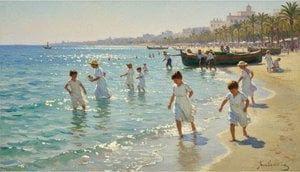
Joaquín Sorolla: Capturing Spanish Light & Life – A Legacy of Impressionism
Explore the luminous world of Joaquín Sorolla, Spanish master of Impressionism. Discover his life, techniques & legacy – a guide for art collectors and enthusiasts. Invest in timeless beauty.

Топ 10 шедьовъра в пясъчни тонове: Изкуство за вашия дом от ArtsDot.com
Открийте топ 10 шедьовъра в пясъчни тонове – от Ван Гог до Моне! Разгледайте историите зад известните картини, техники и цветове. Репродукции на картини с музейно качество за вашия дом от ArtsDot.com. Explore the full collection online!


