


 Сподели
 Сподели
 Подробности
 Ръководство

 Изтегляне
 Подобни артикули
 Слайдшоу
 Статистика
Interor view


 Разгърни целия текст
Жикле / Художествен принт
Giclée печат или принт върху платно с музейно качество, бързо производство и гъвкави опции за завършен вид. ( Поръчайте ръчно рисувано репродукция на този колекционерски предмет Превключване към дигитално изображение)




































Изберете от нашите предварително зададени размери, които съответстват на оригиналните пропорции на произведението.

Въведете необходимата ширина и височина, за да паснат на вашата рамка или стена. Принтовете могат само да се изрязват, но никога не могат да бъдат по-големи от оригиналната картина, така че при размер с различен формат част от изображението ще бъде загубена. Преди да започнем печат, ще ви изпратим дигитален мок업 за одобрение. Изображението, показано на тази страница, не показва реалното изрязване — само мок업ът го показва.
Доставка по целия свят () в рамките на 2 седмици вместо стандартните 4/5 седмици. (22 Октомври)

Безплатна експресна доставка по целия свят

Висококачествено ленено платно

Пълно застраховане на доставката

Гаранция за възстановяване на митнически такси

Гаранция за пълно съответствие на цветовете

Политика за връщане в рамките на 100 дни (само при дефекти)

100% Гаранция за връщане на сумата

Отстъпка при поръчка на повече произведения
 Опцията със стъкло е налична само за размери под 110 см

Interor view
Жикле / Художествен принт
Размер на репродукцията
-


Крайна цена
€ 54
The Painting's Composition
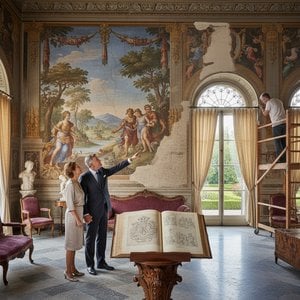
The Interor view painting depicts a grand room with high ceilings adorned with frescoes. The walls are lined with framed paintings, each featuring different subjects, possibly historical events or religious scenes. The floor is made of large, dark tiles that contrast with the lighter colors of the walls and ceiling. The overall atmosphere is one of quiet elegance and historical significance.Giorgio Vasari's Artistic Style
Giorgio Vasari was a renowned Italian artist and historian who lived during the 16th century. His artistic style is characterized by classical influences and attention to detail. In the Interor view painting, Vasari's use of frescoes and classical figures creates a sense of depth and grandeur. You can find more information about Giorgio Vasari and his works on our website: /art/list/?Filter=8Y2UWJ-Giorgio-Vasari-Interor-view.Other Notable Works by Giorgio Vasari
Some of Giorgio Vasari's other notable works include the Sala del Cinquecento in the PALAZZO VECCHIO museum in Florence, Italy. You can learn more about this painting on our website: /art/list/?Filter=8Y2UX3-Giorgio-Vasari-Sala-del-Cinquecento.- Childhood of Jupiter is another notable work by Giorgio Vasari, which can be found on our website: /art/list/?Filter=D4FCJF-Giorgio-Vasari-Childhood-of-Jupiter.
- The Casa Vasari museum is also home to many other artworks, including paintings by Alessandro Allori and Perin del Vaga.
You can also find more information about the Casa Vasari museum on Wikipedia: https://en.wikipedia.org/wiki/Casa_Vasari.
Въпроси и отговори
От коя историческа епоха е „Interor view“ на Жоржo Вазари?
„Interor view“ на Жоржo Вазари датира от периода на Renaissance. Този период предоставя исторически контекст за произведението.
На колко години е бил Жоржo Вазари, когато е създал „Interor view“ през 1542?
Жоржo Вазари създава „Interor view“ на възраст 31. Художникът е роден през 1511, а датировката на произведението е 1542.
Мога ли да гледам "Interor view" като слайдшоу на цял екран?
Налична е галерия със снимки: страницата Слайдшоу на „Interor view“ на Жоржo Вазари.
Свързани произведения


Биография на художника
A Life Woven into the Renaissance Fabric
Giorgio Vasari, born in Arezzo, Tuscany, on July 30, 1511, was more than simply a painter; he was a quintessential embodiment of the Italian Renaissance spirit. His life unfolded as a vibrant tapestry woven with threads of artistic creation, architectural innovation, insightful historical writing, and an unwavering dedication to celebrating the masters who came before him. From his earliest training under Guglielmo da Marsiglia, a skilled artisan in stained glass, young Giorgio’s path was steered towards visual artistry. However, it was his move to Florence at sixteen that truly ignited his potential. Immersing himself within the dynamic circle of Andrea del Sarto and absorbing the influences of Rosso Fiorentino and Jacopo Pontormo, Vasari began a journey that would see him become one of the most influential figures of his era. His formative years were also deeply marked by the patronage and friendship of the powerful Medici family, a relationship that would shape both his career and his perspective on art’s role in society.The Artist's Hand and Eye
Vasari’s artistic style is often categorized as Mannerist, reflecting the prevailing aesthetic trends of the mid-16th century. His paintings are characterized by elongated figures, dynamic compositions, and a sophisticated use of color—qualities highly admired during his lifetime. While perhaps not achieving the same level of enduring fame as some of the artists he chronicled, Vasari’s skill was undeniable. Notable works such as *The Studio of the Painter*, a fresco housed in Casa Vasari in Arezzo, offer a fascinating glimpse into the artistic practices of the time. The sheer scale and ambition of his frescoes for the Palazzo Vecchio in Florence, undertaken between 1555 and 1572, demonstrate his mastery of large-scale decorative schemes. His final monumental undertaking, *The Last Judgement*, adorning the cupola of Florence Cathedral—completed after his death by Federico Zuccari—stands as a testament to his unwavering commitment to grand artistic visions. Beyond painting, Vasari’s architectural contributions were equally significant. He designed the elegant loggia of the Palazzo degli Uffizi, transforming it into a public piazza and creating a vital link within Florence's urban landscape. Perhaps most famously, he conceived and oversaw the construction of the Vasari Corridor, a secret passageway connecting the Uffizi Gallery with the Palazzo Pitti—a feat of engineering and architectural ingenuity that continues to captivate visitors today.A Historian Forging a Legacy
However, it is arguably as an art historian that Giorgio Vasari secured his most lasting legacy. His monumental work, *Lives of the Most Excellent Painters, Sculptors, and Architects*, published in 1550 (with a revised edition in 1568), revolutionized the way art was understood and appreciated. This groundbreaking text wasn’t merely a collection of biographies; it established a narrative framework for the development of Italian Renaissance art, tracing its evolution from the early masters like Cimabue and Giotto to his contemporaries Michelangelo and Raphael. Vasari's work introduced the very concept of the “Renaissance” – a rebirth of classical ideals—and laid the foundation for modern art history as a discipline. While acknowledging that Vasari’s accounts are not without their biases and inaccuracies, particularly concerning artists predating his own time, the impact of *Lives* remains profound. It provided a crucial historical context for artistic creation, elevating the status of artists from skilled craftsmen to intellectual figures worthy of scholarly attention.Influences and Enduring Significance
Vasari’s artistic development was profoundly shaped by his exposure to the works of Renaissance masters. His visit to Rome in 1529, where he studied the art of Raphael and other High Renaissance artists, proved pivotal. He absorbed their principles of composition, anatomical accuracy, and idealized beauty, incorporating them into his own style. Michelangelo, whom Vasari greatly admired, exerted a particularly strong influence on both his painting and architecture. The grandeur and dynamism characteristic of Michelangelo’s work are evident in many of Vasari’s projects. Beyond specific artists, the broader intellectual currents of the Renaissance—humanism, classical learning, and a renewed interest in empirical observation—also informed Vasari's approach to art and history. Giorgio Vasari died on June 27, 1574, in Florence, leaving behind a multifaceted legacy that continues to resonate today. He was not only a talented artist and architect but also a pioneering historian whose writings shaped our understanding of one of the most transformative periods in Western art history. His work remains essential for anyone seeking to explore the rich cultural heritage of the Italian Renaissance.Major Achievements
- The Studio of the Painter (1563): A groundbreaking fresco cycle within his own home, offering a detailed depiction of an artist’s workshop and serving as a visual treatise on artistic practice.
- Frescoes in Palazzo Vecchio (1555-1572): Monumental decorative schemes illustrating Florentine history and civic pride, showcasing Vasari's mastery of large-scale fresco painting.
- Design of the Uffizi Gallery (1560): A transformative redesign of a former arsenal into a public space, integrating art and architecture to create a vibrant center for Florence.
- The Vasari Corridor (1564-1573): An ingenious architectural solution connecting the Uffizi Gallery with the Palazzo Pitti, providing a secure passage for the Medici family.
- Lives of the Most Excellent Painters, Sculptors, and Architects (1550, 1568): A seminal work of art history that established a framework for understanding the development of Renaissance art and cemented Vasari’s legacy as a cultural historian.
Notable Works
Paintings:- The Studio of the Painter (Casa Vasari, Arezzo)
- Allegories
- Portraits (including portraits of members of the Medici family)
- Loggia of Palazzo Vecchio, Florence
- Uffizi Gallery, Florence
- Vasari Corridor, Florence
- Church of Santa Croce, Florence (restoration and decoration)
- Palazzo Pitti, Florence (design elements)
- Lives of the Most Excellent Painters, Sculptors, and Architects (1550, 1568)

Жоржo Вазари
1511 - 1574 , Италия
Бързи факти
- Artistic Movement Or Style: Ренесансова школа
- Artists Or Movements Influenced By This Artist: ['Ренесанс']
- Artists Who Influenced This Artist:
- Андреа дел Сарто
- Микеланджело
- Date Of Birth: 30 юли 1511
- Date Of Death: 27 юни 1574
- Full Name: Giorgio Vasari
- Nationality: Италианец
- Notable Artworks:
- Студио на художника
- Последното съдилище
- Place Of Birth: Арецо, Италия
Свързани статии

The Enduring Legacy of Fresco: Technique, History & Artistic Expression Across Cultures
Explore the rich history & enduring legacy of fresco painting! Discover ancient techniques, Giotto's masterpieces, and modern applications. Expert insights for art lovers & professionals.

Трансформация на интериора: Муралните изкуства като нов акцент в кухнята и банята
Открийте как муралните изкуства трансформират кухнята и банята ви! Експертни съвети за стил, материали и издръжливост. Вдъхновете се от най-новите тенденции в дизайна и създайте уникален интериор с висококачествени стенописи.

The Enduring Legacy of Fresco: Technique, History & Artistic Expression
Explore the rich history & enduring artistry of fresco painting. Discover techniques from Giotto to Michelangelo, conservation efforts, & modern applications. Learn how ArtsDot brings this timeless art form to your home.
Фреската като Семейно Наследство: Пресъздайте Своята История по Стените
Създайте уникална семейна фреска с ! Експертни художници, висококачествени материали и персонализиран дизайн. Запазете спомените си за поколения наред!

Възраждането на фреската: Защо стенните мурали са новият луксозен акцент в интериорния дизайн
Открийте изкуството на стенните мурали за луксозни хотели и интериори! Експертни консултации, висококачествени изпълнения и реставрация. Създайте уникална атмосфера с ArtsDot.


