

- 36.0 x 51.0 cm


Картината следва вашите избори: , .
Описание на колекционерския предмет
Gerhard Richter’s "S. with Child" (1995) is a poignant photographic study of a newborn, rendered in warm tones & subtle realism. Explore this intimate work by a renowned artist.
 Прочети повече
Биография на художника
Герхард Рихтер – немски художник, известен с абстрактни и фотореалистични картини, концепцията за "Капиталистична реалност" и цветните схеми. Влиятелен артист, изследващ съвременността чрез изкуството.
Ръчно изработена маслена репродукция
Ръчно рисувана маслена картина върху платно във вашия размер и рамка, изработена по поръчка от нашите художници. ( Превключване към принт Превключване към дигитално изображение)
Това произведение е защитено от авторско право
Изкуството, представено на тази страница, е защитено от законите за авторско право, което означава, че не можем законно да създаваме или продаваме идентични репродукции. Тази защита се прилага съгласно международни споразумения като Бернска конвенция и от националното законодателство, включително разпоредбите на Закон за авторското право на САЩ – Раздел 17.
Като уважителна и законна алтернатива, ние предлагаме изработени по поръчка, ръчно рисувани произведения на изкуството, вдъхновени от оригинала. Нашите умени и професионални артисти внимателно изучават стила, настроението и артистичната същност на оригиналното произведение, за да създадат ново, уникално творческо произведение, което предизвиква същото чувство – оставайки в същото време самостоятелно оригинално творение.
Този метод е напълно съвместим с законите за авторско право, тъй като не включва копиране или дублиране на защитеното произведение. Вместо това става въпрос за творческа реинтерпретация – нова картина, която е вдъхновена от оригинала, но не е идентична с него.
Още информация за тази картина
 Преглед в реален мащаб
 Изпрати
 Сподели
 Детайли
 Ръководство

 Изтегляне
 Подобни артикули
 Рентгенова снимка
 Слайдшоу
 Въпроси и отговори
 Статистика
Поръчайте вашата картина в четири лесни стъпки
Не бързайте. Можете да промените всеки от отговорите; цената в количката ви се актуализира според всеки избор.
1 Стъпка първа от четири
Какъв размер бихте искали?
Тези размери запазват пропорциите на оригиналната картина. Илюстрацията показва избрания от Вас размер върху стена, над двуметрова софа.
Или въведете свои собствени размери
Изберете от нашите предварително зададени размери, които съответстват на оригиналните пропорции на произведението.

Въведете необходимата ширина и височина, за да паснат на вашата рамка или стена. Тъй като това е ръчна работа, при избор на размер с различен формат художникът може да нарисува малко повече около картината или да отреже малко от периферията — вие избирате. Преди да започне рисуването, ще ви изпратим дигитален мок업 за одобрение. Картината, показана на тази страница, не е реалният резултат — само мок업ът го показва.
2 Стъпка две от четири
Как трябва да бъде подготвено: на руло, на платно или в рамка?
Цените по-долу са за избрания от Вас размер от първа стъпка.
Изберете страните на разпънатото платно
Изберете своята рамка

Бяло €1

Размити краища €1

Разширен €1

P118B €10

P118H €10

P118W €10

P438Z €10

P508JH €12

P508YH €12

P805H €10

P805Z €10

P919BZ €10

P919G €10

P919XJ €10

P959ZH €10

P968JZ €12

W106C €8

W218G €10

W218JH €8

W218Y €10

W307PJ €10

W316G €10

W316PJ €8

W316Y €10

W398PJ €8

W4111J €10

W500HY €15

W500JH €15

W692G €12

W849H €8

W940BG €15

W953PJ €8

H24-GOLD €30

H24-SILVER €30

H36-GOLD €45

H36-SILVER €45
С рамка
Рамка: . Общ размер с рамката: .
3 Стъпка три от четири
Желаете ли да промените нещо в картината?
Повечето хора отговарят с „не“. Тъй като всяка картина е изработена на ръка, нашият художник може също така да я адаптира специално за Вас.
След получаване на поръчката, екипът на ArtsDot.com ще изпрати имейл до клиента с инструкции и ще предостави примерен макет
4 Четвърта от четирите стъпки
Няколко варианта за завършен вид
Всички те са по избор. Вече избраните отговори не включват допълнителни разходи.
Кой го рисува?
Доставка по целия свят () в рамките на 3-4 седмици вместо стандартните 5 седмици. (4 Ноември). Без компромис с качеството.
Табелка, точно като в музея?
Детайли за гравираната бронзова плака
This elegant plaque features the artist's name and the title of the artwork, finely engraved for a timeless presentation.
It is made from bronze with a refined, elegant finish. The text is precisely laser-engraved for a sharp and permanent result. Measuring 9x2 cm, the plaque is compact yet easy to read. It's built to be durable and scratch-resistant, offering a professional, museum-quality look. Mounting is simple thanks to the included adhesive backing.
Детайли за прозрачната акрилна плака
The plaque includes essential engraved details such as the artist's name, the title of the artwork, the date it was created, the type of media used-like oil on canvas or watercolor-a brief description of the piece, and a QR code that links to the complete artwork information.
It is crafted from clear acrylic, offering a sleek, modern appearance. The text is UV-engraved in black to ensure strong visual contrast. With a size of 10x15 cm, it ensures optimal readability. It comes equipped with two metal hooks for secure wall mounting. The plaque is designed to be weather-resistant, making it suitable for various environments, and it includes interactive features that work seamlessly with smartphone scanning.
Детайли за черната акрилна плака
This elegant plaque includes engraved information such as the artist's name, the title of the artwork, the date it was created, the type of media used (like oil on canvas or watercolor), a short description of the artwork, and a QR code for quick access to more information.
The plaque itself is made from refined black acrylic with a premium finish. The text is laser-engraved in white for high contrast and readability. Its size is 10x15 cm, designed to be easy to read. It comes with two metal hooks for professional mounting. The design is sleek and fits any interior style. It is also weather-resistant and durable, with built-in digital integration for mobile compatibility.
Защитен лак?
Кога ви е необходимо?
✓ Проверете и поръчайте
Вашата картина, точно както я поръчахте

S. with Child
Вид репродукция
Размер на репродукцията
-

Елитен старши художник
Повече детайлност, изящество и допълнително време за производство
-

Рамка за репродукция
-
-
За произведения на изкуството или репродукции, чийто размер е над 105 см (приблизително 41 инча) във всяка страна, рамката ще бъде изпратена в разглобен вид като комплект за сглобяване. Този метод гарантира безопасна доставка и предотвратява повреди по време на транспортиране.
Изисква се професионално сглобяване – това не е продукт за самостоятелна изработка (DIY).
Комплектът трябва да бъде сглобен, а платното – опънато от опитен професионален багер, като се използва дървено лепило (не е включено в комплекта), клещи за опъване на платно и затягащи скоби, за да се поддържа правотата на подрамника, докато лепилото изсъхне. Неправилното сглобяване или неравномерното опъване на платното може трайно да повреди произведението и не е покрито от нашата гаранция.
 За произведения на изкуството или репродукции, чийто размер е над 105 см (приблизително 41 инча) във всяка страна, рамката ще бъде изпратена в разглобен вид като комплект за сглобяване. Този метод гарантира безопасна доставка и предотвратява повреди по време на транспортиране.
Всички елементи от масивна дървесина са включени, прецизно изрязани по размер.
Сглобява се с предоставените винтове, както и с лепило за дърво за ъгловите връзки, което не е включено в комплекта и трябва да бъде осигурено от вашия рамкар.
Изискват се професионални инструменти, които не са включени: щипка за опъване на платно (натягач) и скоби за фиксиране на подрамниците под прав ъгъл, докато лепилото изсъхне.
Важно:
За сглобяването на ъглите е необходимо лепило за дърво, рейките трябва да се фиксират с

Етикет с име
-
-

Защитен лак
Гланцов лак (подсилва цветовете и предпазва от светлина и влага)
-

Персонализирай моето произведение
Примери за възможности за персонализация: Заменете лицето със снимка на клиента; Добавете домашен любимец (например, заменете котка с куче); Включете скрито съобщение във фона; Променете пейзажа или елементите на фона.
-

Спешно
Доставка по целия свят () в рамките на 3-4 седмици вместо стандартните 5 седмици. (4 Ноември). Без компромис с качеството.
-
Експресна доставка
Доставка по целия свят () в рамките на 5 седмици. (11 Ноември).
Включена
Обща цена
€ 234
Опцията със стъкло е налична само за размери под 110 см
Включено във всяка поръчка
- Безплатна експресна доставка по целия свят
- Висококачествено ленено платно
- Пълно застраховане на доставката
- Гаранция за възстановяване на митнически такси
- Гаранция за пълно съответствие на цветовете
- Политика за връщане в рамките на 100 дни (само при дефекти)
- 100% Гаранция за връщане на сумата
- Оферта за отстъпка при поръчка на повече бройки


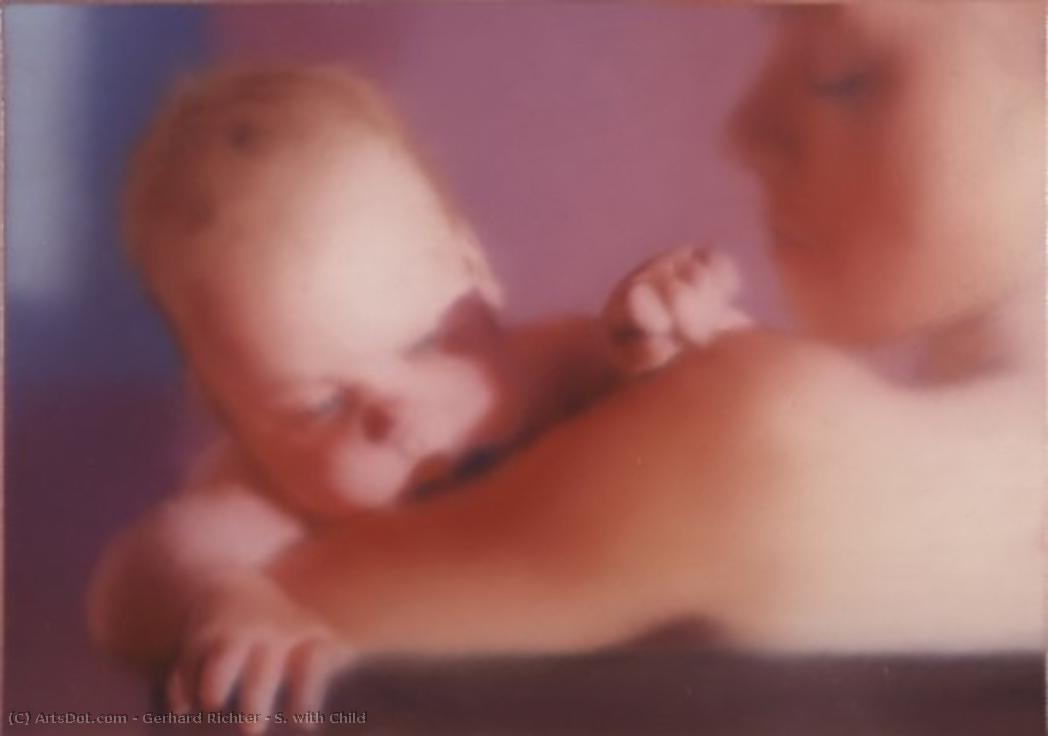
A Tender Moment: Exploring Gerhard Richter’s ‘S. with Child’
This intimate photograph by renowned German artist Gerhard Richter, created in 1995, offers a poignant glimpse into the universal themes of new life and maternal connection. Titled ‘S. with Child’, the work transcends simple portraiture, becoming an evocative meditation on vulnerability, innocence, and the enduring power of beginnings.Subject & Composition
The image centers on a newborn infant lying supine, its face gently illuminated. Richter’s masterful composition focuses intently on the baby's features and form, employing a shallow depth of field that softly blurs the background—drawing all attention to the subject. This deliberate choice creates an immediate sense of closeness and intimacy, as if we are sharing a private moment with mother and child. The framing is tight, emphasizing the smallness and fragility inherent in new life.Style & Technique
While seemingly straightforward in its realism, ‘S. with Child’ embodies Richter's complex artistic approach. Known for his explorations of photography’s relationship to reality, he often manipulates images to question their objectivity. Here, the photograph possesses a subtle, almost faded quality—a characteristic achieved through techniques like selenium toning—that lends it a nostalgic and dreamlike atmosphere. The warm color palette – dominated by pinks, reds, and oranges – further enhances this emotional resonance. Though photographic in nature, the image’s soft focus and tonal qualities imbue it with a painterly sensibility.Historical Context & Artistic Lineage
Richter emerged as a significant figure in post-war German art, grappling with themes of memory, history, and representation. His early work was influenced by artists like Picasso and Jean Arp, but he quickly developed his unique style, often blurring the lines between abstraction and figuration. ‘S. with Child’ represents a departure into more personal territory, yet still reflects Richter's broader interest in exploring the subjective nature of perception. The 1990s saw Richter increasingly engage with portraiture, utilizing found photographs as source material—a practice that continued to challenge conventional notions of authorship and originality.Symbolism & Emotional Impact
The symbolism within ‘S. with Child’ is both universal and deeply personal. The newborn represents potential, hope, and the cyclical nature of life. The soft lighting and warm tones evoke feelings of tenderness, protection, and unconditional love. The image doesn't simply depict a baby; it embodies the profound emotional weight associated with parenthood. It’s a quiet, contemplative work that invites viewers to reflect on their own experiences of family, connection, and the fleeting beauty of infancy.For Collectors & Interior Design
‘S. with Child’ is a compelling piece for collectors seeking works that blend technical mastery with emotional depth. Its muted palette and intimate subject matter make it exceptionally versatile for interior design. The photograph would be particularly striking in:- A nursery or children's room, adding a touch of sophisticated warmth.
- A living space, creating a focal point that invites contemplation.
- A bedroom, fostering a sense of peace and tranquility.
Въпроси и отговори
Използва ли „S. with Child“ на Герхард Рихтер силни контрасти или меки хармонии?
Цветовата композиция на „S. with Child“ на Герхард Рихтер съчетава Gentle контраст с Strong Color Unity хармония.
„S. with Child“ на Герхард Рихтер светла или тъмна творба?
„S. with Child“ е с обща яркост balanced, а неговата светлост е Soft Shadow.
Какъв вид произведение на изкуството е „S. with Child“ на Герхард Рихтер?
В каталога „S. with Child“ на Герхард Рихтер е класифициран като WallArt. Тази категория помага за намирането на подобни творби.
Подобни произведения


Герхард Рихтер
1932 - , Германия
Биография на художника
A Life Shaped by Division: The Early Years and Artistic Formation of Gerhard Richter
Gerhard Richter’s life story is inextricably woven into the complex tapestry of 20th-century Germany, a nation perpetually grappling with its past. Born in Dresden in 1932, his childhood unfolded under the looming shadow of rising National Socialism, an experience that profoundly shaped his artistic sensibility and worldview. The displacement inherent to wartime – his family’s repeated moves during those turbulent years – instilled within him a deep-seated sense of uncertainty and a questioning spirit, qualities that would consistently inform his art for decades. The idyllic landscapes he first knew in Reichenau and Waltersdorf were soon shattered by conflict, leaving an indelible mark on his psyche. His father, while not actively involved in the Nazi party, navigated the challenging realities of life under authoritarian rule as a schoolteacher, while his mother nurtured within him a love for literature and music – a counterpoint to the prevailing ideological pressures. This duality—a pragmatic acceptance of circumstance alongside a yearning for cultural expression—became a defining characteristic of Richter’s artistic approach, a tension he continually explored in his work. He began formal training at the Dresden Academy of Fine Arts in 1951, initially immersed in the rigid tradition of socialist realism mandated by the East German state. Even within this constrained environment, however, a quiet rebellion simmered beneath the surface, fueled by a growing dissatisfaction with ideological constraints and a desire to push beyond prescribed boundaries.Escaping Constraints: Düsseldorf and the Exploration of Style
A pivotal moment arrived in 1961. Alongside his wife, Marianne Eufinger, Richter made the courageous decision to flee East Germany, seeking refuge in the vibrant and experimental art scene of Düsseldorf. This move represented a radical transformation in his artistic trajectory. The West German landscape offered an environment where experimentation wasn’t merely tolerated but actively encouraged – a stark contrast to the stifling control he had experienced in the East. In Düsseldorf, Richter encountered a dynamic community of artists, each grappling with their own questions about identity, representation, and the legacy of history. He quickly began dismantling the conventions of socialist realism, embarking on a period of intense exploration that would define his early mature work. This era was characterized by a fascinating oscillation between seemingly disparate approaches: from meticulously detailed photorealism, painstakingly recreating photographic images with astonishing precision, to abstract compositions bursting with bold colors and dynamic brushstrokes. Crucially, he collaborated closely with Sigmar Polke, forging a powerful artistic partnership that resulted in the coining of the term ‘Capitalist Realism’ – a deliberately ambiguous label reflecting their shared skepticism towards established artistic norms and their fascination with imagery from advertising and mass media. This period wasn't about finding *a* style; it was about questioning the very concept of stylistic coherence, embracing contradiction as a fundamental element of artistic expression.Blurring Boundaries: Photorealism, Abstraction, and the Power of Chance
Richter’s artistic vocabulary expanded dramatically throughout the 1960s and beyond, encompassing an astonishing range of techniques and themes. His photorealistic paintings – often based on family photographs or images from newspapers – are not simply copies of reality; they are intricate investigations into the nature of perception and representation. By rendering these images with a clinical detachment, he forces viewers to confront the inherent ambiguity of photographic truth—is it a faithful record, or merely an interpretation? Simultaneously, Richter delved deeper into abstraction, creating canvases layered with vibrant colors and gestural marks. These abstract works are often produced using a unique technique involving squeegees – tools typically used for cleaning windows – which he drags across the surface of the canvas, manipulating the paint in unpredictable ways. This embrace of chance and spontaneity became central to his artistic philosophy, allowing him to relinquish control and invite unexpected outcomes. His ‘Color Charts,’ systematic arrangements of colored squares, further challenged traditional notions of artistic expression, questioning the very definition of painting itself—is it about individual aesthetic preferences, or simply about exploring the inherent properties of color? Throughout this period, Richter consistently sought to disrupt established visual conventions, pushing the boundaries of what was considered “art.”The Weight of History and the Search for Meaning
Richter’s work is profoundly shaped by his personal history and the tumultuous events that unfolded in Germany during his formative years. The war left an indelible mark on his family—his aunt and uncles perished, and his father struggled to find employment after returning from imprisonment. This experience instilled within him a deep awareness of loss, displacement, and the fragility of human existence. He frequently revisited these themes in his art, not through overt political statements, but through subtle gestures and evocative imagery. His early photographs of Dresden—often depicting the ruins of the city—are particularly poignant, capturing both the devastation and the resilience of its inhabitants. Later works, such as his ‘Self-Portraits,’ explore the complexities of identity and memory, grappling with questions about personal history and collective trauma. Richter’s art is not simply a reflection of historical events; it's an attempt to grapple with their enduring impact on the human psyche—a constant negotiation between remembrance and oblivion.A Lasting Legacy: Influence and Critical Acclaim
Gerhard Richter’s influence on contemporary art is undeniable, solidifying his position as one of the most important artists of our time. His willingness to challenge conventions, his relentless experimentation with technique, and his profound engagement with historical and political themes have established him as a towering figure in the 20th and 21st centuries. He has consistently resisted easy categorization, defying attempts to confine his work within a single stylistic framework—a testament to his intellectual rigor and artistic independence. Richter’s paintings regularly command record prices at auction, reflecting not only their aesthetic value but also their cultural significance. Beyond the market, however, lies a deeper resonance: Richter's art speaks to the complexities of modern existence, grappling with issues of memory, identity, and the search for meaning in an increasingly fragmented world. He doesn’t offer easy answers; instead, he poses challenging questions, prompting viewers to confront their own preconceptions and engage in critical dialogue. His legacy is not simply about creating beautiful objects; it's about expanding the possibilities of painting itself—a constant exploration of perception, representation, and the very nature of art.


Свързани статии

Gerhard Richter: A Retrospective on Abstraction, Memory & the Photographic Source
Explore the profound world of Gerhard Richter's abstract paintings. Discover his techniques, influences, and lasting impact on contemporary art – a guide for discerning collectors.
Pictorialism: A Search for Artistic Photography's Soul – Aesthetics, Techniques & Legacy
Explore the captivating world of Pictorialism – a pivotal movement that transformed photography into fine art. Discover key artists like Stieglitz & Käsebier, techniques, and collecting tips from experts.
Witnessing History Through Lens & Light: Documentary Photography's Enduring Legacy
Explore the powerful history of documentary photography – from its origins to contemporary masters like Gordon Parks & W. Eugene Smith. Discover how this art form shapes our understanding of society and witness pivotal moments in time.