

 Преглед в реален мащаб
 Изпрати
 Сподели
 Детайли
 Ръководство

 Изтегляне
 Подобни артикули
 Рентгенова снимка
 Слайдшоу
 Q&A
Q&A Статистика
Apostle St Peter

- 97.0 x 77.0 cm


 Прочети повече
Жикле / Художествен принт
Giclée печат или принт върху платно с музейно качество, бързо производство и гъвкави опции за завършен вид. ( Купете ръчно рисувана картина Превключване към дигитално изображение)




P118B €10

P118H €10

P118W €10

P438Z €10

P508JH €12

P508YH €12

P805H €10

P805Z €10

P919BZ €10

P919G €10

P919XJ €10

P959ZH €10

P968JZ €12

W106C €8

W218G €10

W218JH €8

W218Y €10

W307PJ €10

W316G €10

W316PJ €8

W316Y €10

W398PJ €8

W4111J €10

W500HY €15

W500JH €15

W692G €12

W849H €8

W940BG €15

W953PJ €8




Изберете от нашите предварително зададени размери, които съответстват на оригиналните пропорции на произведението.

Въведете необходимата ширина и височина, за да паснат на вашата рамка или стена. Принтовете могат само да се изрязват, но никога не могат да бъдат по-големи от оригиналната картина, така че при размер с различен формат част от изображението ще бъде загубена. Преди да започнем печат, ще ви изпратим дигитален мок업 за одобрение. Изображението, показано на тази страница, не показва реалното изрязване — само мок업ът го показва.
Доставка по целия свят () в рамките на 2 седмици вместо стандартните 4/5 седмици. (2 Ноември)

Безплатна експресна доставка по целия свят

Висококачествено ленено платно

Пълно застраховане на доставката

Гаранция за възстановяване на митнически такси

Гаранция за пълно съответствие на цветовете

Политика за връщане в рамките на 100 дни (само при дефекти)

100% Гаранция за връщане на сумата

Оферта за отстъпка при поръчка на повече бройки
 Опцията със стъкло е налична само за размери под 110 см

Apostle St Peter
Жикле / Художествен принт
Размер на репродукцията
-


Обща цена
€ 55
The Soul of Crete Captured in Paint
Doménikos Theotokópoulos, universally known as El Greco (meaning “the Greek”), stands as one of the most singular figures in the history of Western art. Born in Crete around 1541 – then under Venetian rule – his artistic journey began with rigorous training in Byzantine iconography, a tradition prioritizing religious imagery and meticulous detail. This formative influence instilled within him an unwavering commitment to conveying spiritual depth through visual representation.
El Greco’s distinctive style swiftly transcended the conventions of his time, forging a path toward expressive abstraction that would resonate powerfully with subsequent generations. He moved to Venice and Rome, absorbing elements of Mannerism and Renaissance aesthetics, yet stubbornly resisting assimilation into prevailing artistic trends. This paradoxical blend resulted in an oeuvre characterized by elongated figures, vibrant colors, and emotionally charged compositions—a stylistic hallmark instantly recognizable across his vast body of work.
A Masterpiece Born from Spiritual Intensity
“Apostle St Peter,” painted in 1610, exemplifies El Greco’s unparalleled ability to distill complex theological concepts into breathtaking visual drama. Measuring 97 x 77 cm and currently residing at the Museo de El Greco in Toledo, Spain, this oil on canvas artwork is more than just a depiction of Saint Peter; it's an embodiment of his artistic philosophy.
The painting’s central figure—St Peter himself—dominates the composition with an arresting presence. Dressed in a luminous blue robe and clutching a golden cloth, he embodies both humility and unwavering faith. El Greco skillfully employs dramatic chiaroscuro – the interplay of light and shadow – to sculpt the saint's form, emphasizing his muscular physique and conveying a palpable sense of spiritual yearning.
Symbolism Rooted in Byzantine Tradition
El Greco’s artistic vocabulary draws heavily from Byzantine iconography, reflecting a profound understanding of theological symbolism. The blue robe symbolizes divine grace and royalty, while the golden cloth represents Christ's sacrifice—a visual reminder of salvation offered to humanity. Furthermore, St Peter’s upward gaze directs the viewer’s attention towards heaven, signifying aspiration for spiritual transcendence.
The Museo de El Greco: A Legacy Preserved
The Museo de El Greco serves as a crucial repository of El Greco's artistic legacy, housing an impressive collection encompassing not only “Apostle St Peter” but also the entirety of his monumental “Apostolado” series—a cycle of thirteen paintings portraying Christ and his disciples. Created between 1610 and 1614 for the Hospital de Santiago in Toledo, this ambitious undertaking represents El Greco’s magnum opus.
Alongside “Apostle St Peter,” visitors can explore other iconic works by El Greco, including “St James the Greater” and “St Mary Magdalene,” each imbued with similar expressive power. These paintings stand as testament to El Greco's unwavering devotion to conveying spiritual truth through artistic innovation—a singular achievement that continues to inspire admiration and scholarly inquiry.
For a deeper understanding of El Greco’s life and art, consult El Greco (Doménikos Theotokopoulos) and Painting by 'El Greco (Doménikos Theotokopoulos)' | El Greco (Doménikos Theotokopoulos): Apostle St Peter.
Въпроси и отговори
Какво е общото настроение на „Apostle St Peter“ на Ел Греко?
„Apostle St Peter“ на Ел Греко се характеризира с Dramatic настроение. Тази класификация може да помогне за съчетаването на творбата с подходяща обстановка.
„Apostle St Peter“ на Ел Греко портретна, пейзажна или квадратна композиция ли е?
„Apostle St Peter“ на Ел Греко е Portrait композиция. Пропорциите си заслужават да бъдат проверени преди избор на размер на принта.
Как е изградена цветовата композиция на „Apostle St Peter“ на Ел Греко?
Цветовата композиция на „Apostle St Peter“ на Ел Греко съчетава Bold контраст с Softly Mixed Palette хармония.


Биография на художника
Doménikos Theotokópoulos, Known As El Greco – A Pioneer Of Expressionism And Cubism
Doménikos Theotokópoulos, universally recognized as El Greco – “the Greek” – stands apart in the annals of Western art history. Born in Crete, Greece, around 1541, his artistic journey was marked by constant movement and transformation, culminating in a singular style that anticipated the revolutionary impulses of Expressionism and Cubism centuries later. He wasn’t merely responding to trends; he fundamentally reshaped visual language, forging a path toward modern art while retaining an unwavering devotion to Byzantine spiritual traditions.Early Training And Cretan Roots
El Greco's formative years were steeped in the Orthodox faith of Crete, then under Venetian rule. His early artistic training focused on mastering the meticulous techniques of icon painting – a practice deeply rooted in Byzantine aesthetics—characterized by precise detail and symbolic representation. This foundational understanding profoundly influenced his subsequent work, informing his compositional choices and his use of color. The influence of Byzantine art is palpable in his earliest paintings, demonstrating an acute sensitivity to spiritual themes and a commitment to conveying profound emotion through visual imagery. His signature “Krḗs” – Cretan – served as a defiant assertion of his heritage, signaling both pride and artistic distinction amidst the cosmopolitan currents of Venice and Rome.Venice And The Renaissance Masters
Around 1567, El Greco relocated to Venice, immersing himself in the vibrant artistic milieu of the Venetian Renaissance. This pivotal move exposed him to the towering figures of Titian, Tintoretto, and Veronese—masters who had revolutionized painting with their mastery of color, perspective, and dramatic lighting. He diligently studied their techniques, absorbing their expressive power and adapting them to his own distinctive vision. The Venetian influence is particularly evident in *St. Sebastian* (1600), where anatomical accuracy merges seamlessly with theatrical staging – a testament to El Greco’s ability to synthesize disparate artistic traditions. He skillfully employed oil paint, embracing its sensual qualities and experimenting with innovative compositional approaches.Rome And Mannerism: A Difficult Embrace
A subsequent journey to Rome presented El Greco with a contrasting aesthetic landscape—the Mannerist style. While he demonstrated considerable talent in capturing the elegance and sophistication of Mannerist art, he struggled to gain acceptance within the competitive Roman artistic community. The elongated figures and distorted perspectives characteristic of Mannerism posed challenges to his ingrained Byzantine sensibilities, highlighting the difficulties inherent in reconciling tradition with innovation. Nevertheless, El Greco persevered, refining his technique and exploring new expressive possibilities—a testament to his unwavering determination as an artist.Toledo And Spiritual Intensity
His final artistic home was Toledo, Spain – a city pulsating with religious fervor during the Counter- Reformation. This relocation provided El Greco with both patronage and an environment conducive to developing his intensely spiritual paintings. He found inspiration in the austere beauty of Toledo’s churches and monasteries, channeling his faith into monumental works that conveyed profound emotion and spiritual transcendence. *The Burial of the Count of Orgaz* (1586-1588), arguably his masterpiece, exemplifies this culmination of artistic vision—a breathtaking fusion of realism and mysticism that solidified El Greco's reputation as one of Spain’s greatest painters. The painting’s dramatic lighting, elongated figures, and symbolic imagery continue to captivate viewers today, embodying the enduring legacy of a truly singular artist.A Lasting Impact On Art History
El Greco’s distinctive style—characterized by elongated figures, intense emotion, and theatrical lighting—anticipated the expressive fervor of Expressionism and Cubism centuries later. Artists like Picasso and Braque recognized him as a precursor to modern art, admiring his innovative use of form and color. His paintings resonated with the spirit of the avant-garde, demonstrating that artistic innovation could emerge from unexpected sources. El Greco’s legacy extends far beyond his own lifetime—he remains an icon of spiritual artistry and a testament to the transformative power of creative vision. He is remembered not merely as a painter but as a prophet of modern art, whose work continues to inspire artists and scholars alike.
Ел Греко
1541 - 1614 , Гърция
Бърза информация
- Artistic Movement Or Style: Ренесанс и Барокко
- Artists Who Influenced This Artist:
- Тициан
- Тинторетто
- Date Of Birth: 1541 г.
- Date Of Death: 1614 г.
- Full Name: Doménikos Θεοτοκόπουλος
- Nationality: Гръцки-Испански
- Notable Artworks:
- Погребението на граф Оргоз
- Панорама над Толедо
- Разделен Христосъбитие
- Place Of Birth: Крета, Гърция
Свързани статии
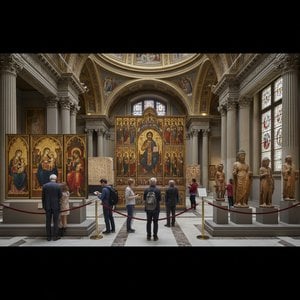
Sacred Narratives Embodied: A Comprehensive Exploration of Religious Iconography in Art History
Explore the rich history of religious iconography in art! Discover symbolism, movements & masterpieces from Byzantine to Renaissance periods. Expert insights for collectors and enthusiasts at ArtsDot.

Топ 25 шедьовъра на Ел Греко: Духовност и гений в изкуството за вашия дом
Разгледайте топ 25 шедьовъра на Ел Греко – икони на Ренесанса и испанското изкуство. Открийте историите зад духовните му картини, уникалната техника и символиката във всяка творба. Купете висококачествени репродукции за вашия дом на ArtsDot.com!

Sacred Narratives on Canvas: Exploring Religious Painting Through History
Explore the rich history of religious painting with ArtsDot.com! Discover iconic artworks, symbolism & techniques from antiquity to the Renaissance. Enhance your art appreciation today.

Illuminating Eternity: A Comprehensive Exploration of Byzantine Art's Legacy
Explore the rich history & stunning artistry of the Byzantine Empire! Discover iconic mosaics, profound symbolism, and lasting influence on Western art. A comprehensive guide for history lovers.

El Greco: Spirituality, Style & Innovation – A Renaissance Master's Legacy
Explore the captivating world of El Greco! Discover his unique style, spiritual intensity, and lasting impact on art history. Learn about this Renaissance master's life, iconic paintings & legacy.


