Преглед в реален мащаб
 Сподели
 Сподели
 Подробности
 Ръководство

 Изтегляне
 Подобни артикули
 Рентгенова снимка
 Слайдшоу
 Статистика
Springime


 Разгърни целия текст
Жикле / Художествен принт
Giclée печат или принт върху платно с музейно качество, бързо производство и гъвкави опции за завършен вид. ( Поръчайте ръчно рисувано репродукция на този колекционерски предмет Превключване към дигитално изображение)




P118B €10

P118H €10

P118W €10

P438Z €10

P508JH €12

P508YH €12

P805H €10

P805Z €10

P919BZ €10

P919G €10

P919XJ €10

P959ZH €10

P968JZ €12

W106C €8

W218G €10

W218JH €8

W218Y €10

W307PJ €10

W316G €10

W316PJ €8

W316Y €10

W398PJ €8

W4111J €10

W500HY €15

W500JH €15

W692G €12

W849H €8

W940BG €15

W953PJ €8




Изберете от нашите предварително зададени размери, които съответстват на оригиналните пропорции на произведението.

Въведете необходимата ширина и височина, за да паснат на вашата рамка или стена. Принтовете могат само да се изрязват, но никога не могат да бъдат по-големи от оригиналната картина, така че при размер с различен формат част от изображението ще бъде загубена. Преди да започнем печат, ще ви изпратим дигитален мок업 за одобрение. Изображението, показано на тази страница, не показва реалното изрязване — само мок업ът го показва.
Доставка по целия свят () в рамките на 2 седмици вместо стандартните 4/5 седмици. (19 Октомври)

Безплатна експресна доставка по целия свят

Висококачествено ленено платно

Пълно застраховане на доставката

Гаранция за възстановяване на митнически такси

Гаранция за пълно съответствие на цветовете

Политика за връщане в рамките на 100 дни (само при дефекти)

100% Гаранция за връщане на сумата

Отстъпка при поръчка на повече произведения
 Опцията със стъкло е налична само за размери под 110 см

Springime
Жикле / Художествен принт
Размер на репродукцията
-


Крайна цена
€ 54
A Moment of Renewal: Introducing Charles Edward Conder’s “Springime”
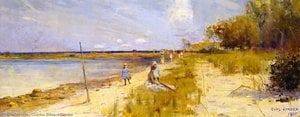
Charles Edward Conder's "Springime," painted in 1892, isn’t merely a depiction of springtime; it’s an immersion into the very essence of renewal. This oil on canvas, currently residing within the hallowed halls of the Tate Gallery in London, captures a fleeting moment of vibrant beauty – a celebration of burgeoning life against a backdrop of warm, inviting hues. Conder, a pivotal figure in Australia's Heidelberg School movement, masterfully blends Impressionistic techniques with a distinctly Australian sensibility, creating an artwork that resonates with both tranquility and dynamic energy.
The painting immediately draws the eye to its foreground: a profusion of delicate pink blossoms clustered around a graceful tree. These aren’t simply flowers; they are symbols of rebirth, mirroring the season's promise of new beginnings. Behind this vibrant display, a smaller, more distant tree provides depth and scale, anchoring the scene within a broader landscape. The careful layering of colors – from the warm yellows dominating the sky to the subtle greens of the foliage – establishes a harmonious balance between light and shadow, creating an atmosphere that is both luminous and deeply felt.
The Heidelberg School: A New Vision of Australian Art
To fully appreciate “Springime,” it’s crucial to understand its context within the Heidelberg School. Emerging in late 19th-century Australia, this group of artists sought to capture the unique beauty and spirit of their homeland – a landscape vastly different from the European traditions dominating the art world at the time. Rejecting academic formality, they embraced *plein air* painting, working directly outdoors to observe and record nature’s nuances with immediacy and sensitivity. Conder, along with Tom Roberts and Frederick McCubbin, became central figures in this movement, developing a distinctive style characterized by loose brushstrokes, vibrant colors, and an emphasis on everyday Australian life.
Conder's work often reflected his own experiences – his early years in India, his move to Australia, and his travels throughout Europe. “Springime,” however, feels distinctly rooted in the Australian landscape, capturing not just a visual representation but also a feeling of optimism and connection to the natural world. The painting’s composition subtly evokes the vastness of the Australian outback, hinting at both its beauty and its inherent challenges.
Technique and Symbolism: A Dance of Light and Color
Conder's masterful use of color is a defining characteristic of “Springime.” He employs broken brushstrokes to create an impressionistic effect, allowing the colors to blend and shimmer in the viewer’s eye. The warm yellows and oranges of the sky are juxtaposed with the cooler greens and pinks of the foliage, creating a dynamic interplay of light and shadow. The artist's attention to detail is evident in the delicate rendering of the flowers and leaves, as well as the subtle variations in tone that suggest depth and texture.
Beyond its aesthetic qualities, “Springime” carries symbolic weight. The blossoming tree represents hope and regeneration, while the distant landscape suggests a connection to something larger than oneself. The painting’s overall mood is one of serenity and contemplation – an invitation to pause and appreciate the simple beauty of nature. It's a testament to Conder's ability to capture not just what he saw but also what he felt.
Bringing “Springime” Home: Reproductions and Artistic Inspiration
“Springime” is more than just a painting; it’s an experience. High-quality reproductions offer a remarkable way to bring this captivating artwork into your home or office, adding a touch of timeless beauty and tranquility to any space. Whether you're drawn to the painting's vibrant colors, its evocative symbolism, or simply its undeniable charm, “Springime” is sure to inspire and delight.
Въпроси и отговори
Позволява ли авторското право на „Springime“ на Чарлз Едуард Кондер възпроизвеждане?
„Springime“ на Чарлз Едуард Кондер, намираща се в Tate Gallery, е в обществено достояние – авторското му право е изтекло. Този статус определя дали могат да се правят репродукции на изображението.
За коя стая се препоръчва „Springime“ на Чарлз Едуард Кондер, предвид цветовете му?
Предвид цветовете в неговата Earthy палитра, се препоръчва "Springime" за Living Room.
Намира ли се произведението „Springime“ на Чарлз Едуард Кондер в общественото достояние и защо?
„Springime“ на Чарлз Едуард Кондер е в в обществено достояние – авторското му право е изтекло. Срокът на авторското право се изчислява от годината на смъртта на художника, която е през 1909.
Свързани произведения


Биография на художника
Early Life and Artistic Journey
Charles Edward Conder (1868 – 1909) was an English-born painter, lithographer and designer. He emigrated to Australia and was a key figure in the Heidelberg School*, arguably the beginning of a distinctively Australian tradition in Western art.
Conder was born in Tottenham, Middlesex, the second son, of six children, of James Conder, civil engineer and Mary Ann Ayres.
He spent several years as a young child in India before the death of his mother on 14 May 1873 in Bombay, aged 31 years; he was then sent back to England and attended a number of schools including a boarding school at Eastbourne, which he attended from 1877. He left school at 15, and his very religious, non-artistic father, against Charles's natural artistic inclinations, decided that he should follow in his footsteps as a civil engineer.
Artistic Career in Australia
In 1884, at the age of 16, he was sent to Sydney, Australia, where he worked for his uncle, a land surveyor for the New South Wales government. However he disliked the work, much preferring to draw the landscape rather than surveying it. In 1886, he left the job and became an artist for the “Illustrated Sydney News”, where he was in the company of other artists such as Albert Henry Fullwood, Frank Mahoney and Benjamin Edwin Minns.
He also attended the painting classes of Alfred James Daplyn and had joined the Art Society of New South Wales.
Short of cash, Conder apparently paid off his landlady by sexual means, catching syphilis in the process, which was to plague the later years of his life.
The Heidelberg School and Notable Works
Conder’s masterpiece, Departure of the Orient – Circular Quay (1888) showcased his newfound mastery of form and brushwork.
This dockside scene, depicting the bustling harbour at sydney cove, was quickly purchased by the Art Gallery of New South Wales, making it Conder’s first work to enter a public collection.
A holiday at Mentone (1888), a fun-loving painting showcasing men and women relaxing on the beach, is another notable example of Conder's work.
Conder’s association with G. P. Nerli, an itinerant italian painter, significantly influenced his development as an artist.
His contributions to the 9 by 5 impression exhibition in melbourne, alongside tom roberts and arthur streeton, solidified his position within the Heidelberg School movement.
Legacy and Later Life
Conder’s later years were plagued by poor health, including paralysis and a bout of delirium tremens.
Despite this, he continued to paint, leaving behind a legacy as a key figure in the heidelberg school. His art was better received in england than in paris, with his portrait being painted by Henri de Toulouse-Lautrec in 1892.
View Conder’s works at the Art Gallery of New South Wales or explore more about the Heidelberg School on ArtsDot's charles edward conder page.
Discover more about Conder's life and works on wikipedia's charles conder page. Explore ArtsDot's collection of Conder's paintings, including A Holiday at Mentone (1888) and Departure of the Orient – Circular Quay (1888), on ArtsDot's website.

Чарлз Едуард Кондер
1868 - 1909 , Великобритания
Бързи факти
- Artistic Movement Or Style: Heidelberg School
- Artists Who Influenced This Artist:
- Alfred Daplyn
- Victor Mann
- Julian Ashton
- Date Of Birth: October 24, 1868
- Date Of Death: February 9, 1909
- Full Name: Charles Edward Conder
- Nationality: British
- Notable Artworks:
- Departure of the Orient – Circular Quay
- A holiday at Mentone
- Under The Southern Sun
- Place Of Birth: Tottenham, United Kingdom
Свързани статии

Топ 25 шедьовъра на Джон Констабъл: Английски пейзажи за вашия дом | ArtsDot.com
Открийте топ 25 шедьовъра на Джон Констабъл – английски пейзажи, романтизъм и красотата на природата. Репродукции с музейно качество за вашия дом! Разгледайте пълната колекция онлайн на ArtsDot.com.

Топ 10 шедьовъра на Романтичния пейзаж: Изкуство за вашия дом от ArtsDot.com
Открийте 10 шедьовъра на Романтичния пейзаж – Фридрих, Търнър и други! Разгледайте историите зад картините, техниките и емоциите. Репродукции с музейно качество от ArtsDot.com. Вдъхновете се за вашия дом!

Stephen Bone: A Reassessment of Colour, Form & the British Neo-Romantic Landscape Tradition
Explore the vibrant world of Stephen Bone (1904-1958), a key figure in British Neo-Romanticism. Discover his captivating landscapes, impactful war art & unique artistic style. Learn about his life, influences & legacy.

Топ 25 шедьовъра на Едуард Хопър: Изображения на американската самота и светлина
Разгледайте топ 25 шедьовъра на Едуард Хопър – икони на американския реализъм, самотата и светлината. Вдъхновете се за декорацията на дома си с картините му! Репродукции високо качество на ArtsDot.com.

Edward Wilkins Waite: A Victorian Vision of Surrey's Serene Landscapes & Artistic Legacy
Explore the serene landscapes of Edward Wilkins Waite (1854-1924), a prolific Victorian painter celebrated for his depictions of Surrey's countryside. Discover his artistic influences, career highlights & collecting guide.