


1of 34
دوتشيو 1255–1319
إيطالي From سيينا المدرسة السينية، القوطية في القرن الرابع عشر On Wikipedia in 31 of 32 languages


New to Gothic? Start here
If you remember one Gothic فنان, make it دوتشيو (1255–1319), the name behind العذراء الروسيلية (تفاصيل) و مادونا روتشيلاي. After that come سيمون مارتيني, جنتيلي دا فابريانو, بيزانيلو و ستيفان لوكنر. Our 34 picks go from Master Mateo (born 1161) to Jan Baegert (born 1465), from 8 countries.
How we picked them. We list the artists our catalogue links to Gothic, from the most famous down. Artists born after 1955 that we cannot yet check on Wikidata are left out. The Wikipedia number shows in how many of our 32 languages Wikipedia writes about them.
Quick facts
Meet them one by one
1of 34
إيطالي From سيينا المدرسة السينية، القوطية في القرن الرابع عشر On Wikipedia in 31 of 32 languages
3of 34
إيطالي From فابريانو القوطية الدولية On Wikipedia in 23 of 32 languages

4of 34
إيطالي From بيزا عصر النهضة المبكر، القوطية الدولية On Wikipedia in 28 of 32 languages

5of 34
ألماني From ميرزبورغ القوطية المتأخرة، القوطية الدولية On Wikipedia in 19 of 32 languages

6of 34
إيطالي From فلورنسا القوطية، عصر النهضة المبكر On Wikipedia in 20 of 32 languages

7of 34
هولندي From نيميخن القوطية الدولية On Wikipedia in 21 of 32 languages

8of 34
إيطالي From البندقية التأثير البيزنطي والفن القوطي On Wikipedia in 15 of 32 languages

10of 34
إيطالي From أرِتسَة حلقة وصل بين مدرسة جيوتو والمدرسة السيينية On Wikipedia in 16 of 32 languages

11of 34
إيطالي From فلورنسا عصر النهضة المبكر On Wikipedia in 17 of 32 languages

13of 34
Spanish Romanesque Sculpture

Master Mateo, a sculptor whose name remains shrouded in mystery despite his monumental contribution to the Catedral de Santiago de Compostela Cathedral, stands as one of the most revered figures of Romanesque art in Spain. Born around 1161 in Galicia, though precise details about his life are scarce, Mateo’s legacy rests primarily on his unparalleled achievement: the Portico de la Gloria.
14of 34
هولندي From نايميخن القوطية الدولية On Wikipedia in 16 of 32 languages

Jean Malouel, or Jan Maelwael as he was known in his native Netherlands, occupies a fascinating, pivotal position in the transition from Gothic to Renaissance art. Malouel’s career took its first significant turn in 1396-97 when he found himself working in Paris, tasked with painting armorial decorations for Isabelle of Bavaria, the Queen of France.
16of 34
هولندي From Lower Rhine نهضة القوطية On Wikipedia in 14 of 32 languages

Johannes Francke, known as Frater Francke, stands as a pivotal figure in the burgeoning artistic landscape of 15th-century Germany – specifically within the vibrant Gothic tradition of Hamburg. Early Life and Training: Precise information regarding Francke's formative years is scarce.
18of 34
Italian From Florence Gothic On Wikipedia in 7 of 32 languages

Born in Florence sometime between 1320 and 1330, he emerged from a family deeply rooted in artistic tradition—his three elder brothers, Andrea di Cione (Orcagna), Nardo di Cione, and Matteo di Cione—were themselves accomplished painters, establishing a lineage of creative excellence.
19of 34
Catalan From فالس Late Gothic, Flemish influence On Wikipedia in 10 of 32 languages

Between 1440 and 1445, his hand reached into the workshops of Zaragoza and Tarragona, where he encountered the influential Flemish style brought by Luis Dalmau. His ability to command both scale and detail is evident in his diverse body of work: The Archangel St Michael: A celestial sentinel rendered with heroic posture, framed by stylized foliage and a radiant, textured gold leaf that seems to emanate an inner light.
20of 34
German From Weil der Stadt Late Gothic Art On Wikipedia in 10 of 32 languages

Lukas Moser, a name perhaps unfamiliar to many outside the circles of art history, represents a pivotal figure in the transition from the International Gothic style to the burgeoning realism that would characterize early Renaissance painting.
21of 34
German From Minden International Gothic On Wikipedia in 13 of 32 languages

Born in Minden, Germany, around 1345 and passing away in Hamburg circa 1415, Master Bertram remains a captivating figure within the history of European art. Often referred to as Meister Bertram or Master of Minden, he stands as a pivotal artist bridging the International Gothic style with the nascent trends of the early Renaissance in Northern Europe.
Works to know · Their 100 best-known works · نسخ Master Bertram
22of 34
Spanish Gothic-Italian

Pere Serra, also known as Jaume Serra, stands as a compelling figure in the transition from the International Gothic style to the burgeoning Renaissance aesthetic within Catalonia. Born around 1357 and passing away in 1406, his life coincided with a period of significant artistic and cultural change across Europe, yet he maintained a distinctly Catalan sensibility throughout his career.
23of 34
إيطالي From سان كيريكو دورشيا الطبيعية، عصر النهضة المبكر On Wikipedia in 10 of 32 languages
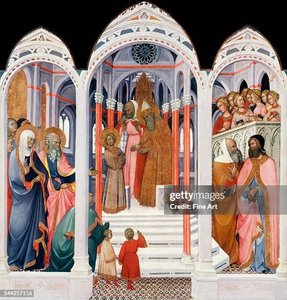
Works to know · Their 100 best-known works · نسخ باولو دي جيوفاني في
 The Coronation of the Virgin, and Saints
 The Camarlingo Niccolò di Leonardo della Gazaia, His Scrivener and Three Taxpayers (Sienese account book cover)
 Madonna and Child Enthroned with Saint John the Evangelist, Saint Peter, Saint Agnes, Saint Catherine of Alexandria, Saint Lucy, an Unidentified Female Saint, Saint Paul, and Saint John the Baptist, with Eve and the Serpent; the Annunciation
24of 34
Italian From Milan Gothic Illuminations

Giovannino de’ Grassi remains one of the most captivating enigmas of the late medieval period, a figure whose brushstrokes breathed life into the prestigious Visconti court of Milan. He operated in an era where the transition from the rigid structures of the Middle Ages to the burgeoning naturalism of the early Renaissance was beginning to stir, and de’ Grassim stood at the very heart of this aesthetic evolution.
25of 34
Catalan From Girona International Gothic On Wikipedia in 8 of 32 languages

A pioneer who fundamentally reshaped the visual language of Catalonia, Borrassà emerged from the historic streets of Girona to become a master of the International Gothic style. The foundations of Borrassá’s mastery were laid in his youth, likely under the guidance of his father, Honorat Borrassà, a fellow painter.
26of 34
Italian From Venice International Gothic On Wikipedia in 10 of 32 languages

In the heart of fifteenth-century Venice, a city defined by its shimmering lagoons and unparalleled maritime wealth, the artistry of Michele Giambono emerged as a luminous bridge between the medieval past and the dawning Renaissance. As a follower of luminaries such as Jacobello del Fiore and Gentile da Fabriano, Giambono inherited a fascination with delicate line work and the use of precious materials to evoke the celestial realm.
27of 34
Italian From فلورنسا Late Gothic/Renaissance On Wikipedia in 7 of 32 languages

Born around 1385 in the heart of Tuscany, his life unfolded during a period where the graceful lines of the Gothic tradition were beginning to yield to the burgeoning naturalism championed by artists like Masaccio.
29of 34
إيطالي From فلورنسا القوطية المتأخرة On Wikipedia in 6 of 32 languages

30of 34
إيطالي From فلورنسا الفن القوطي On Wikipedia in 4 of 32 languages

31of 34
German Late Gothic On Wikipedia in 11 of 32 languages

The earliest evidence of his workshop dates back to around 1463, with the completion of a series of eight panels for the Ursulakirche (Ursuline Church) in Cologne. These scenes – including the Annunciation, Visitation, Nativity, Presentation in the Temple, Flight into Egypt, and various episodes from Mary’s childhood and later life – quickly established his reputation.
32of 34
From Wesel Late Gothic On Wikipedia in 3 of 32 languages

By 1492, Jan Baegert was recognized as a master in Kalkar, a significant milestone that confirmed his ability to manage large-scale commissions independently. Following the death of his father in 1502, Jan Baegert took over the family business in Wesel.
See them at Tracing the physical remains of Jan Baegert’s output requires looking toward the Westphalian and Lower Rhine regions.
33of 34
Italian Late Gothic On Wikipedia in 8 of 32 languages

He was born around 1405 in Siena, likely into a family involved in the production of dyes—a profession reflected in his surname, “ di Pietro ” (of Peter).
34of 34
Austrian International Gothic On Wikipedia in 5 of 32 languages

The earliest known works attributed to the Master are diptychs – two-panel paintings – discovered at the Cistercian Abbey of Heiligenkreuz in southeastern Austria. The left panel depicts the Annunciation, showcasing the Virgin Mary receiving the news of her divine conception, while the reverse portrays the Madonna and Child – a tender scene brimming with serenity.
Pictures worth knowing
When it happened
Fun figures
| إيطاليا | 16 |
|---|---|
| Germany | 4 |
| هولندا | 3 |
| Italy | 3 |
| ألمانيا | 2 |
| Spain | 2 |
| إسبانيا | 1 |
| Austria | 1 |
| القرن 12th | 1 |
|---|---|
| القرن 13th | 6 |
| القرن 14th | 18 |
| القرن 15th | 5 |
| متحف المتروبوليتان للفنون | 7 |
|---|---|
| معرض أوفيزي | 4 |
| متحف إيزابيلا ستيوارت غاردنر | 3 |
| المعرض الوطني | 3 |
| Museo dell'Opera del Duomo | 2 |
| متحف فالراف ريتشارتس | 2 |
| متحف اللوفر | 2 |
| Hamburger Kunsthalle | 2 |
Just the names
دوتشيوإيطالي · 1255–1319 سيمون مارتينيإيطالي · 1284–1344جنتيلي دا فابريانوإيطالي · 1370–1427بيزانيلوإيطالي · 1395–1455ستيفان لوكنرألماني · 1410–1451أنيولو جاديإيطالي · 1350–1396الإخوة فان ليمبرغهولندي · 1385–1416باولو فينيتسيانوإيطالي · 1333–1358
 ليبو ممي1291–1356سبينيلو أريتينوإيطالي · 1350–1410برناردو داديإيطالي · 1290–1348
 أندريا بيسانوإيطالي · 1290–1348Master MateoSpanish · 1161–1217جان مالويلهولندي · 1370–1415
 تلمان ريمنشنايدر1460–1531ماستر فرانكي (فراتر فرانكي)هولندي · 1380–1435
 كلاوس سلوترهولندي · 1355–1406Jacopo di CioneItalian · 1325–1399جاومي هوغيتCatalan · 1445–1492Lucas MoserGerman · 1390–1443Master BertramGerman · 1345–1415Pere SerraSpanish · 1357–1406باولو دي جيوفاني فيإيطالي · 1345–1411Giovannino De' GrassiItalian · 1350–1398Lluís BorrassàCatalan · 1360–1425Michele GiambonoItalian · 1400–1462Giovanni dal PonteItalian · 1385–1438
 ثيودوريك براغتشيكي · نيكولو دي بيترو جيرينيإيطالي · 1368–1415باتشينو دي بوناجويداإيطالي · 1280–1340Master Of The Life Of The VirginGerman · Jan Baegert1465–1535Master Of The OsservanzaItalian · Master of Heiligenkreuz AbbeyAustrian ·
Good questions
دوتشيو (#1) is first in this ranking, followed by سيمون مارتيني (#2) and جنتيلي دا فابريانو (#3).
دوتشيو (#1), سيمون مارتيني (#2), جنتيلي دا فابريانو (#3), بيزانيلو (#4) و ستيفان لوكنر (#5).
إيطاليا: 16 of the 34 فنانون in this list were born there, then Germany (4) و هولندا (3).
The highest-ranked فنانون born in إيطاليا are دوتشيو (#1), سيمون مارتيني (#2), جنتيلي دا فابريانو (#3), بيزانيلو (#4) و أنيولو جادي (#6).
The earliest-born فنان in this list is Master Mateo (#13), born in 1161.
The museums holding the most key works of this list are متحف المتروبوليتان للفنون (7), معرض أوفيزي (4) و متحف إيزابيلا ستيوارت غاردنر (3).
فلورنسا: 5 of the فنانون in this list were born there.
“Yet, within this framework, he demonstrated a forward-thinking approach, particularly in his adoption of glazing techniques that foreshadowed the innovations of oil painting pioneered later by Jan van Eyck.” — from our biography of جان مالويل (#14).
Most فنانون in this list were born in the القرن 14th (18 of 34), between 1161 and 1465 overall.
Our catalogue holds 1,535 works by these فنانون. Each one can be ordered as a hand-painted oil reproduction or a print.
Read more
Other styles
 فنانون مشهورون من Baroqueالحارس الليلي · رامبرانت
 فنانون مشهورون من Contemporary Realistالجامعات · جان فرانسوا ميليه
 فنانون مشهورون من Impressionistليلة مرصعة بالنجوم (نيويورك، متحف الفن الحديث) · فنسنت فان خوخ
 فنانون مشهورون من Romanticistزحل وهو يلتهم ابنه · فرانثيسكو غويا
 فنانون مشهورون من NeoclassicistThe Death of Marat · جاك لوي دافيد
 فنانون مشهورون من Realistأصل العالم · غوستاف كوربيه
 فنانون مشهورون من Renaissanceالموناليزا (لا جوكوندا) · ليوناردو دا فينشي
 فنانون مشهورون من Dutch Golden Ageالفتاة ذات القرط المنصوع من اللؤلؤ · يوهانس فيرمير
 فنانون مشهورون من Expressionistتكوين السابع · فاسيلي كاندينسكي
 فنانون مشهورون من Rococoجين-أنتوان واتو
1717
الإنزال إلى سيثيرا: تحفة من أناقة الروكوكو
"الإنزال إلى سيثيرا" لجين-أنتوان واتو مثال نموذجي على أسلوب الروكوكو، حيث يلتقط روح المرح والرومانسية في القرن الثامن عشر الفرنسي. تدعو هذه اللوحة الساحرة، التي تم إنشاؤها عام 1717، المشاه · أنطوان واتو
Other eras
 فنانون مشهورون من Early MedievalSnowy River · وانج وي
 فنانون مشهورون من High Medievalالعذراء في العظمة (عذراء أوني سانتيني) · جوتو دي بوندوني
 فنانون مشهورون من Late Medievalالبشارة والقديسان · سيمون مارتيني
 فنانون مشهورون من Renaissanceخلق آدم · ميكيلانجيلو
 فنانون مشهورون من Early Modernنداء القديس متى · كارافاجيو
 فنانون مشهورون من 19th Centuryالزنابق المائية (أو النيمفيا) · كلود مونيه
 فنانون مشهورون من Modernغرنيكا · بابلو بيكاسو
 فنانون مشهورون من ContemporaryWind Sculpture III (one in a series of nine) · Yinka Shonibare
Keep exploring


