A life shaped by light and travel
Born in Castle Cary, Somerset, Samuel Woodforde lived a life often guided by the hands of others. He was the second son of Heighes Woodforde, an accountant from Ansford, and his wife Anne. His path into the world of paint was paved by lineage and patronage. As a descendant of the painter Samuel Woodford, he carried a familiar name into the Royal Academy Schools, where he began his studies in 1782. The steady support of the banker Henry Hoare of Stourhead provided the means for him to leave England behind.
In 1786, Woodforde moved toward Italy. He spent much of his time in Rome, walking through galleries to study the brushwork of Raphael, Michelangelo, and Paolo Veronese. His eyes saw Venice and Florence before he eventually returned to London in 1791. This period of wandering through Italian landscapes and classical halls left a mark on the subjects he chose to capture. He later returned to Italy with his wife, Jane Gardner, whom he married in 1815, until fever took his life in Bologna in 1817.
The subjects on the canvas
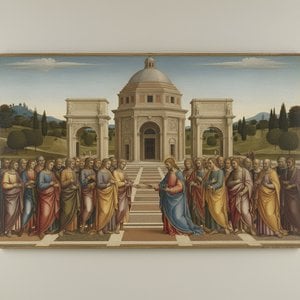
His work moved between the faces of individuals and the stories found in old books. Between 1792 and 1815, he kept a constant presence in exhibitions, presenting portraits alongside scenes of Italian life and historical compositions. He often looked to literature for his themes, translating written drama into visual form. Some of these literary scenes were even chosen for engraving, appearing in the Boydell Shakespeare edition of 1805 and later in Longmans Shakespeare.
The variety of his output can be seen in the different ways he approached a subject:
- Portraits that captured the likeness of his sitters.
- Scenes of Italian life, reflecting his time spent in the south.
- Historical pictures rooted in classical and literary traditions.
- Works such as Apollo and the Muses on Parnassus that drew from ancient myth.
Recognition and legacy
Woodforde’s presence in the London art scene was marked by frequent contributions to major institutions. He brought no less than 133 pictures to the Royal Academy and 39 to the British Institution. His standing within the academy grew steadily, moving from a student to an associate in 1800, and finally achieving full membership in 1807.
Though his life ended in Bologna, his work remained part of the English artistic record. He left behind a collection of works that range from oil on canvas to delicate watercolors and ink washes, such as his study of a rocky stream in Italy. His ability to move between the grand scale of historical painting and the quiet detail of a portrait remains visible in the pieces held in collections like the National Trust and the Metropolitan Museum of Art.
الأسئلة والأجوبة
من أي بلد Samuel Woodforde؟
وُلد Samuel Woodforde في Kingdom of Great Britain.
أين يمكنني تصفح أعمال Samuel Woodforde الفنية مصنفة حسب الحركة الفنية؟
تجمع صفحة جميع المدارس الفنية أعمال Samuel Woodforde الفنية حسب الحركة الفنية.
هل يمكنني تصفح أعمال Samuel Woodforde حسب لوحة الألوان؟
يمكنك تصفح أعمال Samuel Woodforde حسب لوحة الألوان عبر صفحة حسب لوحة الألوان الخاصة بالفنان.