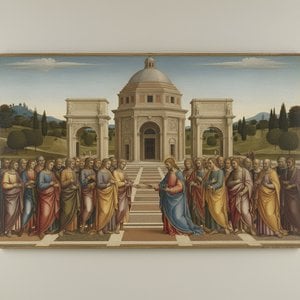
The Life and Activity of Pere Teixidor
The documented presence of Pere Teixidor begins in Barcelona in 1397. He moves through the urban landscapes of Barcelona and Lleida, maintaining a steady professional footprint for nearly half a century. His life follows the rhythms of the Gothic era, defined by the demands of religious and civic commissions. He is a painter of the Gothic style, working within a tradition that emphasizes structured devotion and formal elegance.
The timeline of his activity remains clear until the mid-1440s. Between 1397 and 1446, his name appears in the records of the cities where he practiced. The final trace of his existence in the historical record occurs in July 1447, when he appears not as a creator, but as a witness in a legal dispute. This moment marks the end of his documented life, leaving the specifics of his final years to the silence of the archives.
The family workshop survives his departure. His son, Tomás Teixidor, takes up the mantle, ensuring the continuity of the Teixidor name in the local art scene. While the son's own documentation eventually fades, the lineage of the workshop remains a bridge between the era of Pere Teixidor and the subsequent generations of painters in the region.
Professional Life in Barcelona and Lleida
The documented activity of Pere Teixidor spans the cities of Barcelona and Lleida, beginning in 1397 and continuing until 1446. His presence in Lleida is particularly marked by civic involvement. Between May 1418 and March 1419, he moves from the workshop to the halls of government, serving as a counselor in the Paeria of Lleida. In this capacity, he represents the interests of the common people, specifically the artisans, small merchants, and farmers known as the ma menor.
His professional standing in Lleida deepens in 1419 when he begins working for the Lleida Cathedral. The artist's workshop remains a central fixture in the city's urban fabric. In 1439, Teixidor and the painter Jaume Ferrer II secure permission to occupy a space on the upper floor of the town hall, providing a dedicated location to paint and store their large-scale altarpieces.
Patrons and Major Commissions
Teixidor’s professional standing is visible through the ecclesiastical institutions that commissioned his work. In 1427, he secured a contract for the main altarpiece of the church of San Jaime in Ulldemolins. This period of activity saw him moving between significant religious centers, securing work for the Seo de Urgel between 1431 and 1432. His presence in the religious landscape was marked by these large-scale liturgical objects designed to anchor the visual identity of local churches.
The year 1438 brings a surge of documented activity. He received payment for a gold-decorated altarpiece dedicated to Saints John the Baptist and John the Evangelist, intended for a convent in Montblanch, Tarragona. During this same year, he was also engaged to paint altarpieces for the church of Sucs. These commissions highlight a steady demand for his skill in handling precious materials and complex iconographic programs for various religious orders and parishes.
Notable Attributed Works
The surviving record of Teixidor's hand is often tied to the sacred imagery of the 15th century. In the Museu Nacional d'Art de Catalunya, a panel depicts the Savior in mandorla, a central piece from an altarpiece originally belonging to Estopiñán, Huesca, where the figure is surrounded by angels. Nearby, the museum holds a Salvator Mundi, executed in gold leaf and metal foil on panel about 1420–1430. This work highlights the material intensity of his period.
Other fragments of his output appear in collections as distinct narrative episodes. Four specific scenes illustrating the life of Saint Andrew are attributed to him, serving as lateral panels for a larger altarpiece. These works, alongside an altarpiece titled 'Salvador' from the 15th century, represent the persistent demand for religious iconography in the regions where he practiced.
- Salvador Altarpiece dedicated to the Savior of Estopiñán (Huesca)
- Altarpiece dedicated to Saints John the Baptist and John the Evangelist for a convent in Montblanch, Tarragona
Where to See His Works Today
The legacy of Pere Teixidor remains anchored in the institutional collections of Catalonia. The Museu Nacional d'Art de Catalunya (MNAC) in Barcelona holds several pieces attributed to his hand. Among these is the Salvator Mundi, a panel featuring gold leaf and metal foil, dated about 1420–1430. This work sits within the museum's permanent holdings alongside other significant pieces, including a panel depicting the Savior in mandorla surrounded by angels, which originated from an altarpiece in Estopiñán, Huesca.
Beyond the halls of the MNAC, his influence extends to other regional sites. The Salvador Altarpiece, dedicated to the Savior of Estopiñán, remains located in Huesca. These surviving fragments offer a physical connection to the Gothic traditions he helped establish through his workshop in Barcelona and Lleida.
الأسئلة والأجوبة
أين يمكن العثور على أعمال Pere Teixidor الفنية مصنفة حسب لوحة الألوان؟
للعثور على أعمال Pere Teixidor ضمن لوحة ألوان محددة، يرجى زيارة صفحة حسب لوحة الألوان الخاصة بالفنان.
إلى أي حقبة تاريخية ينتمي Pere Teixidor؟
أبدع Pere Teixidor خلال حقبة Late Medieval، وهي الفترة التي تضع نشاط الفنان في سياقه التاريخي.
هل يمكنني تصفح أعمال Pere Teixidor حسب الحالة المزاجية؟
تستعرض صفحة ركن الأجواء الخاصة بالفنان أعمال Pere Teixidor الفنية مرتبة حسب أجوائها.
هل يمكنني استكشاف أعمال Pere Teixidor حسب الموضوع؟
تُعد دليل المواضيع الخاصة بـ Pere Teixidor صفحةً تستعرض أعمال الفنان وتصنفها وفقاً لموضوعاتها.