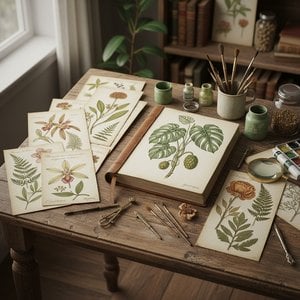
Pancrace Bessa: A Life in Botanical Art
Early Life and Education
Pancrace Bessa (January 1, 1772 – June 11, 1846) was a French natural history artist celebrated for his exquisite botanical illustrations. Born in Paris, France, Bessa embarked on his artistic journey as a student of the esteemed engraver Gerard van Spaendonck. This foundational training instilled in him a meticulous attention to detail and a refined technique that would characterize his later work.
Artistic Development and Influences
Bessa’s artistic development was significantly shaped by his association with Pierre-Joseph Redouté, another prominent botanical artist of the era. The influence of Redouté is evident in Bessa's delicate treatment of subjects and his ability to capture the subtle nuances of plant life. He honed a masterful use of stipple engraving, an essential technique for color printing at the time.
Career and Salon Exhibitions
Bessa established himself as a regular exhibitor at the prestigious Paris Salons between 1806 and 1831. This consistent presence showcased his talent to a wide audience and solidified his reputation within the artistic community. His work quickly gained recognition for its accuracy, beauty, and scientific value.
Patronage and Royal Commissions
A pivotal moment in Bessa’s career came in 1816 when he received patronage from the Duchesse de Berry, daughter-in-law of King Charles X of France. This support not only provided financial stability but also led to opportunities to provide painting lessons to the de Berry family – a connection echoing the artistic traditions of the Très riches heures du duc de Berry. Furthermore, Bessa dedicated much of his later career to working on the Velins du Roi (Royal Vellum Collection) from 1823 until his death.
Major Works and Collaborations
- Histoire des arbres forestiers de l'amerique septentrionale: A collaborative project with Redouté, showcasing North American trees.
- L’herbier général de l'amateur: Bessa prepared approximately 572 watercolours for this extensive herbarium compiled by Mordant de Launey and Loiseleur-Longchamp.
- Description des plantes cultivées à Malmaison et à Navarre: This work featured nine illustrations by Bessa alongside fifty-four by Redouté.
- Flore des jardiniers: Published in 1836, this was Bessa’s final major publication.
Artistic Style and Technique
Bessa's style is characterized by its precision, delicate rendering of detail, and vibrant color palettes. He primarily focused on fruit and flowers, occasionally depicting birds and mammals. His mastery of stipple engraving allowed him to create richly textured and visually appealing botanical illustrations.
Historical Significance
In the early nineteenth century, Bessa, alongside artists like Redouté, Jean-Louis Prévost, Lancelot-Théodore Turpin de Crissé, and Madame Vincent, played a crucial role in elevating France to a position of pre-eminence in botanical painting. His work not only contributed to the aesthetic beauty of the era but also advanced scientific understanding through accurate depictions of plant life. Bessa’s legacy continues to inspire artists and botanists today.
الأسئلة والأجوبة
هل يمكنني فرز أعمال Pancrace Bessa الفنية حسب اللون؟
تُعد مؤشر الألوان الخاصة بـ Pancrace Bessa صفحةً تُنظم أعمال الفنان حسب ألوانها.
هل يوجد سجل زمني لمسيرة Pancrace Bessa؟
تُعد سجل زمني الخاصة بـ Pancrace Bessa خطاً زمنياً يعتمد على التمرير، حيث تعرض أعمال الفنان بترتيب زمني، مقسمة إلى فصول تمثل مراحل مسيرته المهنية.
أين يمكنني مشاهدة المخطط اللوني لأعمال Pancrace Bessa؟
يمكن دراسة استخدام Pancrace Bessa للألوان عبر الأعمال المدرجة في هذا الموقع من خلال صفحة بصمة الألوان الخاصة بالفنان.