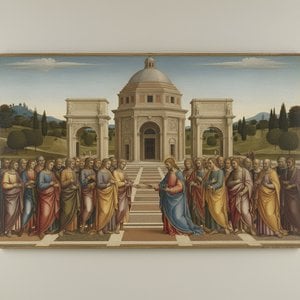
The Workshop of Catalonia
Barcelona, late 15th century. The air in the studio is thick with the scent of tempera and the fine dust of gold leaf. Here, the Vergós Group operates not as a collection of isolated individuals, but as a cohesive family workshop. Pablo Vergós, often identified in historical records as Pau Vergós, works within this collective alongside figures like Joan Antigó and Honorat Borrassà. The lines between their hands often blur. They produce altarpieces that define the visual language of the region, moving through a period of profound cultural transition.
The work is rooted in the International Gothic tradition. It is a world of elongated proportions and elegant, flowing drapery. Every panel is a study in narrative clarity, designed to guide the faithful through the lives of Christ and the saints. There is a meticulousness to the detail, a devotion to the sacred that demands precision in every brushstroke of oil and tempera.
A Transition of Form
A shift occurs in the workshop's output. The rigid hierarchies of the Gothic style begin to soften. It is a subtle evolution rather than a sudden break. Figures gain a newfound weight, a sense of physical presence that was previously absent. The faces carry a growing naturalism, and the landscapes begin to suggest a depth that pulls the viewer into the scene. This is the emergence of a new sensibility, one that anticipates the Renaissance while remaining deeply anchored in the traditions of the past.
The technical mastery is evident in several key works attributed to his hand or the group's collective effort:
- Calvary: A depiction of the crucifixion that captures the intense sorrow of Mary, Mary Magdalene, and John the Apostle.
- The Conversion of Saint Augustine: A scene rendered with the weight of spiritual transformation.
- Retablo de Granollers: A significant altarpiece reflecting the workshop's scale and influence.
- Saint Augustine Meditates on the Trinity: A work exploring the intersection of the divine and the human.
Legacy in the Catalan Landscape
The influence of Pablo Vergós remains tied to the ecclesiastical and private patronage of the Catalan region. His work resides in the Museu Nacional d'Art de Catalunya in Barcelona, preserved as a record of a specific artistic lineage. The workshop's ability to negotiate evolving aesthetic preferences allowed their style to endure, bridging the gap between the symbolic grace of the Middle Ages and the burgeoning realism of a new era. The paintings remain as physical evidence of a family's shared vision and the technical evolution of Spanish painting.
الأسئلة والأجوبة
أين يمكنني مشاهدة أعمال Pablo Vergós الفنية مرتبة حسب الأجواء؟
يمكنك تصفح أعمال Pablo Vergós حسب الحالة المزاجية عبر صفحة ركن الأجواء الخاصة بالفنان، والتي ترتب الأعمال الفنية وفقاً لمشاعرها المسجلة.
هل يمكن عرض أعمال Pablo Vergós وفق تسلسل زمني؟
تعرض صفحة التسلسل الزمني للأعمال الفنية الخاصة بالفنان أعمال Pablo Vergós مرتبة زمنياً، عاماً تلو الآخر.
أين يمكنني مشاهدة المخطط اللوني لأعمال Pablo Vergós؟
تستعرض صفحة بصمة الألوان الفنية الخاصة بـ Pablo Vergós المخطط اللوني لمجموعة أعمال الفنان.
أين يمكنني العثور على أعمال Pablo Vergós الفنية المصنفة حسب اللون؟
تُصنف صفحة تدرج الألوان أعمال Pablo Vergós الفنية حسب اللون.