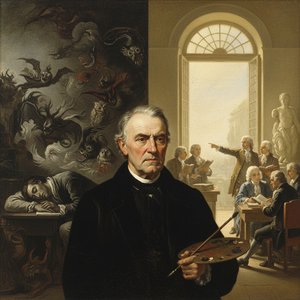
The Scenographic Journey of Manuel Fontanals
Manuel Fontanals was a Spanish art director who eventually settled and worked in Mexico during the Golden Age of Mexican cinema. Born in 1893, he began his professional life working at his father's workshop in Paris. Upon returning to Catalonia, he settled in Barcelona, where he studied at the academy of painter Francesc d'Assís Galí and worked with the sculptor Esteve Monegal Prat and the architect Josep Puig i Cadafalch. His early career included decorating the Canaletes Café and working in scenography for the "Teatro del Arte" in Madrid, where he learned from Sigfrido Burmann and Fernando Mignoni Monticelli.
His professional path took him across Europe, including travels to Germany, Milan, and Paris. In Milan, he collaborated with Gabriele D'Annunzio, and in Paris, he fulfilled commissions for the Odéon, the Opera, and the Palace. He also contributed to the Barcelona International Exhibition of 1929 and the construction of the Poble Espanyol in Montjuïc. During the 1930s, he worked with various theatrical figures, including Federico García Lorca and Margarita Xirgu, before choosing to go into exile.
Exile and the Golden Age of Mexican Cinema
After leaving for Latin America in 1936, Fontanals visited Mexico City in 1938 to design the bar at Ciro's, a luxury establishment located inside the Reforma Hotel. His presence in Mexico led to a prolific career in the film industry, where he founded his own film decoration company, Escenografía de Manuel Fontanals. He worked with prominent actors and directors such as Dolores del Río, María Félix, Mario Moreno Cantinflas, and Emilio Fernández.
Fontanals was a co-founder of the Mexican Academy of Motion Picture Arts and Sciences and received the Ariel Prize in 1947, 1949, and 1972. His cinematic work was extensive, encompassing 247 sets or sets and costumes. In his later years, he designed houses for friends and completed his final film, The Castle of Purity. He died in 1972, having burned his personal documents and architectural renderings to vanish without a trace.
الأسئلة والأجوبة
هل يمكنني تصفح أعمال Manuel Fontanals حسب الحالة المزاجية؟
تتيح لك صفحة ركن الأجواء الخاصة بـ Manuel Fontanals تصفح أعمال الفنان مرتبةً حسب الحالة المزاجية.
كيف تنقسم المسيرة المهنية لـ Manuel Fontanals إلى فترات زمنية؟
يمكنكم الاطلاع على سجل زمني لأعمال Manuel Fontanals عبر صفحة مسيرة فنية الخاصة بالفنان، حيث تُعرض الأعمال الفنية بترتيب إنتاجها، فصلاً تلو الآخر.
هل يمكنني تصفح أعمال Manuel Fontanals حسب لوحة الألوان؟
للعثور على أعمال Manuel Fontanals ضمن لوحة ألوان محددة، يرجى زيارة صفحة حسب لوحة الألوان الخاصة بالفنان.
أين يمكن العثور على أعمال Manuel Fontanals الفنية مصنفة حسب التقنية؟
للعثور على جميع أعمال Manuel Fontanals حسب الوسيط الفني، يرجى زيارة صفحة حسب الوسيط الفني الخاصة بالفنان.