A Life Shaped by Color and Kin
In the city of Plzeň, a boy named Karel Špillar entered a world where art was woven into the very fabric of his family. His father, Antonín, managed the finances for the city, but it was his brothers, Jaroslav and Rudolf, who shared with him a common language of brushes and pigments. This early immersion in a household of creators meant that the path toward the School of Applied Arts was not merely a choice, but a natural progression of his upbringing.
His training began under the watchful eye of František Ženíšek, focusing on the delicate art of decorative painting. These formative years, stretching from 1885 to 1893, instilled in him a sense of scale and purpose. He learned how a single stroke could serve a larger architectural vision. His first significant commission arrived shortly after his studies concluded, tasking him with the creation of an altarpiece for a chapel in Ostrava. This early success anchored his reputation as a painter capable of handling both sacred themes and grand spaces.
The Parisian Influence and the Return to Bohemia
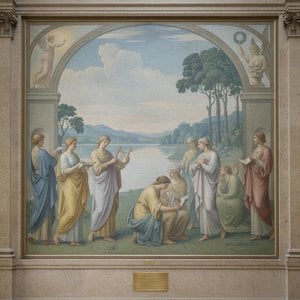
As his ambitions grew, so did his horizons. Karel found himself drawn to Paris, a city that offered new light and different ways of seeing. During his time in France, he sought out the quiet strength found in the works of Puvis de Chavannes. This encounter with a more subdued, symbolic approach left its mark on his sensibilities. He even traveled through Normandy, finding inspiration in the coastal landscapes that would later appear in his repertoire.
Yet, the pull of home remained strong. In 1908, the death of his father and the declining health of his brother Jaroslav brought him back to his native lands. This period of return saw him engaging deeply with the decorative needs of his community. He worked alongside Jan Preisler on panels for the Czech Chamber of Commerce at the Exposition Universelle in Paris, proving that even while physically distant, his influence reached the great international stages. In 1909, he left a permanent mark on the Municipal House in Prague by creating the "Tribute to Prague" on its façade.
A Legacy of Teaching and Observation
The later years of his life were defined by a commitment to passing on the craft he had mastered. After 1913, he returned to the School of Applied Arts, not as a student this time, but as a teacher of nude drawing. By 1925, he reached the rank of Professor, guiding a new generation through the complexities of form and anatomy. His life was one of constant observation, whether sketching the landscapes near his brother's villa in Pec or capturing the quiet moments of daily existence.
His repertoire remained diverse, ranging from mythological subjects like Leda and the Swan to the salt-sprayed scenes of Ocean Beach. He possessed a unique ability to move between the monumental and the intimate. While his work faced a period of obscurity following 1948, the rediscovery of his paintings in the 1980s allowed the public to once again appreciate the breadth of his vision. He passed away in Prague in 1939, leaving behind a body of work that captured the shifting spirit of his era.