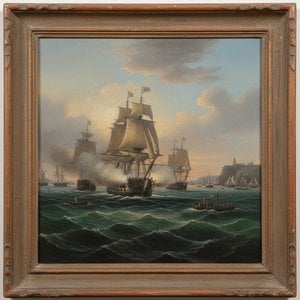
A Life Shaped by Salt and Steel
In the quiet reaches of Simtuna socken, the life of Johan Tietrich Schoultz began, destined to be shaped by the turbulent waters of the Baltic. He was a man of two worlds, walking the line between the disciplined life of military personnel and the observant eye of a painter. This dual existence meant that his brush was often guided by the smoke of cannon fire and the rhythmic movement of naval vessels. He did not merely observe the sea; he lived through its conflicts, capturing the very essence of maritime struggle.
His hand was most active during a period of intense naval engagement, particularly around the year 1790. The chaos of war provided him with a subject matter that few others could claim to understand with such intimacy. He witnessed the spray of the waves and the heavy presence of warships, translating the tension of combat into visual records. His work remains a window into a specific, violent era of Swedish history, where the fate of nations was decided upon the waves of the Finnish archipelago.
The Canvas of Conflict
The compositions of Schoultz often centered on the heavy, wooden hulls of ships locked in combat. He possessed a particular talent for documenting the specific mechanics of naval warfare, from the movement of a galley to the chaotic geometry of a fleet in battle. His paintings were not mere decorations but were records of specific, historical moments of high tension.
Several of his notable works focus on the intense naval engagements of the late eighteenth century, including:
- The Battle of Fredrikshamn in May 1790.
- The engagement at Slaget vid Svensksund on July 9, 1790.
- The naval clash at Slaget vid Uransari on June 16, 1790.
- The movement of the Swedish fleet from Biörcköö=Sund in July 1790.
- The struggle of the galley Kalmar against a Russian schebeck near Porkala on July 30, 1789.
Through these works, he captured the movement of the wind and the heavy, dark weight of the sea. His depictions of the Battle of Skargard and the events near Bjorko show a man preoccupied with the scale of these maritime encounters. He understood how the light hit the sails and how the smoke of gunpowder would hang over the water, creating a sense of immediate, pressing reality for those who viewed his work.
A Legacy in Oil and Paper
As the years passed, the man who had seen so much of the sea's fury eventually found his end in Perniö in 1807. He left behind a body of work that speaks to the grit of naval life and the precision of military observation. His paintings have survived through the centuries, occasionally appearing in auction houses like Bukowskis, where they remind collectors of the dramatic history of the Swedish navy. Whether through a large-scale oil painting or a smaller work on paper, his hand remains tied to the salt and the wind of his homeland.
الأسئلة والأجوبة
كيف يمكنني تتبع أعمال Johan Tietrich Schoultz حسب التسلسل الزمني؟
يمكن مشاهدة أعمال Johan Tietrich Schoultz الفنية مرتبة زمنياً في صفحة التسلسل الزمني للأعمال الفنية.
هل يوجد عرض شامل لجميع الموضوعات التي رسمها Johan Tietrich Schoultz؟
تستعرض صفحة دليل المواضيع أعمال Johan Tietrich Schoultz الفنية مصنفة حسب الموضوع.
هل يمكنني استكشاف أعمال Johan Tietrich Schoultz حسب طيف الألوان؟
تُتيح تدرج الألوان الخاصة بـ Johan Tietrich Schoultz تصفح أعمال الفنان مُنظمةً حسب ألوانها.