Early Life, Family and Training
Ilmari Ikonen enters the world on March 21, 1897, in Myllykoski, Sippola, Finland. He is born into a household defined by the structured life of a railway official; his father, Herman August Ikonen, holds that position, while his mother is Ida Maria Siippainen. The environment is one of stability, yet the pull toward visual expression begins early. By 1911, the young Ilmari Ikonen is already seeking formal instruction, attending evening courses at the Central School of Applied Arts.
The path toward professional mastery requires a fragmented, persistent effort. He does not follow a singular, continuous academic route. Instead, his training is marked by distinct periods of study at the Drawing School of the Finnish Art Association. He attends during the years 1917–1919, then returns to the school for another period between 1921 and 1924. These years of study form the technical foundation of his later work, bridging the gap between a student's practice and a professional's eye.
Artistic Career and Recognition
The year 1921 marks the beginning of Ikonen's professional presence. He makes his artistic debut, stepping into the public eye as a painter. From that moment until 1943, his work maintains a steady presence in the Finnish Artists' Exhibition, appearing in these shows for over two decades. He moves through the art scene with a focused intent, establishing himself within the established circles of Finnish painting.
Recognition arrives in stages. In 1932, he secures a distinction at the state art competition, a moment that validates his technical skill. The momentum continues into the following decade. By 1937, he captures a second prize at the Kordelin landscape painting competition. This period of success highlights his ability to command attention within specialized competitions focused on the natural world.
The later years of his career see a continued presence in significant institutional settings. In 1950, his work is featured in the Academy of Fine Arts' 3-year exhibition. This inclusion places his output within the context of the nation's most formal academic structures, cementing his status in the Finnish art landscape before his death in 1953.
Technique and Artistic Style
Ikonen focuses his lens on the landscape. He works primarily with oil, applying the medium to capture the specificities of the natural world. His approach relies on the physical properties of the paint to define space and light. In works like Village (37), the oil technique allows for a structured depiction of rural settings, grounding the viewer in a specific sense of place.
A shift occurs in 1933. He travels to Paris for a study trip, a move that introduces new perspectives to his established practice. This period marks a transition in how he observes his surroundings. He moves through the landscape not as a mere observer, but as a painter translating light and form onto the canvas. His compositions often prioritize the quietude of the Finnish terrain, using the oil medium to build depth within his scenes.
Key Works and Collections
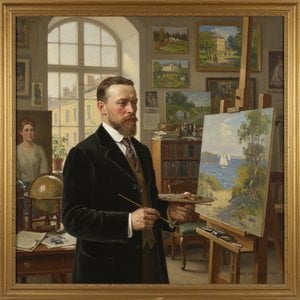
The trajectory of Ikonen's output finds significant weight within the Finnish National Gallery in Helsinki. This institution holds three of his primary works, anchoring his legacy within the national collection. His 1929 Self-Portrait captures a specific moment of early maturity, presenting a man looking over his shoulder. This piece remains a central point of reference for his early development.
As the decades progress, his focus shifts toward the landscape. In 1935, he produced Highway, a work that reflects the changing environments of the era. By 1942, his compositions moved toward more rugged terrain, exemplified by Pines on a Cliff. These paintings demonstrate a consistent engagement with the Finnish landscape, moving from the intimate study of the self to the expansive observation of nature.
الأسئلة والأجوبة
هل يمكنني تصفح أعمال Ilmari Ikonen حسب الوسيط الفني؟
للعثور على جميع أعمال Ilmari Ikonen حسب الوسيط الفني، يرجى زيارة صفحة حسب الوسيط الفني الخاصة بالفنان.
هل يمكن عرض أعمال Ilmari Ikonen وفق تسلسل زمني؟
يمكن مشاهدة أعمال Ilmari Ikonen الفنية مرتبة زمنياً في صفحة التسلسل الزمني للأعمال الفنية.
هل يمكنني استكشاف أعمال Ilmari Ikonen حسب الموضوع؟
تستعرض صفحة دليل المواضيع أعمال Ilmari Ikonen الفنية مصنفة حسب الموضوع.
ما هي أكثر الأعمال الفنية مشاهدةً لـ Ilmari Ikonen؟
توجد صفحة إحصائيات الزيارات خاصة بـ Ilmari Ikonen، تعرض إحصائيات حول أعمال الفنان على هذا الموقع.