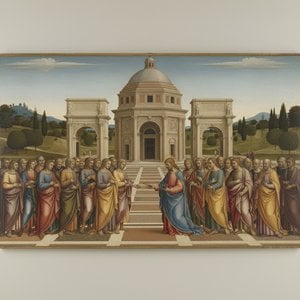
The Enigmatic Master of the Umbrian Twilight
In the golden age of the Italian Renaissance, while names like Perugino and Pinturicchio commanded the grandest stages of history, a more subtle and profound genius was quietly shaping the aesthetic soul of Perugia. Fiorenzo di Lorenzo (c. 1445–1522) remains one of the most compelling enigmas of the Umbrian school. Though the legendary biographer Giorgio Vasari offered little in the way of direct praise, the very fabric of the era's art bears his unmistakable imprint. To study Fiorenzo is to peel back the layers of a period defined by transition, discovering an artist who did not merely follow trends but provided the foundational vocabulary for the masters who followed him.
The early life of Fiorenzo di Lorenzo is shrouded in the soft mists of the fifteenth century. While precise records of his birth and formative training are elusive, his presence in Perugia is undeniable. He was a man deeply embedded in the civic and spiritual life of his city; historical documents even reveal him serving as a decemvir in 1472, suggesting a person of significant social standing and responsibility. This connection to the heart of Umbrian society likely provided him with the patronage necessary to cultivate a style that was both deeply devotional and technically sophisticated. While we cannot point to a specific master's workshop with absolute certainty, the stylistic echoes found in his early works suggest he breathed the same creative air as Benedetto Bonfigli, absorbing the local traditions of clarity and grace that would become his hallmark.
A Style Defined by Emotional Resonance
What truly distinguishes Fiorenzo from the more celebrated, often more "affected" grace of his contemporary Perugino, is a palpable sense of human intensity. Where others sought a serene, almost ethereal detachment, Fioreniente pursued an expressive depth that grounded his religious subjects in a tangible reality. His mastery of space and light allowed him to create compositions that felt both monumental and intimate. In his hands, the sacred was not distant; it was present, breathing with a character that resonated with profound emotional power.
His technical prowess is most evident in his handling of tempera on panel, a medium that requires immense discipline to achieve luminosity. His oeuvre, though comprising around fifty surviving works, showcases a remarkable versatility in subject matter:
- The Madonna of the Recommended (1476): A luminous masterpiece that serves as one of his most vital signatures, demonstrating an early command of light and tender maternal emotion.
- The Adoration of the Magi (c. 1490): A grander, more complex composition that highlights his ability to organize large groups of figures within a coherent, architecturally sound space.
- Altarpieces and Retables: His work for churches like Santa Maria Nuova showcases his skill in the polyptych format, where he utilized intricate predellas and lunettes to weave complex theological narratives.
Legacy and Historical Significance
The true measure of Fiorenzo di Lorenzo’s importance lies not in the quantity of his surviving canvases, but in his profound influence on the trajectory of the Umbrian Renaissance. It is widely accepted by scholars that the early works of both Perugino and Pinturicchio contain mannerisms and stylistic nuances that point directly back to Fiorenzo's influence. He acted as a vital bridge, translating the rigid structures of the earlier Quattrocento into the more fluid, emotive language of the High Renaissance. He was the quiet architect of an aesthetic movement, providing the technical scaffolding upon which the great masters built their fame.
Today, much of his legacy is preserved within the hallowed halls of the Galleria Nazionale dell'Umbria. To stand before a Fiorenzo original is to witness a moment in time where the spiritual and the human converged with unparalleled sincerity. He remains a testament to the idea that greatness does not always require the loudest voice, but rather the most enduring vision—a painter who, through his mastery of character and space, helped define the very essence of the Italian Renaissance.
الأسئلة والأجوبة
أين يمكن استكشاف أعمال Fiorenzo di Lorenzo الفنية مصنفة حسب الموضوع؟
يمكن استكشاف أعمال Fiorenzo di Lorenzo حسب الموضوع عبر صفحة دليل المواضيع الخاصة بالفنان.
أين يمكنني مشاهدة المخطط اللوني لأعمال Fiorenzo di Lorenzo؟
يمكن استكشاف أسلوب Fiorenzo di Lorenzo في استخدام الألوان عبر الأعمال المدرجة في هذا الموقع من خلال صفحة بصمة الألوان الفنية الخاصة بالفنان.
هل يمكنني تصفح أعمال Fiorenzo di Lorenzo حسب لوحة الألوان؟
تجمع صفحة حسب لوحة الألوان أعمال Fiorenzo di Lorenzo الفنية حسب لوحات ألوانها.