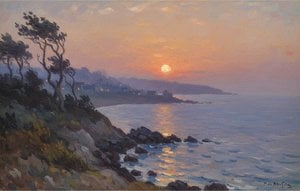
The Quiet Legacy of Eugen Dekkert
In the vast tapestry of late nineteenth and early twentieth-century European art, certain names resonate not through loud revolutionary manifestos, but through the steady, masterful execution of light and atmosphere. Eugen Dekkert belongs to this esteemed tradition of painters who captured the soul of their surroundings with a profound sense of stillness. Born in 1865, Dekkert lived through an era of immense transition, witnessing the shift from the romanticized landscapes of the past to the more structured, observational approaches of the modern age. His life, spanning nearly nine decades until his passing in 1956, serves as a bridge between these two worlds, embodying a classical devotion to the craft of oil painting.
The work of Dekkert is characterized by an intimate relationship with the natural world. He possessed an uncanny ability to translate the fleeting nuances of light—the way it filters through dense foliage or rests upon a tranquil body of water—into permanent, emotive compositions. His technique often relied on a sophisticated layering of tones, creating a sense of depth that invites the viewer to step directly into the scene. There is a certain nostalgia embedded in his brushwork; even when depicting simple landscapes, there is an underlying reverence for the permanence of nature amidst the encroaching industrialization of his time.
Artistic Development and Mastery
To understand the evolution of Dekkert’s style, one must look at his commitment to the fundamental principles of composition and color harmony. While much of his work remains rooted in the tradition of fine landscape painting, his development was marked by an increasing sensitivity to atmospheric perspective. He did not merely paint objects; he painted the air that surrounded them. This mastery allowed him to achieve a sense of luminosity that defines his most celebrated pieces.
His artistic journey can be viewed through several key thematic lenses:
- The Play of Light: His ability to capture the "golden hour" and the soft, diffused light of overcast days.
- Textural Realism: A meticulous approach to rendering the organic textures of bark, stone, and water.
- Compositional Balance: The use of natural elements to guide the eye through a landscape, creating a sense of narrative movement within a static frame.
Throughout his long career, Dekkert remained a steadfast practitioner of the classical tradition. While contemporaries were experimenting with the fragmented forms of Cubism or the aggressive strokes of Expressionism, Dekkert found his greatest strength in the refinement of the existing canon. His significance lies in this preservation of beauty and the quiet dignity of the natural landscape, ensuring that the contemplative essence of the 19th-century masters was carried forward into the mid-20th century.
الأسئلة والأجوبة
أين يمكن استكشاف أعمال Eugen Dekkert الفنية المصنفة حسب الكلمات المفتاحية؟
تجمع صفحة حسب الكلمات المفتاحية الخاصة بـ Eugen Dekkert أعمال الفنان وفقاً للكلمات المفتاحية.
أين يمكن العثور على أعمال Eugen Dekkert الفنية مصنفة حسب التقنية؟
للعثور على جميع أعمال Eugen Dekkert حسب الوسيط الفني، يرجى زيارة صفحة حسب الوسيط الفني الخاصة بالفنان.
في أي مدينة ودولة وُلد Eugen Dekkert؟
وُلد Eugen Dekkert في Szczecin، في Poland.
أين يمكنني العثور على إحصائيات حول أعمال Eugen Dekkert؟
تستعرض صفحة إحصائيات الزيارات الخاصة بـ Eugen Dekkert إحصائيات مستخرجة من أعمال الفنان المدرجة على هذا الموقع.