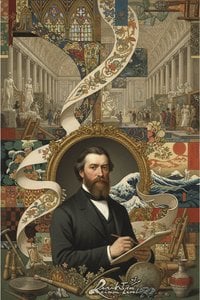
The Painter of History and Portraiture
Born in Béziers in 1813, Augustin Régis lived a life defined by the shifting political and cultural landscapes of nineteenth-century France. His career was marked by a steady presence in the Parisian art scene, where he exhibited at the Salon between 1838 and 1847. During these years, he developed a reputation for capturing the gravity of historical subjects and the nuance of individual character through his portraiture. His work was not merely a study of likeness, but an attempt to document the weight of specific moments in time.
His technical approach relied heavily on the medium of oil on canvas, a choice that allowed him to navigate the complexities of light and shadow essential to his chosen themes. While his early years were rooted in the traditions of French portraiture, his interests expanded as he encountered the broader world beyond the borders of his native Béziers. This expansion was most evident in his engagement with the historical narratives of the era, often focusing on the intersection of French and Algerian history.
A Shift Toward the Orient
The mid-century period brought a change in both his subject matter and his physical surroundings. In 1849, Régis traveled to Algiers, a move that signaled his emergence as an Orientalist painter. This period of travel provided him with the visual vocabulary necessary to depict the complexities of North African life and conflict. His work from this era often focused on the tension between opposing forces, moving away from the quietude of a studio portrait toward the drama of historical confrontation.
His output during this time was characterized by several key elements:
- A focus on historical subjects involving French and Algerian figures.
- The depiction of significant political events, such as the surrender of Abd el-Kader.
- A transition from traditional portraiture to more expansive, narrative compositions.
- The use of oil on canvas to render the specific textures of historical attire and landscapes.
The Legacy of the Musée Condé
The historical significance of Régis is preserved through the collections of major institutions, most notably the Musée Condé. His work, such as the depiction of the surrender of Abd al qadir to the French in 1847, has been held within the private collections of the French nobility, specifically through the donation of Henri d'Orléans, the duc d'Aumale. This connection to the d'Aumale collection ensures that his contributions to nineteenth-century painting remain part of the permanent record of European art history.
By the time of his death in 1880, Régis had established himself as a painter who could bridge the gap between the intimate study of a face and the grand scale of a historical event. His ability to document the specificities of the mid-nineteenth century through his brushwork provides a window into the era's preoccupation with both personal identity and the consequences of empire.
الأسئلة والأجوبة
بأي أسماء أخرى يُعرف Augustin Régis؟
يُعرف Augustin Régis أيضاً باسم Augustin André François Régis.
أين يمكنني العثور على إحصائيات حول أعمال Augustin Régis؟
تستعرض صفحة إحصائيات الزيارات الخاصة بـ Augustin Régis إحصائيات مستخرجة من أعمال الفنان المدرجة على هذا الموقع.
أين يمكن استكشاف أعمال Augustin Régis الفنية مصنفة حسب الموضوع؟
تُعد دليل المواضيع الخاصة بـ Augustin Régis صفحةً تستعرض أعمال الفنان وتصنفها وفقاً لموضوعاتها.
هل يمكنني استكشاف أعمال Augustin Régis عبر الكلمات المفتاحية؟
تجمع صفحة حسب الكلمات المفتاحية الخاصة بـ Augustin Régis أعمال الفنان وفقاً للكلمات المفتاحية.