The Architect of Light and Line: The Legacy of Abraham Rademaker
In the golden twilight of the Dutch Republic, as the 17th century transitioned into the 18th, a profound shift occurred in how the world perceived the beauty of the built environment. At the heart of this transformation stood Abraham Rademaker, an artist whose name became synonymous with the meticulous preservation of urban grandeur. Born in the serene landscape of Lisse, Netherlands, in 1677, Rademaker did not merely paint scenes; he documented the very soul of Dutch architecture. His life’s work serves as a breathtaking visual archive, capturing the intricate details of churches, townscapes, and estates that defined an era of prosperity and architectural ambition.
Rademaker’s journey was deeply intertwined with the vibrant artistic pulse of Haarlem. It was here, amidst a thriving printing industry, that he honed his technical mastery. While many of his contemporaries sought the ephemeral beauty of nature, Rademaker found poetry in the permanence of stone and brick. His training allowed him to bridge the gap between fine art and the burgeoning field of topographical documentation. He possessed a rare ability to marry the precision of an architect with the emotive touch of a painter, creating works that felt both structurally sound and atmospherically rich.
A Mastery of Perspective and Print
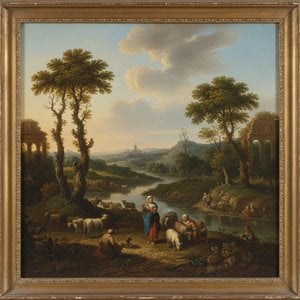
The true brilliance of Rademaker lies in his versatility, particularly his command over the medium of printmaking. While he was a skilled painter of Italianate landscapes—scenes that evoked the sun-drenched, idealized vistas of the South—he achieved his most enduring fame through his prolific output of cityscapes and architectural drawings. These works were not intended for solitary contemplation alone; they were designed to be reproduced, disseminated, and celebrated across Europe.
His technique was a masterclass in perspective and light. By employing sophisticated depth-conveying methods, he invited the viewer to step into the streets of Delft or the bustling waterways of Amsterdam. His prints often featured:
- Precise Architectural Rendering: A devotion to the structural integrity of landmarks, such as the magnificent Jesuit Church on the Oude Langendijk in Delft.
- Atmospheric Depth: The use of light and shadow to create a sense of lived-in reality, reminiscent of the dramatic chiaroscuro popularized by masters like Caravaggio.
- Topographical Accuracy: A commitment to documenting urban planning and the changing face of Dutch cities with scientific clarity.
Through these illustrations, Rademaker became a vital contributor to the historical record. His work appeared in significant publications that documented the customs, privileges, and landscapes of South Holland, ensuring that the visual splendor of his homeland would survive long after the physical structures themselves might have changed.
Historical Significance and Artistic Influence
The influence of Abraham Rademaker extends far beyond the borders of the Netherlands. His ability to synthesize the idealized beauty of Claude Lorrain with the rigorous detail required for topographical printmaking helped shape the aesthetic tastes of the 18th century. He stood at a crossroads of artistic movements, blending the classical reverence for landscape with the Enlightenment-era passion for documentation and discovery.
As we look back upon his career, which concluded with his death in Haarlem in 1735, we see an artist who provided a window into a vanishing world. Rademaker did more than capture buildings; he captured the dignity of the Dutch Republic. His legacy remains etched in the fine lines of his engravings and the sweeping vistas of his landscapes, reminding us that there is profound art to be found in the very foundations of our civilization. To study Rademaker is to walk through the streets of history, guided by a hand that never lost its reverence for the beauty of the permanent.