


 معاينة الحجم الحقيقي
 مشاركة
 مشاركة
 التفاصيل

 تحميل الملف
 قطع مشابهة
 الأشعة السينية
 عرض شرائح
Mammoth. Saturn


 عرض المزيد
نسخة زيتية مصنوعة يدوياً
لوحة زيتية مرسومة يدوياً على الكانفاس بالمقاس والإطار الذي تفضله، تُنفذ حسب الطلب على أيدي فنانينا. ( اشترِ نسخة مطبوعة اشترِ الصورة)




P118B $10

P118H $10

P118W $10

P438Z $10

P508JH $12

P508YH $12

P805H $10

P805Z $10

P919BZ $10

P919G $10

P919XJ $10

P959ZH $10

P968JZ $12

W106C $8

W218G $10

W218JH $8

W218Y $10

W307PJ $10

W316G $10

W316PJ $8

W316Y $10

W398PJ $8

W4111J $10

W500HY $15

W500JH $15

W692G $12

W849H $8

W940BG $15

W953PJ $8




اختر من بين أحجامنا المُعدّة مسبقًا والتي تتطابق مع النسب الأصلية للعمل الفني.

يمكنك إدخال أبعادك الخاصة لتناسب إطارًا معينًا أو مساحة محددة. وإذا لم يتطابق الحجم الذي اخترته مع نسب الصورة الأصلية، فسنقوم إما بقص العمل الفني أو توسيع اللوحة بإضافة عناصر مرسومة يدويًا. سيتم إرسال نموذج رقمي إليك للموافقة عليه قبل بدء الإنتاج.
يرجى ملاحظة أن المعاينة على الشاشة لا تعكس عملية القص أو التوسيع الفعلية؛ حيث إن النموذج الرقمي وحده هو الذي سيوضح التكوين النهائي بدقة.
وعلى الرغم من توفر أحجام مخصصة، إلا أننا نوصي باختيار أبعاد من القائمة المحددة مسبقًا للحفاظ على النسب الأصلية للعمل الفني.
بعد إتمام الطلب، سيرسل فريق ArtsDot.com بريداً إلكترونياً للعميل لطلب التعليمات وتزويده بمعاينة تجريبية (mockup).
توصيل عالمي إلى خلال 3 إلى 4 أسابيع بدلاً من المدة المعتادة البالغة 5 أسابيع. (6 سبتمبر). جودة لا تهاون فيها.

شحن سريع ومجاني لجميع أنحاء العالم

قماش كتان عالي الجودة

تأمين شحن شامل

ضمان استرداد الرسوم الجمركية

ضمان مطابقة الألوان الحقيقية

سياسة الإرجاع خلال 100 يومًا (في حالات العيوب فقط)

ضمان استرداد نقدي بنسبة 100%

خصم عند طلب عدة قطع
 خيار الزجاج متاح فقط للمقاسات التي تقل عن 110 سم

Mammoth. Saturn
خامة إعادة الإنتاج
مقاس النسخة المطبوعة
-


السعر الإجمالي النهائي
$ 263
A Visionary Encounter: The Mystical World of Teofil Ociepka
In the evocative landscape of 1954, Teofil Ociepska birthed a vision that transcends the boundaries of reality, inviting the viewer into a dreamscape where the prehistoric and the celestial converge. Mammoth. Saturn is not merely a depiction of a creature; it is a portal into the profound, mystical psyche of one of Poland's most significant self-taught primitivist masters. The painting presents a monumental mammoth, distinguished by its striking blue mane and tail, moving through a terrain that feels simultaneously ancient and otherworldly. As the beast utilizes its long trunk to grasp an unseen object, the presence of two small human figures provides a sense of scale that is both humbling and surreal. This encounter between the colossal and the mortal creates a tension that is central to Ociepka’s unique artistic language.
The composition breathes with the raw, uninhibited energy characteristic of Naive Art. Eschewing the rigid academic constraints of his era, Ociepka employs bold colors and simplified, flat forms to construct a narrative that feels as much like a folk legend as it does a cosmic event. The background, featuring sparse trees and a desert-like expanse, suggests a world stripped of modern complexity, focusing instead on the elemental essence of life and myth. For the discerning collector or interior designer, this piece offers a captivating focal point that commands attention through its vibrant palette and the sheer imaginative audacity of its subject matter.
Symbolism and the Occult Thread
To understand Mammoth. Saturn, one must look beneath the surface of its charming simplicity to find the threads of theosophy and occultism that wove through Ocieperka’s life. As a practitioner of mysticism, the artist often infused his landscapes with esoteric symbols, turning a simple scene of nature into a complex spiritual allegory. The title itself suggests a connection between the terrestrial mammoth and the celestial realm of Saturn, hinting at an astrological or cosmic significance that elevates the painting from a mere zoological study to a profound meditation on time and existence. The blue hues of the mammoth’s mane may serve as a bridge between the earthly ground and the infinite sky, symbolizing the union of the physical and the spiritual.
This layer of symbolic depth makes the artwork an extraordinary choice for those seeking pieces that provoke thought and conversation. It is a work that rewards repeated viewing, as each glance reveals new nuances in its dreamlike quality. The interplay between the massive, powerful beast and the fragile human figures serves as a poignant reminder of our place within the vast, often incomprehensible cycles of the universe. In an era of digital perfection, the soulful, hand-painted textures of Ociepka’s style offer a grounding, authentic emotional resonance that is increasingly rare.
An Essential Addition to the Sophisticated Collection
For those looking to curate a space with character and depth, a high-quality reproduction of this masterpiece provides an unparalleled opportunity. The painting's ability to harmonize bold, primary colors with a sense of quiet, spiritual wonder makes it incredibly versatile for various interior design aesthetics—from modern minimalist galleries to more eclectic, bohemian studies. It brings with it a sense of history and a connection to the rich tradition of Polish Primitivism, offering much more than mere decoration.
Investing in such a piece is an invitation to surround oneself with the sublime. Whether placed in a grand living area or a private library, Mammoth. Saturn acts as a window into a lost world of wonder. It captures the essence of a time when art was a direct expression of the soul's journey through the mysteries of the cosmos, making it a timeless treasure for any serious lover of fine art.
أعمال فنية ذات صلة


السيرة الذاتية للفنان
The Mystical Vision of Teofil Ociepka
In the quiet corners of Polish art history, few figures possess the enigmatic allure of Teofil Ociepka. Born on April 22, 1891, in Janów Śląski, Poland, Ociepka was far more than a mere painter; he was a seeker, an occultist, and a dedicated theosophist whose brush served as a conduit for the unseen realms. As a self-taught primitivist, his work emerged not from formal academic training, but from a profound, internal necessity to translate spiritual truths onto canvas. His life, which spanned until 1978 in Bydgoszcz, was a continuous journey through the layers of the subconscious and the esoteric, leaving behind a body of work that vibrates with a dreamlike, otherworldly energy.
Ociepka’s artistic development was deeply intertwined with his spiritual pursuits. His fascination with the occult and theosophy provided him with a unique visual vocabulary, one where the boundaries between the physical landscape and the metaphysical plane are perpetually blurred. Unlike many of his contemporaries who sought to capture the external reality of the Polish countryside, Ociepka looked inward. His early life in Poland, marked by a deep immersion in folk traditions and mystical philosophies, allowed him to cultivate a style that felt both ancient and deeply personal. This fusion of folk art simplicity and complex esoteric symbolism created a tension in his work that continues to captivate modern viewers.
A Language of Symbols and Color
The aesthetic power of Ociepka’s paintings lies in their striking, unadorned clarity. His technique was characterized by the use of bold, saturated colors and remarkably flat, simplified forms—a hallmark of the Primitivist movement. However, beneath this deceptive simplicity lies a dense web of meaning. Every stroke and every shape often carries a weight of symbolic significance, reflecting his preoccupation with the hidden forces of the universe. His landscapes and still-life compositions are rarely just depictions of nature; they are sacred spaces populated by motifs that whisper of cosmic order and spiritual mystery.
When observing his most celebrated works, such as "The Garden" or "The Mountain," one is struck by the following elements:
- Bold Color Palettes: The use of vibrant, often non-naturalistic hues to evoke emotional and spiritual states.
- Symbolic Motifs: The integration of esoteric symbols that bridge the gap between the earthly and the divine.
- Flatness of Form: A rejection of traditional perspective in favor of a more direct, iconographic presentation.
- Dreamlike Atmosphere: A sense of stillness and transcendence that invites the viewer into a meditative state.
Legacy and Historical Significance
Teofil Ociepka stands alongside legendary figures like Nikifor and Henri Rousseau as a master of the Primitivist tradition. While his work shares the raw, intuitive quality found in Rousseau’s jungles, Ociepka’s focus on theosophy gives his oeuvre a distinctively spiritual gravity. He did not merely paint what he saw; he painted what he felt to be true in the higher vibrations of existence. His ability to weave the humble aesthetics of Polish folk art into a grander narrative of universal mysticism has secured his place as one of Poland's most fascinating and enduring artistic voices.
Today, the legacy of Ociepka is preserved through collections in prestigious institutions, including the National Museum in Wrocław and the Museum of Folk Architecture in Sanok. His work remains a vital touchstone for anyone interested in the intersection of art, spirituality, and the human psyche. To encounter an Ociepka painting is to step into a realm where the veil between worlds is thin, offering a glimpse into the profound mysteries that the artist spent his entire life attempting to illuminate.

Teofil Ociepka
1891 - 1978 , Poland
حقائق سريعة
- Artistic Movement Or Style: Primitivism
- Artists Or Movements Influenced By This Artist:
- Nikifor
- Henri Rousseau
- Artists Who Influenced This Artist:
- Nikifor
- Henri Rousseau
- Date Of Birth: April 22, 1891
- Date Of Death: January 15, 1978
- Full Name: Teofil Ociepka
- Nationality: Polish
- Notable Artworks:
- The Garden
- The Mountain
- Place Of Birth: Janów Śląski, Poland
مقالات ذات صلة

Slate Blue Masterpieces: 10 Iconic Paintings & Timeless Home Decor Ideas
Immerse yourself in the captivating world of slate blue! Explore 10 iconic paintings by Monet, Van Gogh & Renoir. Discover their stories, techniques & find museum-quality art reproductions for your home at .
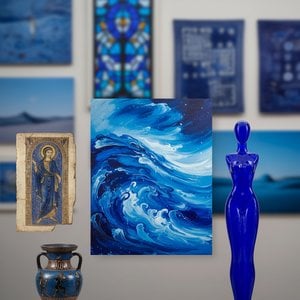
The Allure of Azure: Exploring the Symbolic & Aesthetic Depths of Blue in Art History
Explore the rich history of blue in art! Discover its symbolism, from ancient pigments to modern masterpieces by Kandinsky & Seurat. Uncover the psychological impact and cultural meanings behind this captivating hue.

Stanisław Wyspiański: Symbolism, National Identity & the Polish Secession
Explore the life & work of Stanisław Wyspiański, a pivotal figure in Polish Symbolism and the Young Poland movement. Discover his iconic paintings, dramas, and stained glass designs reflecting national identity & artistic innovation.

Azure Visions: Exploring Representations of the Blue Dress in Western Art History
Explore the rich history of the blue dress in Western art! Discover its symbolism, from Renaissance masterpieces to modern interpretations by artists like Martin & Schiele. Uncover cultural meanings and artistic techniques.

Jan Matejko: Historical Narrative & National Identity in 19th-Century Polish Painting
Explore the powerful historical paintings of Jan Matejko, Poland's national artist. Discover his iconic works & learn how he shaped Polish identity in the 19th century. High-quality reproductions available.