The Quiet Brush of the Qing Dynasty
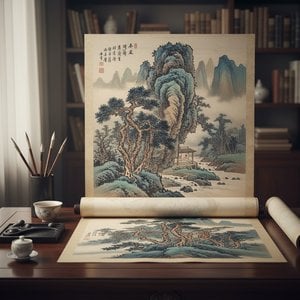
In the mid-19th century, Xu Xiang began a life shaped by the ink and paper of the Qing dynasty. Born in 1850, his hands learned the subtle movements required to capture the natural world, moving between the vastness of mountains and the delicate details of a single petal. His work often reflects a deep connection to the traditions of those who came before him, particularly in how he approached the landscape. He did not seek to reinvent the world, but rather to observe it with a steady, practiced eye.
His training was guided by the hands of teachers like Qian Hui'an and Ren Bonian. Through them, he absorbed the technical discipline needed to balance ink and color. This education allowed him to navigate different modes of expression, from the expansive scale of a landscape to the intimate focus of a folding fan. He worked through the later years of the 1800s, leaving behind traces of his vision in various forms of paper and silk.
Technique and Subject Matter
The way Xu Xiang handled his materials reveals a preference for specific textures and compositions. He often worked with ink and color on alum paper, a choice that dictates how the pigment settles and how the light interacts with the surface. His subjects were drawn from the immediate rhythms of nature, focusing on the interplay between flora and fauna.
- Landscape paintings that follow the structural models of earlier masters.
- Bird and flower compositions, such as those featuring narcissus.
- Works on folding fans, often intended for personal use or as gifts.
- The use of semi-cursive script in inscriptions to balance the visual weight of the painting.
A Legacy in Ink
By the time of his death in 1899, Xu Xiang had established a way of seeing that favored clarity and tradition. His 1883 work, Birds and Narcissus, shows a careful attention to the way a bird might rest near a bloom, a scene painted at the request of Bingheng in the mid-spring of the guiwei year. This ability to respond to specific requests or moments in time shows a painter deeply embedded in the social and artistic fabric of his era. His landscapes, such as those dated 1889, show him looking back to the styles of the past to find his own way forward.