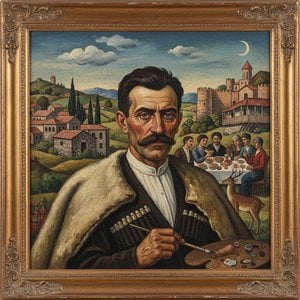
The Formative Years of a Visual Storyteller
Born in Tartu, Estonia, in 1902, Viktor Alekseyev developed a visual language that bridged the gap between traditional aesthetics and modern illustration. His education was a nomadic pursuit of skill, beginning in the Russian State Art School in Voronezh under the guidance of Maksimov. This early training provided a foundation that he would later refine through the rigorous academic traditions of Europe. He moved from the classrooms of Voronezh to the studios of Leipzig, studying portraiture and painting under Kühler, before eventually finding his footing at the Dresden Academy of Arts, where he graduated as a graphic artist in 1926.
His early career was marked by a prolific output and a desire to engage with his home city. In 1921, he presented seventy-eight stylistic compositions at an exhibition held by the Art Promotion Society in Tartu. By 1923, he had organized a solo exhibition featuring forty-two works, many of which focused on the quietude of landscapes, the delicate structure of flowers, and the movement of birds. These early explorations established a sensitivity to the natural world that would persist throughout his life.
A Distinctive Aesthetic and Narrative Depth
Alekseyev’s artistic identity was defined by a singular, idiosyncratic touch. His work often carried the weight of national and religious undertones, drawing inspiration from the aesthetics of medieval and Eastern art. He was particularly skilled at translating these influences into the realm of book illustration, where his graphic precision met a deep sense of symbolism. His ability to marry fine art with narrative required a specific technical discipline, which he applied to several significant projects:
- The 1936 illustrations for the children's book "Three Squirrels."
- Graphic designs for the suspenseful stories of Edgar Wallace.
- A series of forty-seven miniature illustrations based on the apocalyptic themes of the Book of Revelation between 1926 and 1940.
- Illustrations for Hans Christian Andersen's tales, including "The Ugly Duckling" and "The Steadfast Tin Soldier."
This period of his life saw him moving between the roles of a fine artist and a commercial illustrator, a duality that allowed him to explore both the grand scale of landscape and the intimate detail of a miniature. His work in the graphic arts was not merely decorative; it was an attempt to find a modern way to express ancient or folkloric themes.
The Final Chapter in Tartu
The later years of Alekseyev's life were shaped by the profound upheavals of the mid-twentieth century. He experienced the hardships of the Tartu concentration camp, eventually finding freedom on November 9, 1941, alongside his second wife, Leida. Despite the pressures of the era, his hand remained active, contributing to the visual culture of Estonia through his illustrations and paintings. His life came to an end in Tartu in 1945, shortly after the conclusion of the war.
Today, his legacy is preserved in the collections of the Art Museum of Estonia in Tallinn and the Tartu Art Museum. His paintings, such as the 1930 still life and the 1938 forest landscape, remain as physical remnants of a career that sought to find beauty in both the natural landscape and the structured world of the printed page. He remains a significant figure for those studying the intersection of Estonian graphic art and European academic tradition.