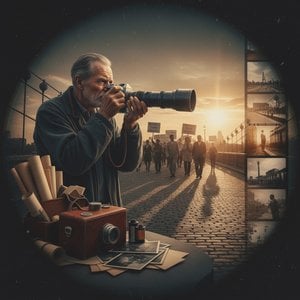
A Pioneer of Visual Dialogue: The Life and Legacy of Ugo Mulas
Ugo Mulas, born in Pozzolengo, Italy, in 1928, emerged as a pivotal figure in the landscape of postwar Italian photography. His career wasn’t forged through formal training but blossomed organically within the vibrant artistic milieu of Milan during the 1950s. Initially studying law, Mulas gravitated towards art, enrolling at the Brera Fine Arts Academy and quickly immersing himself in the intellectual ferment of bar Jamaica—a hub for artists, writers, and thinkers. This early exposure to diverse perspectives shaped his unique approach, one that prioritized observation, engagement, and a willingness to challenge conventional photographic boundaries. His initial work documented the everyday life of Milan’s suburbs, laying the foundation for a career defined by its sensitivity to social context and artistic innovation.From Biennale Chronicles to Artistic Portraits
Mulas's professional journey began in 1954 with his assignment to cover the Venice Biennale, an event he would document consistently until 1972. This long-term engagement proved transformative. It wasn’t merely a record of artworks; it was a study of the evolving art world itself—a chronicle of shifting styles and emerging voices. Simultaneously, Mulas cultivated close relationships with artists, moving beyond detached documentation to create intimate portraits that revealed not just their public persona but also their creative processes and inner worlds. He collaborated extensively with Giorgio Strehler at Milan’s Piccolo Teatro, capturing the energy and dynamism of theatrical performances. These early collaborations honed his ability to convey narrative through images, establishing a signature style characterized by its psychological depth and compositional elegance. His portraits weren't simply likenesses; they were explorations of identity and artistic expression.The American Encounter: Pop Art and a New Vision
A turning point in Mulas’s career arrived with the 1964 Venice Biennale, which introduced him to the burgeoning world of Pop art. This encounter sparked a profound shift in his aesthetic sensibilities, prompting a journey to New York City between 1964 and 1967. In America, he immersed himself in the artistic scene, forging connections with icons like Marcel Duchamp, Jasper Johns, Roy Lichtenstein, and Andy Warhol. The experience proved catalytic, influencing him to experiment with new techniques—large-format prints, projections, solarizations—borrowed from the avant-garde movements of Pop art and New Dada. His resulting book, New York: The New Art Scene, became a landmark publication, offering an unprecedented glimpse into the energy and innovation of American contemporary art. It wasn’t just a collection of photographs; it was a visual essay that captured the spirit of a cultural revolution.The “Verifications” and a Reflection on Photography
As Mulas matured as an artist, he began to question the very nature of photography itself. This introspection culminated in his final project, “La Verifiche” (1968-1972), a series of fourteen photographs that represent a profound meditation on perception, representation, and the limitations of the medium. These images are deliberately ambiguous, often featuring fragmented compositions and symbolic elements, inviting viewers to actively participate in their interpretation. They weren’t intended as straightforward documentation but rather as explorations of the photographic process itself—a questioning of its ability to capture reality accurately or objectively. This period also saw him delve into graphic design and author several influential art books, further solidifying his position as a leading intellectual voice within the artistic community.Historical Significance: A Legacy of Dialogue
Ugo Mulas’s untimely death in 1973 at the age of 45 left an indelible mark on the world of photography. His work transcended mere documentation; it was a form of visual dialogue—an ongoing conversation between artist, subject, and viewer. He challenged traditional notions of photographic representation, embracing experimentation and pushing the boundaries of the medium. His legacy continues to inspire photographers today, encouraging them to question their own assumptions and explore new ways of seeing and interpreting the world. Mulas’s photographs are not simply images; they are windows into a pivotal moment in art history—a testament to the power of visual communication and the enduring search for meaning in a rapidly changing world. His influence can be seen in contemporary portraiture, street photography, and conceptual art, solidifying his place as a true pioneer of postwar Italian photography and a visionary artist whose work continues to resonate with audiences worldwide.问答详情
我可以通过关键词来探索 Ugo Mulas 的作品吗?
若要按特定主题查找 Ugo Mulas 的作品,请访问艺术家的 按关键词检索 页面,该页面通过关键词对作品进行了分类整理。
Ugo Mulas 出生于哪个国家?
Ugo Mulas 出生于 Italy。
Ugo Mulas 的艺术生涯是如何划分为不同时期的?
Ugo Mulas 的艺术生涯在 艺术编年史 页面上按时期逐一展开:以横向时间轴的形式呈现作品,并按创作时期划分为不同的篇章。
Ugo Mulas 的出生地和出生年份是?
Ugo Mulas 于 1928 出生于 Brescia。
如何按特定色调查找 Ugo Mulas 的作品?
按色调分类 页面按色调将 Ugo Mulas 的艺术作品进行了分类。
Ugo Mulas 出生于哪个城市和国家?
Ugo Mulas 出生于 Italy 的 Brescia。
在哪里可以查看 Ugo Mulas 作品的色彩风格?
Ugo Mulas 的 色彩基因 是一个展示该艺术家作品色彩特征的页面。