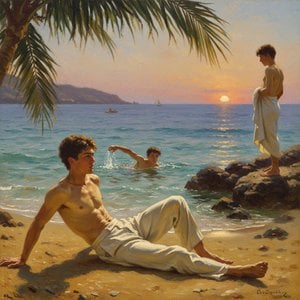
Robert Bagge-Scott: A Master of Dutch Light and Rural Life
Born in Norwich, Norfolk, in 1849, Robert Bagge-Scott’s artistic journey took him from the verdant landscapes of his youth to the meticulously rendered scenes of the Netherlands. His life was one of quiet dedication to capturing the essence of rural existence, particularly the serene beauty of Dutch coastal villages and the rolling fields of South Holland. While he initially gained recognition for his Norfolk watercolors, it was his move to Dordrecht in 1893 that truly defined his artistic output and established him as a leading figure in British landscape painting.
Scott’s early training involved studying at the Norwich School of Art and later at the Royal Academy. However, he quickly developed a distinct style, characterized by an almost photographic realism combined with a deep understanding of light and color. He wasn't simply depicting scenes; he was striving to evoke a feeling – a sense of tranquility, timelessness, and connection to the land. This pursuit is evident in his numerous works portraying the daily life of farmers, fishermen, and villagers, all bathed in the characteristic golden light of the Dutch countryside.
The Influence of Dutch Masters
Scott’s artistic sensibilities were profoundly shaped by the paintings of the Old Masters, particularly those associated with the Dutch Golden Age. Artists like Jan van Goyen, Jacob van Ruisdael, and Johannes Vermeer served as silent mentors, influencing his meticulous attention to detail, his use of atmospheric perspective, and his ability to capture the subtle nuances of light on water and foliage. He was deeply impressed by their mastery of depicting ordinary subjects with extraordinary grace and dignity. The quiet dignity of a fisherman mending his nets or the simple beauty of a thatched cottage resonated strongly with Scott’s own artistic vision.
Furthermore, Scott's time spent in Dordrecht allowed him to immerse himself in the local art scene and study the works of contemporary Dutch painters. This exposure undoubtedly informed his understanding of color palettes, composition, and the overall aesthetic values associated with Dutch landscape painting. He wasn’t merely imitating; he was engaging in a dialogue with a rich artistic tradition.
A Palette of Light and Color
Scott's technique is remarkably consistent throughout his career. He favored oil paints, meticulously layering them to build up texture and create the illusion of depth. His color palette was deliberately restrained, relying on muted earth tones – ochres, browns, greens, and blues – to accurately represent the natural world. However, he possessed a remarkable ability to manipulate these colors, creating subtle shifts in tone and hue that conveyed the changing light conditions throughout the day. His use of reflected light, particularly on water surfaces, is consistently masterful, lending his paintings an ethereal quality.
A prime example of this skill is “Twas Calm at Dordt,” a 1923 painting depicting a tranquil scene along the Nieuwe Maas river. The way he captures the shimmering reflections of the sky and surrounding buildings in the water demonstrates a profound understanding of how light interacts with different surfaces. Similarly, "On a Dutch Dyke" showcases his ability to render the textures of the earth, reeds, and distant hills with remarkable precision.
Major Works and Legacy
Throughout his career, Scott produced over 300 paintings, many of which are housed in major museums across Britain. “Twas Calm at Dordt” is arguably his most celebrated work, instantly recognizable for its serene atmosphere and meticulous detail. Other notable pieces include "The Mill at Hoorn," "Fishing Boats at Katwijk," and numerous scenes depicting the daily life of rural communities. His works were exhibited regularly at the Royal Academy and other prestigious venues, solidifying his reputation as a leading landscape painter.
Robert Bagge-Scott died in 1925, leaving behind a substantial body of work that continues to be admired for its realism, tranquility, and profound connection to the natural world. He is remembered not only as a skilled artist but also as a dedicated observer of rural life, capturing the essence of a bygone era with remarkable sensitivity and artistry. His paintings offer a poignant glimpse into the beauty and simplicity of the Dutch countryside, reminding us of the enduring power of landscape art to evoke emotion and inspire contemplation.