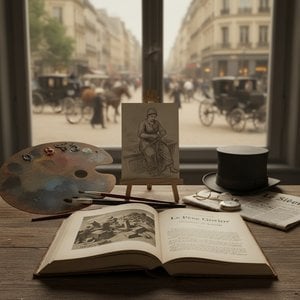
A Life Immersed in Color and Social Commentary: The World of Per Krohg
Per Krohg, born in Kristiania (now Oslo) in 1889, was an artist whose life became inextricably linked to the vibrant currents of early 20th-century art and a deep commitment to social realism. He wasn’t simply *born* into artistry; it flowed through his veins. His father, Christian Krohg, was a celebrated Impressionist painter, and his mother, Oda Krohg, a noted writer and feminist—a lineage that instilled in young Per both an aesthetic sensibility and a profound awareness of the world's complexities. This upbringing wasn’t merely one of privilege but of intellectual and artistic ferment; the family home buzzed with discussions about art, literature, and the pressing social issues of the time. Krohg’s early years were thus formative, shaping his trajectory toward becoming not just a painter, but a visual chronicler of his era. He initially studied at the Kristiania Art School, absorbing traditional techniques before venturing into more modern approaches, influenced by the burgeoning European avant-garde movements.
From Impressionistic Roots to Monumental Visions
Krohg’s artistic development wasn't a sudden leap but a gradual evolution. He began with landscapes and portraits that echoed his father’s Impressionistic style—delicate brushstrokes, a focus on light and atmosphere, and a keen observation of everyday life. However, he soon felt compelled to move beyond mere aesthetic representation. A growing social consciousness led him to explore themes of poverty, injustice, and the plight of marginalized communities. This shift is evident in his early works from the 1910s and 20s, which depict scenes of working-class life with a raw honesty that was uncommon for the time. He wasn’t interested in romanticizing hardship; instead, he sought to portray it with unflinching realism, often employing a somber palette and powerful compositions to convey the weight of human suffering. This period saw him experimenting with various styles, incorporating elements of Expressionism and Realism to create a uniquely potent visual language. His travels throughout Europe further broadened his artistic horizons, exposing him to diverse perspectives and techniques that he skillfully integrated into his own work.
The UN Mural: A Defining Achievement
While Krohg produced a substantial body of work throughout his career—portraits, landscapes, genre scenes—it is undoubtedly his monumental mural for the United Nations Security Council Chamber in New York City that cemented his place in art history. Commissioned in 1952, the painting, titled “The Struggle Against Violence,” is a powerful and symbolic representation of humanity’s enduring quest for peace. The sheer scale of the work—spanning an entire wall of the chamber—is breathtaking, but it's the mural’s complex iconography that truly captivates. Krohg eschewed simplistic depictions of victory or defeat, instead choosing to portray a chaotic yet hopeful scene filled with figures representing various cultures and ideologies engaged in a struggle against forces of destruction. The composition is dynamic and emotionally charged, conveying both the horrors of war and the resilience of the human spirit. It’s a testament to Krohg's ability to synthesize his artistic skills with his deeply held beliefs, creating a work that resonates with universal themes of conflict, hope, and reconciliation. The mural wasn't without controversy; its abstract style was initially met with resistance from some quarters, but it ultimately became an iconic symbol of the UN’s mission.
Influences and Legacy: A Bridge Between Traditions
Krohg’s artistic influences were diverse and far-reaching. His father, Christian Krohg, provided a foundational understanding of Impressionistic techniques and a love for painting *en plein air*. However, he also drew inspiration from European masters such as Édouard Manet and Gustave Courbet, whose Realist depictions of everyday life resonated with his own social concerns. The Expressionist movement, with its emphasis on emotional intensity and subjective experience, further shaped his artistic vocabulary. He wasn’t a slavish follower of any particular style, but rather skillfully synthesized these influences to create a uniquely personal visual language. His legacy extends beyond the UN mural; he inspired generations of Norwegian artists to engage with social issues in their work. He demonstrated that art could be both aesthetically beautiful and politically relevant, challenging conventional notions of what painting could achieve. Krohg’s commitment to realism, his masterful use of color and composition, and his unwavering belief in the power of art to effect change continue to resonate today, making him a significant figure in the history of 20th-century art.
Historical Significance: A Voice for Peace and Social Justice
Per Krohg’s work occupies a unique position within the broader context of 20th-century art history. He emerged during a period of rapid social and political change, witnessing firsthand the horrors of two World Wars and the rise of totalitarian ideologies. His paintings reflect this tumultuous era, offering a powerful critique of injustice and a passionate plea for peace.
His early works documented the struggles of the working class in Norway, providing a valuable glimpse into the lives of marginalized communities.
The UN mural stands as a testament to his belief in international cooperation and the pursuit of global harmony.
He challenged conventional artistic norms, demonstrating that art could be both aesthetically beautiful and politically engaged.
Krohg’s legacy is not simply one of artistic achievement but also of social responsibility. He used his talents to amplify the voices of those who were often unheard, creating a body of work that continues to inspire dialogue and promote understanding. His paintings serve as a reminder of the enduring power of art to effect change and the importance of striving for a more just and peaceful world. He died in 1965, leaving behind a rich artistic heritage that continues to be celebrated and studied today.
Explore the luminous world of Peder Severin Krøyer, a master of Danish Impressionism. Discover his iconic Skagen paintings, artistic evolution, and lasting legacy. Learn about collecting Krøyer's works & find museum-quality reproductions.
Explore the life & work of Christian Krohg, a pivotal figure in Norwegian realism. Discover his social commentary, Skagen influences, and lasting impact on Scandinavian art history. Learn more at ArtsDot.