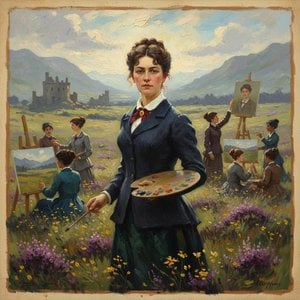
A Life Painted in Vibrant Hues: The Story of Marjorie Arnfield
Marjorie Helen Arnfield, born November 25th, 1930, and passing on April 26th, 2001, was a quietly remarkable English artist whose canvases pulsed with the energy of both industrial grit and the sun-drenched beauty of Mediterranean life. Though perhaps not a household name, Arnfield carved out a distinctive niche for herself through her vivid, impressionistic landscapes—a testament to resilience, keen observation, and a deeply personal connection to place. Her story is one of overcoming physical challenges, embracing color as an emotional language, and finding inspiration in the often-overlooked corners of the world. Raised in Sunderland, a city steeped in the traditions of coal mining and shipbuilding, Arnfield’s early life was profoundly shaped by the landscape of labor and industry that surrounded her. Her family background further nurtured this connection; paternal relatives were regional architects responsible for iconic structures like the Sunderland Empire Theatre, instilling an appreciation for built environments alongside the raw power of manual trades. However, at the tender age of four, Arnfield contracted juvenile chronic arthritis, a condition that would severely limit her mobility throughout her life. This physical adversity did not diminish her artistic drive but instead fueled it, forcing a unique perspective and a determined pursuit of creative expression.
Early Training and Influences
Arnfield’s formal art education began at Sunderland Church High School, followed by studies at Sunderland College of Art and later King Edward VII College of Art, University of Durham. It was here that she encountered a constellation of influential British artists who would shape her developing style. Lawrence Gowing, Quentin Bell, and Victor Passmore each left their mark on Arnfield’s approach to painting, encouraging experimentation with form and color. These mentors fostered an environment where artistic exploration flourished, allowing Arnfield to hone her skills and begin to articulate her own visual language. While the precise nature of these influences is difficult to pinpoint definitively, a sense of dynamic composition and bold use of color—characteristics that would become hallmarks of her work—can be traced back to this period of intensive training. The early years were also marked by a growing fascination with light and its ability to transform ordinary scenes into something extraordinary. This interest would later blossom during her extensive travels throughout the Mediterranean, where she sought to capture the “vibrancy of the sun” on canvas.
From Coal Mines to Coastal Charms: A Diverse Palette
Arnfield’s artistic output was remarkably diverse, encompassing industrial landscapes, rural scenes, and vibrant depictions of life in the Mediterranean. Her paintings of British coal mines stand as powerful testaments to a disappearing way of life—a gritty realism tempered by an empathetic understanding of the workers who toiled within them. These works are not merely documentary; they convey the energy, danger, and communal spirit inherent in these often-harsh environments. In contrast, her Mediterranean paintings radiate warmth and light, capturing the idyllic beauty of Provence and Spain with a distinctly impressionistic flair. Ochres, burnt siennas, cadmium yellows, viridian greens, reds, and blues—the “colors that sing,” as she described them—dominate these canvases, evoking the scent of lavender, the taste of salt air, and the dazzling intensity of the southern sun. She didn’t limit herself to grand vistas; Arnfield found beauty in everyday moments: fishermen mending nets, bustling market scenes, and quiet gardens bathed in golden light. This ability to find poetry in the mundane is a defining characteristic of her work. A particularly charming series focused on Cadaqués, Spain, showcases tranquil leisure and coastal charm through expressive brushstrokes and a masterful use of color.
Recognition and Legacy
Throughout her career, Arnfield exhibited widely across England and Scotland, gaining recognition for her unique vision and technical skill. She also dedicated many years to teaching art to adults and schoolchildren, sharing her passion with aspiring artists. Her commitment to education extended to leading painting holidays in France and the Greek islands, allowing others to experience the landscapes that had so profoundly inspired her. In 2000, Arnfield was awarded an MBE (Member of the Order of the British Empire) for services to British art—a fitting tribute to a lifetime dedicated to capturing the beauty and complexity of the world around her. Today, her paintings are held in public collections documenting industrial heritage and continue to captivate viewers with their vibrant colors, expressive brushwork, and deeply personal perspective. While she may not be as widely celebrated as some of her contemporaries, Marjorie Arnfield’s legacy endures—a testament to the power of art to transcend physical limitations and illuminate the beauty hidden in plain sight.
A Lasting Impression
Style: Impressionistic with a focus on vibrant color and dynamic composition.
Subjects: Industrial landscapes, rural scenes, Mediterranean life (Provence & Spain).
Key Characteristics: Empathetic portrayal of working-class life, capturing the energy of place, expressive brushwork, use of color as an emotional language.
Arnfield’s work offers a unique perspective on 20th-century British art—a blend of social realism and impressionistic beauty that continues to resonate with audiences today.
由 ArtsDot.com 编辑团队撰写
趣味测试
每道题只有一个正确答案。
题目 1:
Marjorie Arnfield was primarily known for painting what types of landscapes?
题目 2:
Which region heavily influenced Arnfield's landscape paintings, known for its vibrant colors?
题目 3:
What artistic style characterized Marjorie Arnfield's work?
题目 4:
In addition to landscapes, what other subject matter did Arnfield paint?
题目 5:
What honor was Marjorie Arnfield awarded in recognition of her contributions to British art?
Explore the captivating world of Mary Agnes Yerkes, a resilient American Impressionist painter renowned for her vibrant landscapes of the West & National Parks. Discover her unique style and enduring legacy.
Discover the life and art of Ethel Walker (1861-1951), a pioneering Scottish Impressionist painter. Explore her captivating portraits, challenge to artistic norms, and lasting legacy with ArtsDot.
Journey through 19th century art with ArtsDot! Explore 10 iconic paintings – from Monet & Renoir to Courbet – and discover the stories behind Romanticism, Realism & Impressionism. Find museum-quality reproductions for your home decor. Explore the full collection online!
What honor was Marjorie Arnfield awarded in recognition of her contributions to British art?
MBE (Member of the Order of the British Empire)
Marjorie Arnfield was primarily known for painting what types of landscapes?
Industrial and rural scenes
What artistic style characterized Marjorie Arnfield's work?
Impressionistic
Marjorie Arnfield 属于哪个艺术时期?
Modern
Marjorie Arnfield 的作品是否仍受版权保护?
是的,这位艺术家的作品仍受版权保护。
Marjorie Arnfield 的作品中通常使用哪些色彩?
espresso
谁是 Marjorie Arnfield?
A Life Painted in Vibrant Hues: The Story of Marjorie Arnfield
Marjorie Helen Arnfield, born November 25th, 1930, and passing on April 26th, 2001, was a quietly remarkable English artist whose canvases pulsed with the energy of both industrial grit and the sun-drenched beauty of Mediterranean life. Though perhaps not a household name, Arnfield carved out a distinctive niche for herself through her vivid, impressionistic landscapes—a testament to resilience, keen observation, and a deeply person
Marjorie Arnfield 的出生时间与地点是哪里?
1930
Marjorie Arnfield 还有哪些其他称呼?
Marjorie Helen Arnfield, M. Arnfield
Marjorie Arnfield 在 ArtsDot.com 上排名最高的 3 幅画作是什么?
Save Our Pits, Woodhorn Colliery Museum, Conservatory, Backhouse Park, Sunderland, Tyne and Wear