The Soul of the Madras Movement: The Life and Legacy of K. Jayapal Panicker
In the vibrant tapestry of twentieth-century Indian modernism, few threads are as intricately woven or as emotionally resonant as those spun by K. Jayapal Panicker. Born in 1938 in the lush landscapes of Quilon, Kerala, Panicker emerged from a heritage steeped in the rhythmic beauty of South Indian visual traditions to become a pioneer of an entirely new aesthetic language. His journey was not merely one of personal discovery but a profound movement toward abstraction, where the boundaries between the physical world and the internal psyche began to dissolve. As a central figure within the Cholamandal Artists' Village, Panicker helped spearhead the Madras Movement, a period of intense creative ferment that sought to reconcile indigenous sensibilities with the avant-garde currents flowing from the West.
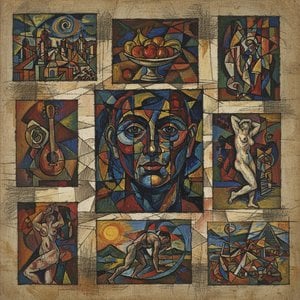
Panicker’s artistic evolution was deeply rooted in his formal training at the Government School of Arts and Crafts, Madras, where he graduated in 1966. This era marked a pivotal transition for him; while his early years were shaped by the stylized motifs and folk textures of Kerala, his academic exposure introduced him to the transformative power of European Expressionism. He found a kindred spirit in the works of masters like Pablo Picasso and Paul Klee, drawing inspiration from their ability to deconstruct form and rebuild it through emotion. His technique became a delicate dance of layers; he was known for applying multiple washes of color onto paper—sometimes five or six layers deep—to achieve a luminous, translucent effect that allowed light to seem as though it were trapped within the very fibers of the medium.
A Language of Color and Form
To encounter a Panicker original is to enter a world where geometry meets organic vitality. His work often eschewed rigid representational accuracy in favor of a primitivist elegance, utilizing bold, sweeping lines and a palette that could shift from the deep, brooding reds of a textured cardboard base to the ethereal, watery washes of his more abstract compositions. In pieces such as Beejagni, one can sense the pulse of life through his use of color and shape, where the subject matter is less about a literal depiction and more about capturing an essence—a feeling of growth, or perhaps a moment of spiritual stillness.
His mastery extended across various mediums, from the delicate precision of watercolor and gouache to the tactile weight of mixed media and bronze sculpture. This versatility allowed him to explore different dimensions of the human experience:
- The Translucent Layering: His signature use of colorwash techniques created a sense of depth and atmospheric mystery, making his surfaces appear almost liquid.
- Geometric Abstraction: By integrating curved and straight lines, he achieved an organic geometry that felt both structured and alive.
- Symbolic Primitivism: Drawing from the simplicity of folk art, he used stylized figures to communicate universal human emotions, stripped of unnecessary ornamentation.
Global Recognition and Enduring Significance
The trajectory of Panicker’s career was marked by a series of prestigious accolades that brought his uniquely Indian modernism to the international stage. His talent was recognized early on with awards from the Academy of Fine Arts in Calcutta and the Hyderabad Art Society, but it was his presence in global exhibitions that truly cemented his historical importance. From the Asian Art Biennale in Dhaka to traveling exhibitions across Europe—including stops in Brussels, Amsterdam, Copenhagen, and Vienna—Panicker acted as a cultural ambassador, proving that the language of Indian abstraction could speak fluently to a global audience.
Throughout the late 1980s and into the 1990s, his contributions were honored with the National Award from the Lalit Kala Akademi in New Delhi, a testament to his standing within the national canon. Even as he participated in significant group shows at the Jehangir Art Gallery in Mumbai or represented India at artist camps in Morocco and Chile, his heart remained tethered to the collaborative spirit of Cholamandal. When he passed away in 2003, he left behind more than just a collection of beautiful objects; he left a blueprint for how an artist might honor their local roots while fearlessly navigating the vast, uncharted territories of modern abstraction. His legacy continues to inspire those who seek to find the extraordinary within the elemental.