The Visionary Architect of the Avant-Garde
Jiro Yoshihara stands as a monumental figure in Japanese postwar art, recognized primarily for his leadership within the Gutai Art Group—a movement that irrevocably altered the trajectory of avant-garde painting. Born in Osaka in 1905, Yoshihara’s artistic journey began without formal training, nurtured instead by a profound, self-taught passion for the medium. Growing up in the wealthy and cosmopolitan environment of a family vegetable oil wholesaler, his early years were shaped by an intellectual curiosity that transcended local boundaries. He was deeply moved by the humanist idealism of the Shirakabaha literary movement, which introduced him to the transformative power of Post-Impressionist masters like Cézanne, Van Gogh, and Renoir. This early exposure to Western aesthetics would prove instrumental in shaping his distinctive visual language, allowing him to bridge the gap between Japanese tradition and global modernism.
As his career matured, Yoshihara’s fascination extended far beyond the canvas. He was captivated by the psychological depths of Giorgio de Chirico, the playful abstraction of Joan Miró, and the rhythmic energy of Wassily Kandinsky. These influences acted as catalysts for a stylistic evolution that saw him move through various experimental phases. During the tumultuous 1930s, his paintings embraced surrealist principles, mirroring the profound anxieties and shifting aspirations of a world in flux. He possessed a rare ability to blend diverse influences, demonstrating an intellectual rigor that refused mere imitation. Gradually, he honed his focus on geometric abstraction, recognizing its capacity to convey complex, universal ideas with uncompromising clarity and strength.
The Spirit of Gutai and the Power of Gesture
The founding of the Gutai Art Association in 1954, alongside Shōzō Shimamoto, marked a watershed moment in Yoshihara’s career and cemented his legacy as a visionary innovator. Under his guidance, Gutai became much more than a mere collective; it was a radical laboratory for experimentation. Yoshihara encouraged his followers to "do what has never been done before," pushing the boundaries of what could be considered art. This era was defined by gestural abstract impasto paintings that celebrated the raw, physical act of creation. The movement explored unprecedented territories, including:
- Performance Art: Utilizing the human body as a medium for expression.
- Interactive Works: Breaking the barrier between the spectator and the artwork.
- Outdoor Exhibitions: Moving art out of the gallery and into the public consciousness.
- Materiality: Experimenting with unconventional substances, from mud to industrial chemicals.
Yoshihara’s leadership was characterized by a global ambition. He worked tirelessly as a networker between the arts, commerce, and industry, ensuring that the Gutai movement communicated internationally. By inserting Japanese avant-garde practices into the globalizing art world, he ensured that the voices of his contemporaries were heard far beyond the borders of the Kansai region.
The Zen Circle: A Legacy of Enlightenment
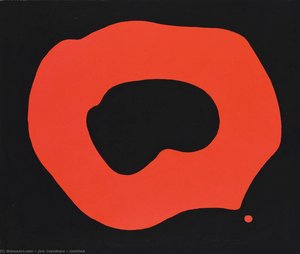
In the later stages of his life, Yoshihara’s work underwent a profound spiritual and stylistic shift. Moving away from the thick, energetic impasto of his earlier years, he began to embrace a more meditative approach known as his Zen-painting inspired hard-edge circles. These iconic works, often featuring singular, bold rings of color, drew heavily from the concept of Satori—the moment of sudden enlightenment. These circles were not merely geometric shapes; they were symbols of wholeness, continuity, and the infinite. Through this minimalist mastery, Yoshihara achieved a synthesis of his Western-influenced abstraction and deeply rooted Japanese philosophical traditions.
His oeuvre remains incredibly diverse, encompassing drawings, murals, sculptures, calligraphy, ink wash paintings, ceramics, and even stage design. This breadth of practice reflects a life dedicated to the total exploration of form and spirit. Jiro Yoshihara passed away in 1972, but his impact remains indelible. He did not just lead a movement; he forged a new way of seeing, leaving behind a legacy where the act of creation is as significant as the finished masterpiece, and where the simple circle can contain the entire universe.