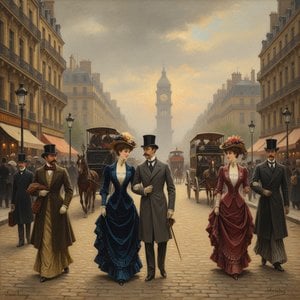
James Tissot: A Parisian Impressionist Capturing Victorian Life
James Jacques Joseph Tissot (1836-1902) stands as a singular figure in Victorian art, renowned for his exquisitely detailed depictions of Parisian society and biblical narratives. Born in Nantes, France, to Marcel Théodore tissot, a drapery merchant, and Marie Durand, whose design skills extended to hats—a testament to the collaborative spirit of their family—Tissot’s upbringing instilled a deep Catholic faith that profoundly shaped his artistic vision. His early fascination with seafaring, likely stemming from his father's profession, foreshadowed recurring motifs of ships and boats in his later oeuvre.- Early Artistic Training: Tissot’s ambition to pursue painting propelled him to Paris around 1854, where he adopted the Anglicized name “James,” possibly influenced by his burgeoning interest in English culture. He enrolled at the École des Beaux-Arts under Jean-Auguste-Dominique Ingres and Louis Lamothe—both prominent Lyonnaise painters who sought Parisian instruction—benefiting immensely from Lamothe’s guidance.
- The Louvre Method: Like many aspiring artists of his era, Tissot honed his skills by meticulously copying works at the Louvre Museum. This disciplined approach allowed him to absorb stylistic nuances and develop a masterful command of technique.
Parisian Society and Genre Painting
Tissot swiftly established himself as a celebrated painter of Parisian life, capturing the elegance and bustle of Victorian society with unparalleled precision. His canvases overflowed with richly dressed women engaged in various activities—shopping, dining, entertaining—presented with meticulous attention to costume and setting. He skillfully blended Impressionistic influences with Japonisme, incorporating decorative patterns and compositional techniques borrowed from Japanese prints into his paintings. This fusion resulted in a distinctive visual language that conveyed both beauty and social commentary. Notable works include “The Huguenot Brides” and “A Christmas Eve,” which cemented his reputation as a master of genre painting.- Technique: Tissot’s technique was characterized by layering thin glazes of oil paint—a hallmark of Impressionism—to achieve luminous colors and subtle tonal variations. He employed mezzotint engraving alongside painting, further expanding his artistic repertoire.
- Notable Paintings: Among his most iconic paintings are “The Huguenot Brides,” depicting a lavish wedding ceremony in Nantes Cathedral, and “A Christmas Eve,” portraying the festive atmosphere of a Victorian family gathering. These works exemplify Tissot’s ability to convey emotion and narrative complexity through visual detail.
Biblical Narratives: Faith and Artistic Expression
Beyond his depictions of Parisian society, Tissot passionately pursued biblical subjects, producing a series of monumental paintings that explored themes of faith, morality, and redemption. His ambitious undertaking to illustrate the Gospels earned him considerable acclaim and solidified his position as one of the foremost artists of his time. He approached these narratives with meticulous scholarship and artistic sensitivity, striving to convey spiritual truths through evocative imagery.- Illustrations: Tissot’s biblical illustrations—particularly “The Last Supper” and “The Nativity”—were groundbreaking for their scale and realism. They demonstrated his commitment to conveying religious ideas with profound emotional impact.
Legacy and Historical Significance
James Tissot's artistic legacy extends beyond his individual paintings; he profoundly influenced subsequent generations of artists. His meticulous observation of detail, combined with his masterful blending of Impressionistic and Japonisme styles, established a precedent for realism and decorative artistry. He remains an enduring symbol of Victorian artistic achievement—a painter who captured the spirit of his era while simultaneously elevating biblical narratives to new heights of expressive power.问答详情
目前目录中共有多少件 James Jaques Joseph Tissot 的作品可供浏览?
您可以在 全部作品 页面浏览由 James Jaques Joseph Tissot 创作的 91 件作品 件作品。
James Jaques Joseph Tissot 还以哪些名称为人所知?
James Jaques Joseph Tissot 也被称为 Jacques Joseph Tissot, Jacques-Joseph Tissot。
在哪里可以找到关于James Jaques Joseph Tissot作品的相关统计数据?
James Jaques Joseph Tissot 的 访问统计 页面展示了基于 本网站 上列出的艺术家作品所计算出的统计数据。