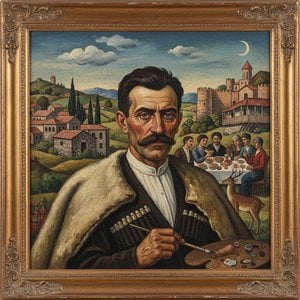
A Life Shaped by the Caucasus
In the small town of Sighnaghi, within the eastern Georgian province of Kakheti, a young boy named Gevorg Bashinjaghian learned to see the world through a lens of both hardship and profound beauty. His early years were marked by the sudden loss of his father, Zakar, during a trip to Persia, leaving his mother, Gayané, to raise her children in much poverty. To keep the spirit of life alive within their walls, the young Gevorg would improvise paints and brushes, even decorating bare furniture with painted scenes. This early impulse to transform his surroundings through color would eventually lead him far from the mountains of his birth.
His path took him first to the Tiflis Arts School and later to the Imperial Academy of Arts in St. Petersburg. It was in the Russian capital that he encountered the influence of Mikhail Clodt, a teacher who helped refine his technical skill. By 1883, Gevorg had earned a silver medal for his painting Birch Grove, an achievement that granted him the scholarship necessary to wander through Europe and beyond. He traveled through Italy and Switzerland, observing the Alps with a critical eye, famously noting that while the Alps possessed beauty, they could never quite match the pull of the Caucasus on his heart.
The Soul of the Landscape
Returning to the lands of his heritage, Bashinjaghian began a period of intense observation across the Caucasus. He wandered through Lake Sevan, Yerevan, and the holy sites of Etchmiadzin, capturing the essence of the terrain. His early works often focused on the foreground, treating trees and rocks with an anatomical precision that felt almost like still-life studies. As his years passed, however, his focus shifted toward the background and the sky, allowing the atmosphere to take center stage.
His brush found its true strength in the quiet, nocturnal moments of nature. He possessed a particular talent for painting misty waterscapes and night scenes that felt heavy with mystery. In works such as Night in Ortachala or Rainy Day in Sevan, the sky is not merely a backdrop but an emotional force. These paintings often suggest a world inhabited by unseen travelers or mountain folk, even when no human figure is present. He captured the following elements with singular focus:
- The profound stillness of nocturnal landscapes.
- The subtle gradations of light in misty environments.
- The rugged, historical weight of ruins like those found in Ani.
- The interplay between the earth and the vast, emotional heavens.
A Legacy Written in Color
Between 1899 and 1901, Gevorg lived in Paris with his wife, Ashkhen Katanian, and their three children. This period in France allowed him to produce over thirty paintings and participate in the Salon d'Arts, further establishing his reputation beyond the borders of the Russian Empire. Despite his travels to the great art centers of Europe, his heart remained anchored to the landscapes of Armenia and Georgia. He settled in Tiflis, which served as a cultural hub for Armenians, and continued to produce an immense body of work, totaling approximately 3,000 pieces throughout his lifetime.
His later years were spent documenting the enduring presence of the mountains, most notably in his 1912 painting Ararat. Even as he became a member of the Armenian Artists' Society in 1923, his work remained deeply personal, reflecting the struggles and the quiet dignity of the people he knew. When he passed away in Tiflis in 1925, he left behind a visual record of a homeland that many had only seen through memory. Today, his name is etched into the streets of Yerevan, and his canvases reside in the National Gallery of Armenia and the Tretyakov Gallery, preserving the light and shadow of a vanished era.