The Hand of the Lithographer
Germany, 1814. A life begins that will bridge the gap between the written word and the etched line. August Friedrich Pecht moves through the nineteenth century not merely as a painter, but as a multifaceted observer: a lithographer, an author, and an art critic. His hands are as comfortable with the sharp precision of steel engraving as they are with the fluid strokes of a drawing. He operates in a space where graphic reproduction meets literary narrative.
The work often emerges from the intersection of history and legend. In the mid-century, a series known as the Schiller-Galerie appears, published around 1859 by George Barrie. Here, Pecht’s drawings find new life through the medium of steel engraving. One particular plate captures Agnes Sorel, drawn from the drama of Die Jungfrau von Orleans. The image is a technical feat of reproduction, translating the soft nuances of his original drawing into the stark, disciplined language of the engraver's tool.
Technique and the Printed Page
Pecht’s career is defined by the versatility of his media. He does not rely on a single method to communicate his vision. Instead, he utilizes:
- Lithography to capture tonal depth.
- Steel engraving for sharp, detailed reproduction.
- Drawing as the foundational source for graphic works.
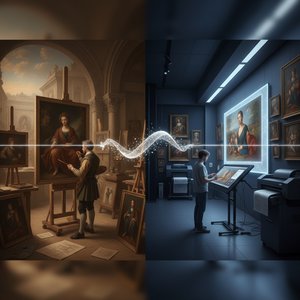
His output is deeply tied to the era of mass-produced imagery and book illustration. He contributes to the visual landscape of his time by providing the illustrations that give life to historical and dramatic subjects. His involvement in projects like the Schiller-Galerie demonstrates a specific skill: the ability to create images that are meant to be seen in print, integrated with text, and distributed through the burgeoning publishing industry of the 1850s.
A Legacy of Lines
By the time 1903 arrives, Pecht leaves behind a body of work that spans the roles of graphic artist and critic. His significance lies in his ability to navigate the technical demands of the printing plate and the intellectual demands of art criticism. He is a figure of the German nineteenth century who understood that an image's power often resides in its ability to be reproduced, shared, and documented.
His traces remain in archives and collections, found in the fine lines of a steel engraving or the detailed documentation of a drawing. He remains a vital link in the history of German graphic arts, a man whose work lived through the very machines and methods designed to multiply his vision across the page.