A Life Between Continents
François Beaucourt was born in La Prairie, Quebec, into a world shaped by the brushstrokes of his father, Paul Malepart de Beaucourt, a military engineer and amateur painter. This early exposure to the craft provided the foundation for a life that would eventually span from the Province of Quebec to the academies of France and even the landscapes of Russia. After his father's death, the family moved toward France, setting the stage for a career defined by movement and the pursuit of professional recognition.
In 1773, Beaucourt solidified his ties to the European art scene when he married Benoîte, the daughter of his painting master, Joseph Camagne, in Bordeaux. This union was more than personal; it anchored him within a lineage of trained decorators and artists. His presence in Bordeaux was marked by both struggle and eventual acceptance. Though an early attempt to join the local academy was met with rejection, he persisted, eventually being named an academician of the Académie de Peintures, Sculpture, et Architecture Civile et Navale de Bordeaux in 1784.
The Hand of a Provincial Rococo
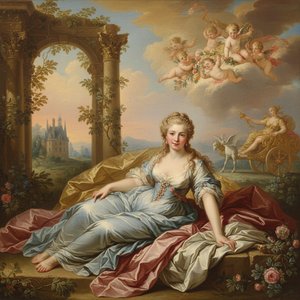
Beaucourt’s technique possessed a specific, unpretentious character. His work is often described as a light, provincial rococo, characterized by a heavy touch and warm colors. He did not seek the polished refinement of the high Parisian salons, instead favoring an approach that felt grounded in the local reality of the regions where he worked. At times, his relief appeared ill-defined, yet there was a certain decorative charm in his ability to capture subjects with a sincere, if somewhat coarse, hand.
His repertoire was broad, ranging from religious commissions to intimate portraits. In France, he undertook significant decorative tasks, such as painting the curtains for the boxes and stage of the Grand-Théâtre of Bordeaux. His religious output included series of paintings for the chapel of the Benedictine monastery of La Réole, where he depicted the life of Saint Peter through six panels and created medallions representing various saints. These works demonstrate a man capable of handling both large-scale architectural decoration and smaller, more focused devotional subjects.
A Return to the Americas
The later years of Beaucourt’s life saw him returning to the Americas, marking his transition from a French-trained painter to one who identified as Canadian. By 1792, he had appeared in Philadelphia, publishing an advertisement that signaled a shift in his self-perception; he no longer presented himself merely as a French painter, but specifically as a Canadian one. This period of his life suggests a man re-establishing his roots while offering his professional services and even the prospect of instruction to new pupils.
His travels likely took him through diverse territories, with some accounts suggesting stays in the West Indies, evidenced by the tropical inspirations found in works like Esclave à la nature morte. This painting, featuring a young woman in a madras headcloth and exotic fruit, reflects a worldly perspective shaped by his migrations. He eventually returned to Montreal, where he lived until his death in 1794. Though much of his French-era work has been lost to time or fire, the portraits and religious pieces remaining in collections like the National Gallery of Canada preserve the record of a painter who bridged the gap between European training and Canadian identity.