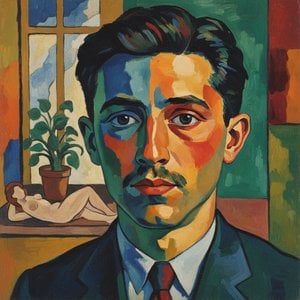
The Soul of the Resistance: The Life and Legacy of Édouard Pignon
Born into the rugged, industrial heart of Bully-les-Mines, France, in 1905, Édouard Pignon carried the grit and resilience of his miner heritage into every stroke of his brush. His early years were defined by a profound connection to the working class, a theme that would later become the heartbeat of his most powerful compositions. Before he was an established master of the School of Paris, Pignon lived the very life he would eventually immortalize on canvas, working in the legendary Citroën and Renault factories. This period of manual labor was not merely a prelude to his artistic career but a foundational element of his identity, instilling in him a deep-seated empathy for the struggles of the proletariat and a commitment to art as a vehicle for social truth.
As he moved to Paris in 1925, the city’s burgeoning avant-garde scene began to shape his intellectual and aesthetic trajectory. Pignon was not merely an observer of the era's political upheavals; he was an active participant. His involvement with the anarchist magazine Indélicats and his later membership in the French Communist Party placed him at the intersection of radical politics and revolutionary art. This dual existence—as both a laborer and a creator—allowed him to develop a visual language that was simultaneously visceral and politically charged. He found inspiration in the haunting shadows of Francisco Goya, whose ability to capture the rawest aspects of human suffering provided a blueprint for Piongn's own explorations of existential tension and social resistance.
A Synthesis of Masters: Style and Technique
The evolution of Pignon’s style is a fascinating study in the synthesis of modernism. While his roots were grounded in the heavy themes of Social Realism, his aesthetic was profoundly elevated by his encounters with the titans of 20th-century art. During his time at the vibrant ceramic workshops of Vallauris, Pignon engaged in transformative collaborations with Pablo Picasso and Henri Matisse. From these masters, he absorbed a sense of monumental scale and a fearless approach to color. He did not simply mimic their brilliance; rather, he distilled their lessons on composition and vibrancy to create something uniquely his own—a style that blended the structural strength of Cubism with the emotive, flowing energy of Expressionism.
Pignon’s technical mastery extended far beyond traditional oil painting into the intricate realm of printmaking. He became a titan of the medium, utilizing techniques such as mezzotint and embossing to imbue his works with a remarkable tactile quality. His prints often reached monumental proportions, sometimes exceeding one meter square, demanding that the viewer confront their scale and texture. Through the masterful manipulation of tonal gradations, he could create images that seemed to pulsate with life, capturing the rhythmic movement of laborers or the stark, dramatic light of a landscape. This ability to marry heavy, social subject matter with a sophisticated, almost lyrical technique is what distinguishes his oeuvre from the more purely didactic works of his contemporaries.
Art as Defiance: Historical Significance
The true weight of Pignon’s contribution to art history is perhaps most visible in his role during the dark years of the German occupation of France. As a member of the French Resistance, his very existence was an act of defiance. His home became a clandestine sanctuary for artists and intellectuals, including Louis Aragon and Elsa Triolet, turning his private space into a hub of intellectual rebellion. In 1941, he stood alongside other prominent painters in the "Twenty painters of French tradition" exhibition, a bold movement designed to resist the Nazi imposition of "degenerate art" by asserting the enduring strength of the French aesthetic lineage.
Ultimately, the significance of Édouard Pignon lies in his refusal to separate the beauty of art from the reality of human struggle. His works, such as The Miner and Three Mothers, serve as enduring monuments to the dignity of labor and the resilience of the human spirit. He remains a pivotal figure of the School of Paris, an artist who successfully navigated the complexities of political commitment and aesthetic innovation. Through his bold lines and vibrant palettes, Pignon ensured that the voices of the marginalized would be heard through the timeless, unyielding medium of fine art.