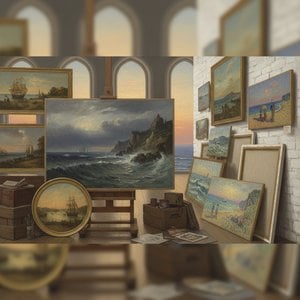
Claude Hayes: A Master of Atmospheric Irish Landscapes
Born in Dublin in 1852, Claude Hayes’s artistic journey was one shaped by a confluence of familial legacy and personal rebellion. His father, Edwin Hayes, a distinguished marine painter, initially steered his son towards the more conventional path of business, but young Claude's innate talent for observation and representation demanded expression beyond mere commerce. This youthful defiance—a brief stint at sea mirroring his father’s profession—laid the groundwork for a career dedicated to capturing the essence of the Irish landscape, particularly its maritime character.
Hayes’s early training was rigorous, encompassing formal studies at Heatherleys School of Fine Art and the Royal Academy Schools in London. However, he quickly recognized that his true passion lay not in portraiture, as initially expected, but in the evocative rendering of light and atmosphere. This shift led him to embrace watercolour—a medium he mastered with a remarkable sensitivity to texture and transparency – allowing him to build layers of color and create an illusion of depth and distance that became hallmarks of his style. Influenced by the Impressionists’ focus on capturing fleeting moments, Hayes developed a unique approach, prioritizing the emotional resonance of a scene over strict realism.
The Maritime Soul of Irish Painting
Hayes's artistic vision was inextricably linked to the maritime heritage of Ireland. His early experiences at sea profoundly shaped his perception of the landscape, imbuing his paintings with a sense of movement and drama. He frequently depicted scenes of harbors, coastlines, and ships in motion—subjects that resonated deeply with his own past. His works aren’t simply representations of physical locations; they are imbued with the spirit of the sea, often conveying a feeling of solitude, contemplation, or even melancholy.
The artist's fascination extended beyond the immediate coastline. He spent considerable time painting in Hampshire and Surrey, absorbing the rolling hills and expansive skies of southern England. However, it was his return to Ireland that truly fueled his creative output. He developed a keen eye for detail, meticulously capturing the nuances of light on water, the textures of weathered stone, and the subtle shifts in color across the landscape. His paintings of Dublin Bay, in particular, are renowned for their atmospheric quality and ability to transport the viewer to a specific time and place.
Technique and Style: A Delicate Balance
Hayes’s technique was characterized by a remarkable control over colour and brushwork. He employed a layered approach, building up his paintings in thin washes of watercolour, allowing the white paper to peek through and create highlights. This technique not only enhanced the luminosity of his scenes but also conveyed a sense of spontaneity and immediacy. He skillfully utilized broken color—a technique borrowed from the Impressionists—to suggest form and depth, creating an illusion of atmospheric perspective that was both subtle and effective.
Unlike some of his contemporaries who favored opaque pigments, Hayes prioritized transparency, letting the underlying paper contribute to the overall effect. He also demonstrated a remarkable ability to capture the fleeting effects of light and weather, conveying the sense of movement and change inherent in the natural world. His work is often described as “atmospheric,” reflecting his commitment to capturing not just the appearance but also the feeling of a landscape.
Legacy and Recognition
Claude Hayes’s career spanned several decades, during which he exhibited extensively at prestigious venues throughout Britain and Ireland. His paintings were consistently praised for their technical skill, atmospheric quality, and emotional resonance. He was elected to membership in the Royal Institute of Painters in Watercolour, a testament to his standing within the artistic community.
Today, Hayes’s work is held in prominent collections, including those of the Victoria and Albert Museum and the Ulster Museum. His paintings continue to be admired for their evocative portrayal of the Irish landscape—a legacy that solidifies his place as one of the most important figures in 19th-century Irish art. His ability to capture the spirit of a place, combined with a masterful command of watercolour technique, ensures that his work will endure for generations to come.