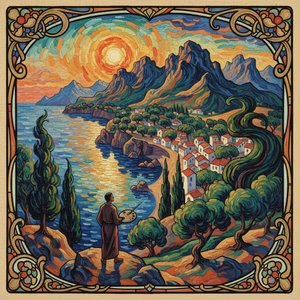
A Catalan Visionary: The Life and Legacy of Baldomer Gili i Roig
In the vibrant tapestry of Catalan art history, few figures embody the transition from Romantic idealism to the dawn of modernity as gracefully as Baldomer Gili i Roig. Born in 1873 into a family where intellect and the written word were paramount, Gili i Roig was destined for a life of profound observation. His early years in Irun provided him with a foundational connection to the natural world; under the tutelage of the marine artist José Salís Camino, he developed an enduring fascination with the sea. This early exposure to the rhythmic, dramatic beauty of the coast would become a recurring motif in his work, imbuing his later compositions with a sense of movement and emotional depth that resonated far beyond the shores of Spain.
As Gili i Roig moved toward the urban heart of Barcelona, his artistic identity began to coalesce through formal training at the Escola de la Llotja. It was here that he encountered the influential Sorollista movement, a style characterized by its luminous palettes and an almost visceral ability to capture the fleeting effects of light. This encounter fundamentally altered his approach, pushing him toward bolder, more expressive hues and a technique that sought to capture not just the surface of a subject, but its psychological essence. His journey was one of constant expansion; from the specialized painting classes of Alejo Vera in Madrid to the rigorous academic environment of the Academy of Fine Arts in Munich, Gili i Roig relentlessly refined his ability to translate the world into pigment and light.
The Intersection of Light, Lens, and Literature
What truly distinguishes Baldomer Gili i Roig is the multidisciplinary nature of his creative spirit. He was not merely a painter but a draftsman and a pioneer of photography, using the camera as an extension of his painterly eye. During his transformative years in Italy—supported by a prestigious government stipend and facilitated by his collaboration with Jaume Morera—he lived amidst the historical grandeur of Rome and Florence. Residing in locations such as the Villa Strohl Fern, he meticulously documented the classical splendor of his surroundings through both the brush and the lens. This dual pursuit allowed him to bridge the gap between the spontaneous emotion of painting and the precise, documentary truth of photography, creating a body of work that is both nostalgic and strikingly modern.
His creative output extended into the realms of literature and theater, reflecting a deep-seated desire to communicate through all available media. He was a skilled illustrator, contributing evocative imagery to notable publications like L'Esquella de la Torratxa, often signing his drawings with the pseudonym "L'Alegret"—a nod to the Gascon troubadour tradition. His foray into playwriting, such as the musical comedy La Canción de la Ninfa, further demonstrates a man who viewed art as an immersive, multi-sensory experience. Whether capturing the joyful chaos of children playing on the beach at Calella de Palafrugell or documenting the solemnity of Roman ruins, his work remains a testament to a life lived in pursuit of aesthetic truth.
Historical Significance and Artistic Heritage
The legacy of Baldomer Gili i Roig is found in the seamless way he wove together the disparate threads of 19th-century tradition and 20th-century innovation. He stood at a crossroads of history, navigating the political turbulence of the Spanish-American War and the shifting cultural tides of Europe, yet his commitment to capturing the "soul" of his subjects remained unshakable. His ability to blend the marine influences of his youth with the sophisticated light-play of the Sorollistas created a unique visual language that remains captivating to contemporary viewers.
Today, we remember Gili i Roig not just as a painter of landscapes or a photographer of monuments, but as an essential architect of Catalan cultural identity. His life’s work serves as a bridge between eras, reminding us that true artistry lies in the ability to see the extraordinary within the ordinary—be it a sun-drenched coastline, a classical archway, or the quiet intimacy of a studio model. Through his diverse contributions, he ensured that the spirit of Catalan modernism would be documented with both precision and profound passion.
问答详情
Baldomer Gili I Roig 还有哪些别名?
Baldomer Gili I Roig 也以 Baldomer Gili Roig, Baldomero Gili Roig, Baldomero Gili, LAlegret 等其他名称为人所知。
如何按年份顺序浏览 Baldomer Gili I Roig 的作品?
您可以在Baldomer Gili I Roig的作品时间轴页面上按时间顺序查看其作品。
哪里可以浏览Baldomer Gili I Roig的所有作品?
您可以在 Baldomer Gili I Roig 的 全部作品 页面上浏览其在 本站 上的所有作品。