

The Enduring Legacy of Masterpieces: Exploring Artistic Influence & Timeless Appeal

目录
The Renaissance Dawn: Context & The Seeds of Change
Renaissance art (1350 – 1620) is the painting, sculpture, and decorative arts of the period of European history known as the Renaissance, which emerged as a distinct style in Italy in about AD 1400, in parallel with developments which occurred in phi...
The story of the Renaissance is not one of sudden eruption, but rather a gradual unfolding—a reawakening that stirred within the late medieval world. While often framed as a decisive break from the past, it was more accurately a complex interplay between tradition and innovation. The 14th century witnessed a confluence of factors that primed Italy for this extraordinary cultural blossoming. The decline of feudalism, coupled with the rise of powerful city-states like Florence, Venice, and Milan, fostered an environment ripe for patronage and intellectual exploration. Crucially, a renewed interest in classical antiquity—the art, literature, and philosophy of ancient Greece and Rome—began to take hold. This wasn’t merely imitation; it was a fervent desire to understand the foundations of human knowledge and achievement. The rediscovery of texts by Plato, Aristotle, and Vitruvius provided a new lens through which artists and thinkers could view the world, shifting focus from solely divine concerns towards a more humanist perspective.
The devastating impact of the Black Death also played an unexpected role. While causing immense suffering, it paradoxically led to a questioning of established norms and a heightened awareness of life’s fragility—a sentiment that fueled a desire to celebrate human potential and earthly beauty. Early proto-Renaissance figures like Giotto di Bondone began to break away from the stylized conventions of Byzantine art, introducing greater naturalism and emotional depth into their frescoes. His work in the Scrovegni Chapel, with its compelling narratives and lifelike depictions of human emotion, foreshadowed the revolutionary changes to come.
Humanism's Embrace: A New Focus in Artistic Representation
 Marriage of the Virgin
Discover Raphael’s ‘Marriage of the Virgin,’ a High Renaissance masterpiece! Admire its classical beauty, intricate details & historical significance. A timeless treasure for art lovers.
At the heart of the Renaissance lay a profound philosophical shift known as Humanism. This intellectual movement emphasized the dignity and worth of the individual, celebrating human reason, creativity, and potential. It wasn’t an abandonment of faith, but rather a re-evaluation of humanity's place within the divine order. Artists increasingly turned their attention to portraying the human form with unprecedented accuracy and realism—not simply as vessels for religious symbolism, but as subjects worthy of study in their own right. This fascination extended beyond physical representation; artists sought to capture the inner lives and emotions of their subjects, imbuing their works with psychological depth.
The rediscovery of classical sculpture proved particularly influential. Ancient statues served as models for anatomical correctness and ideal proportions, inspiring a renewed emphasis on *contrapposto*—a naturalistic stance where weight is shifted onto one leg, creating a dynamic sense of balance and movement. Portraits flourished during this period, reflecting the growing importance of individual identity and social status. Patrons commissioned artworks not only to demonstrate their piety but also to showcase their wealth, power, and refined taste. The emphasis on individualized features and realistic depictions marked a significant departure from the more symbolic representations of the medieval era.
Mastering Technique: Innovation in Painting, Sculpture & Architecture
 A Concise Timeline of Major Art Movements: A History Lover's Guide
Explore a concise timeline of major art movements with . Discover the history behind iconic styles, from ancient masterpieces to modern innovations. Perfect for history lovers & art enthusiasts!
The Renaissance witnessed an explosion of artistic innovation across all disciplines. In painting, artists developed new techniques to achieve greater realism and depth. Linear perspective—the mathematical system for creating the illusion of three-dimensional space on a flat surface—revolutionized composition and allowed for more convincing depictions of architectural settings. Chiaroscuro, the dramatic use of light and shadow, added volume and emotional intensity to figures and scenes. The development of oil painting provided artists with greater flexibility and control over color and texture, enabling them to create richer, more nuanced effects.
Sculpture also underwent a transformation. Artists like Donatello revived classical techniques such as bronze casting and *statuo cavallo*—equestrian statues—creating works that celebrated human strength and heroism. Architecture saw a return to classical principles of proportion, symmetry, and harmony. Filippo Brunelleschi’s dome for the Florence Cathedral stands as a testament to Renaissance engineering prowess and architectural ingenuity. The use of rounded arches, columns, and domes evoked the grandeur of ancient Roman structures, signaling a conscious effort to emulate the achievements of the past.
Iconic Works and Their Enduring Symbolism
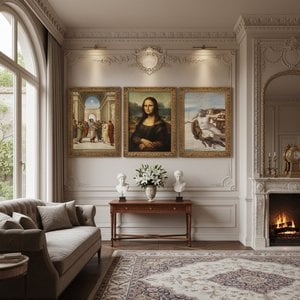
The High Renaissance—spanning roughly from the late 15th to early 16th centuries—represents the culmination of these artistic advancements. Leonardo da Vinci’s Mona Lisa, with its enigmatic smile and masterful sfumato technique, continues to captivate audiences worldwide. The painting is not merely a portrait; it's an exploration of human psychology and the complexities of emotion. His The Last Supper, despite its deteriorated condition, remains a powerful depiction of a pivotal moment in Christian narrative, showcasing his innovative use of perspective and dramatic composition.
Michelangelo’s sculptures—David and Pieta—are celebrated for their anatomical accuracy, emotional intensity, and sheer technical brilliance. His frescoes on the ceiling of the Sistine Chapel are a monumental achievement, depicting scenes from Genesis with unparalleled dynamism and grandeur. Raphael Sanzio, known for his serene and harmonious compositions, exemplified Renaissance ideals in works like The Marriage of the Virgin, showcasing classical beauty and intricate detail. These masterpieces weren’t simply aesthetic achievements; they were imbued with complex symbolism reflecting religious beliefs, humanist values, and the political aspirations of their patrons.
The High Renaissance: Culmination of Genius & Classical Ideals
The artistic fervor of the High Renaissance was fueled by a unique confluence of talent, patronage, and intellectual curiosity. Florence, Rome, and Venice became centers of artistic innovation, attracting artists from across Italy and beyond. The competition among these cities spurred creativity and led to an unprecedented level of artistic excellence. Artists were no longer seen as mere craftsmen but as intellectuals—individuals capable of profound insight and creative expression.
The rediscovery of classical texts continued to influence artistic practice, inspiring a renewed emphasis on ideal proportions, harmony, and balance. Artists sought to emulate the achievements of ancient Greece and Rome, believing that they held the key to unlocking timeless beauty and truth. The High Renaissance also witnessed a growing interest in scientific observation and anatomical study. Leonardo da Vinci’s meticulous dissections of human bodies informed his artistic representations, allowing him to create more accurate and lifelike depictions of the human form.
A Lasting Influence: The Renaissance's Impact on Western Art History
The legacy of the Renaissance extends far beyond the 16th century. Its emphasis on humanism, realism, and artistic innovation profoundly shaped the course of Western art history. The techniques developed during this period—linear perspective, chiaroscuro, oil painting—became foundational elements of subsequent artistic movements. The works of Leonardo da Vinci, Michelangelo, and Raphael continue to inspire artists today.
The Renaissance also laid the groundwork for the development of art history as a scholarly discipline. Early biographers like Giorgio Vasari sought to document and interpret the lives and works of Renaissance artists, establishing a framework for understanding artistic evolution and influence. At ArtsDot.com, we are dedicated to preserving this legacy by offering high-quality reproductions of Renaissance masterpieces, allowing you to bring the beauty and inspiration of this extraordinary era into your own home. Explore our collection today and discover the enduring power of Renaissance art—a testament to the boundless creativity and intellectual curiosity of the human spirit.
相关文章


高文艺复兴十大名作:定义艺术史的巅峰之作
探索高文艺复兴的十大巅峰之作!米开朗基罗、拉斐尔等大师巨著,揭秘艺术史上的辉煌。高清油画复制品,为您的家居注入艺术灵感。ArtsDot.com,博物馆级品质,尽在其中。

领衔文艺复兴曙光:十幅早期大师名作,点亮您的艺术品味
探索文艺复兴曙光!本文精选十幅早期大师杰作,从达芬奇到拉斐尔,揭秘艺术背后的故事与技法。感受色彩的魅力,领略经典永恒的力量。ArtsDot.com为您提供博物馆品质的艺术品复制和个性化家居装饰方案。尽在ArtsDot.com!

Renaissance Visions: Exploring Themes & Techniques in 16th-Century Painting
Explore the captivating world of Renaissance painting! Discover key themes, masterful techniques & iconic artworks from Leonardo da Vinci to Raphael. Learn about Humanism's influence and the stylish departure of Mannerism.

Renaissance Visions: Exploring Artistic Innovation & Cultural Shifts in 16th Century Art
Explore the artistic revolution of the 16th-century Renaissance! Discover humanist ideals, groundbreaking techniques & iconic masterpieces by Raphael, Michelangelo & more. A deep dive into art history.

